
- Home
- Live Blog
- Breaking News
- Top Headlines
- Cities
- NE News
- Sentinel Media
- Sports
- Education
- Jobs
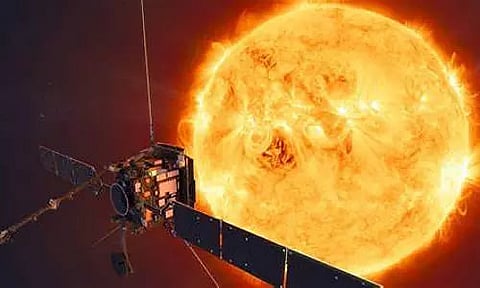
Nothing can be a bigger achievement for the country at the beginning of the New Year than India’s first solar observatory, Aditya-L1, reaching its destination. The feat was accomplished by scientists at the Indian Space Research Organisation (ISRO) on Saturday, when they performed the final manoeuvre to inject the Aditya-L1 spacecraft into its final destination orbit, which is about 1.5 million kilometres away from the Earth. This distance is four times the distance between the Earth and the Moon. The Aditya-L1 spacecraft is the first space-based Indian observatory to carry out studies on the Sun. The success of Aditya-L1 reaching its final destination has not only done India proud but has also proved to the world that Indian scientists are immensely capable in space research. No wonder Prime Minister Narendra Modi has described it as a testament to the relentless dedication of India’s scientists in realizing among the most complex and intricate space missions. President Droupadi Murmu, on the other hand, has called it “another grand feat” of ISRO, the other being Chandrayaan-3, which was the first to land on the Moon’s South Pole. With this, India is now definitely a major stakeholder in space, with several satellites. And, as Jitendra Singh, Union Minister for Science and Technology, has put it, India is no longer to be led by other countries, and India is now in a position to lead others. Important to note, as a target has been set for 2047—when India completes one hundred years as an independent nation—to also become a developed country in all aspects, the success of Aditya-L1 will definitely trigger off a process that will make the space economy a significant part of India’s growth story for the next 25 years. Launched on September 2, 2023, from the second launch pad at Sriharikota’s Satish Dhawan Space Centre using the Polar Satellite Launch Vehicle (PSLV-C57), the Aditya-L1 spacecraft was successfully injected into an elliptical orbit of 235x19500 km around the Earth after a flight duration of 63 minutes and 20 seconds. The spacecraft underwent a series of manoeuvres thereafter and headed for the Sun-Earth Lagrange Point 1 (L1), having escaped the Earth’s sphere of influence. The Aditya-L1-L1acecraft carries seven payloads to observe the photosphere, chromosphere, and outermost layers of the Sun (the corona) using electromagnetic, particle, and magnetic field detectors. As ISRO has mentioned, using the special vantage point L1, four payloads directly view the Sun and the remaining three payloads carry out in-situ studies of particles and fields at the Lagrange point L1, thus providing important scientific studies of the propagatory effect of solar dynamics in the interplanetary medium. The strategic placement at the L1 Lagrange point ensures that Aditya-L1 can maintain a constant, uninterrupted view of the Sun. This location also allows the satellite to access solar radiation and magnetic storms before they are influenced by Earth’s magnetic field and atmosphere. Additionally, the L1 point’s gravitational stability minimizes the need for frequent orbital maintenance efforts, optimizing the satellite’s operational efficiency. The Aditya-L1 payloads are expected to provide the “most crucial information” to understand the problems of coronal heating, coronal mass ejection, pre-flare and flare activities and their characteristics, the dynamics of space weather, and the propagation of particles and fields. The need to study the Sun is significant from various angles. One is that it is the nearest star and, therefore, can be studied in much more detail compared with other stars. And, two, the Sun is a very dynamic star that extends much beyond what we see. It shows several eruptive phenomena and releases immense amounts of energy. The primary mission of Aditya-L1 is to explore the upper reaches of the Sun’s atmosphere, including the chromosomes and corona. By studying these regions, the Aditya-L1 mission intends to uncover the dynamics that govern the Sun’s behaviour. It will study the magnetic field topology and measurements with the solar corona, which is vital for comprehending the drivers of space weather, including the origin, composition, and dynamics of solar winds. When seen in detail, the major science objectives of the Aditya-L1 mission are: study of the solar upper atmospheric (chromosphere and corona) dynamics; Study of chromospheric and coronal heating, physics of the partially ionized plasma, initiation of the coronal mass ejections, and flares; Observe the in-situ particle and plasma environment, providing data for the study of particle dynamics from the Sun; Physics of the solar corona and its heating mechanism; Diagnostics of the coronal and coronal loop plasma: Temperature, velocity, and density; development, dynamics, and origin of coronal mass ejections; Identify the sequence of processes that occur at multiple layers (chromosphere, base, and extended corona), which eventually lead to solar eruptive events; Magnetic field topology and magnetic field measurements in the solar corona; and drivers for space weather (origin, composition, and dynamics of solar wind).