
- Home
- Live Blog
- Breaking News
- Top Headlines
- Cities
- NE News
- Sentinel Media
- Sports
- Education
- Jobs
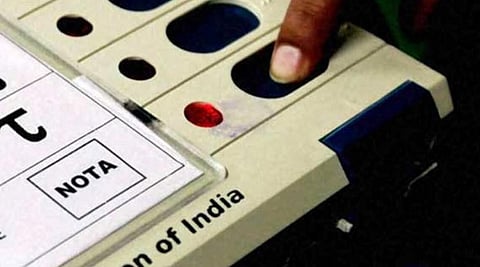
The “None of the Above” (NOTA) option has once again drawn limited support from voters, according to the latest data released by the Election Commission of India on the recently concluded Assembly elections in five states.
Among the states that went to polls, Assam recorded the highest share of NOTA votes at 1.29%, making it the only state where the figure crossed the one percent mark. West Bengal followed with 0.81%, while Puducherry saw 0.73%. In Kerala, the figure stood at 0.58%, and Tamil Nadu reported the lowest share at 0.41%.
These variations in NOTA voting percentages point to subtle differences in regional political sentiment, voter engagement, and satisfaction with available candidates.
Data trends also indicate a broader decline in the use of NOTA in national elections. As per the Election Commission’s “Atlas-2024,” the NOTA vote share in Lok Sabha elections has steadily decreased from 1.08% in 2014 to 0.99% in 2024, marking its lowest level since the option was introduced.
The NOTA feature, identifiable by its symbol of a ballot paper marked with a black cross, was added to electronic voting machines in 2013 following a directive from the Supreme Court of India. It was first implemented in a general election during the 2014 Lok Sabha polls.
Before this, voters who wished to reject all candidates had to use Form 49-O under the Conduct of Elections Rules, 1961. However, this process required disclosure at polling stations, thereby compromising voter secrecy is one of the key issues addressed by the court’s ruling.
Despite introducing NOTA, the Supreme Court has not mandated re-elections even if a majority of voters choose this option.
The Assembly elections in Assam, West Bengal, Tamil Nadu, Kerala, and Puducherry were held in multiple phases throughout April, with the counting of votes completed on May 4.
