
- Home
- Live Blog
- Breaking News
- Top Headlines
- Cities
- NE News
- Sentinel Media
- Sports
- Education
- Jobs
STAFF REPORTER
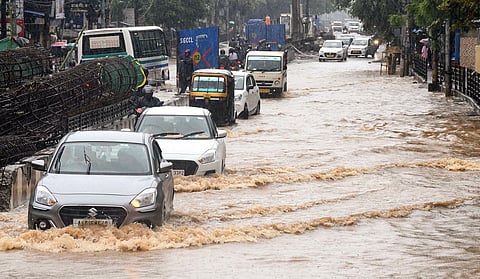
GUWAHATI: The Assam Real Estate & Infrastructure Developers’ Association (AREIDA) has said that Guwahati already has adequate scientific studies and expert recommendations to address its recurring waterlogging and flash flooding. It stressed that the focus should now shift to implementing the proposed solutions instead of commissioning fresh studies.
In a statement, AREIDA President Er. P.K. Sharma said the city does not suffer from a lack of scientific understanding of the problem but from a lack of political will, institutional coordination and time-bound implementation of recommendations prepared by national and international experts.
Explaining the causes of urban flooding, Sharma said rainwater is naturally managed through groundwater recharge, drainage into rivers and storage in wetlands. However, rapid urbanisation, encroachment on wetlands and natural drainage channels, excessive paving that reduces groundwater recharge, illegal construction on the city’s hills and the adjoining Meghalaya hills, and the dumping of plastic waste and garbage into drains have significantly weakened Guwahati’s natural stormwater management system.
He alleged that planning lapses over several decades had also contributed to the present situation. According to Sharma, the city’s first Master Plan, notified in 1965, remained unchanged until 1986 despite Guwahati becoming Assam’s capital in 1971, leading to unplanned urban expansion. He further claimed that the Master Plan for 1986–2001 contained major deficiencies, prompting a fresh scientific study that eventually led to the notification of the 2009 Master Plan.
Sharma said the issue has already been examined in detail through several technical studies commissioned by the government. He referred to the Drainage Master Plan prepared in 2008 by the Israel-based Tahal Group, which recommended the restoration of natural drainage channels, the protection of wetlands, the redesign of drains to handle heavy sediment loads from the surrounding hills and the adoption of an integrated basin-wide drainage approach. He said the study also highlighted the impact of encroachments on drainage channels and hill slopes in reducing the city’s natural water retention capacity.
Also read: Indian Army Rescues Over 200 Flood-Hit Residents in Upper Assam Under Operation Jal Rahat
