
- Home
- Live Blog
- Breaking News
- Top Headlines
- Cities
- NE News
- Sentinel Media
- Sports
- Education
- Jobs
STAFF REPORTER
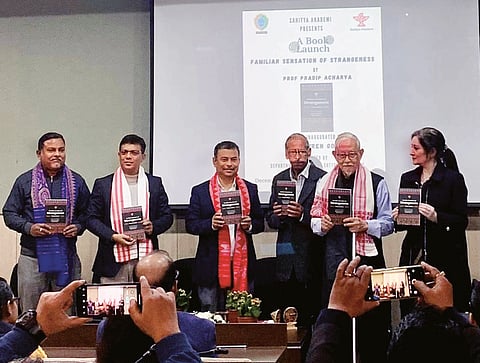
GUWAHATI: The Department of English, Cotton University, in collaboration with the Sahitya Akademi, hosted a thoughtfully engaging book release programme to mark the launch of Familiar Sensation of Strangeness, a volume devoted to the critical and translational writings of eminent scholar Pradip Acharya, former Professor and Head of the Department of English at the erstwhile Cotton College.
Edited by Prof Jyotirmoy Prodhani (NEHU, Shillong Campus) and Prof Dwijen Sharma (NEHU, Tura Campus), the book was formally inaugurated by noted literary critic Prof Hiren Gohain, who described Acharya’s oeuvre as “fugitive writing” - a phrase that resonated through the day’s literary engagement for its playful yet incisive capture of the author’s intellectual style.
Registrar of Cotton University, Dr Hiren Deka, extended the welcome address, after which the dignitaries on the dais - Prof Hiren Gohain, Prof Pradip Acharya, Prof Rakhee Kalita Moral, Prof Jyotirmoy Prodhani and Prof Dwijen Sharma - were felicitated.
Offering an insightful introduction to the volume, Prof. Rakhee Kalita Moral, Head of the Department of English, Cotton University, spoke of her long-standing academic association with Acharya, underlining his mastery as a translator whose rich renditions from Assamese into English made some of the finest literatures of Assam available to a global audience. She elaborated on the structure of the book, published by Sahitya Akademi, which is organized into three thematic sections - On Translations, On Northeast Literature and On Contemporary Assamese Writings - followed by a transcript of an interview with the author at the end.
The literary mood of the event was enriched by recitations of poems translated by Acharya and orated by scholars of the department , Madhurjya Goswami, Samriddha Goswami and Shikha Sengupta, adding cadence and texture to the proceedings.
In his inaugural address, Prof Hiren Gohain praised Acharya’s intellectual brilliance, quirky turns of thought and famously impenetrable jargon, seamlessly traversing literary landscapes from Edmund Wilson and William Blake to F Scott Fitzgerald, while reflecting on what he evocatively termed “the inherited time” of literature.
Also Read: Crowds, culture and creativity define day 5 of Assam Book Fair
