
- Home
- Live Blog
- Breaking News
- Top Headlines
- Cities
- NE News
- Sentinel Media
- Sports
- Education
- Jobs
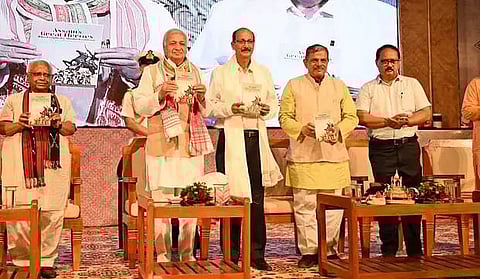
The four-day 'Lokmanthan' festival, which came to a close in Guwahati on Saturday, was indeed a grand event held in Assam in recent years, one that not only brought a large number of delegates from all over the country together, but also saw discussions and deliberations on various aspects of cultural and traditional treasures hidden in the various corners of the country. The organizers, who undoubtedly belong to the Sangh Parivar, have chosen to call it "a national level colloquium" as also "the churn of the nation" which is an attempt to connect intellectuals and practitioners working for the conservation of India's cultural heritage and literally churn out the nectar from the knowledge base latent in the consciousness of the people, both individual as well as collective. This was the third edition of Lokmanthan, which was first held in Bhopal in 2016 and then in Ranchi in 2018. But, while the first two editions were held in capitals of two different states, the Guwahati edition must be considered different altogether because, though held in the Assam capital, it showcased the entire North-eastern region. It is interesting to note that the various discussion and lecture-demo sessions covered issues like tradition of faith and science, importance of genealogy-writing, concept of Shakti, culinary tradition, tradition of story-telling, traditional musical instruments, samskara and kartavya, industrial castes in India, environment and biodiversity, water conservation, third gender etc. The exhibition held as part of Lokmanthan was also diverse. One stall, for instance, show-cased the traditional magic of Mayong, another demonstrated wedding traditions of Manipur, to name a few. While local visitors to the event got a glimpse of various aspects of tradition and culture of Assam and the region, it is important for the organizers to assess and identify what were the major takeaways for the 3,700-plus delegates who had converged in Guwahati from all over the country. Many questions come to mind in this context. Have the delegates been able to take home a fair idea of the people and cultures of the North-eastern region? Have the delegates been able to understand that India also exists beyond Kolkata and Bengal? Have the delegates been able to understand the traditions, customs, food habits, lifestyles and cultural ethos of the various ethnic communities of the North-east?