
- Home
- Live Blog
- Breaking News
- Top Headlines
- Cities
- NE News
- Sentinel Media
- Sports
- Education
- Jobs
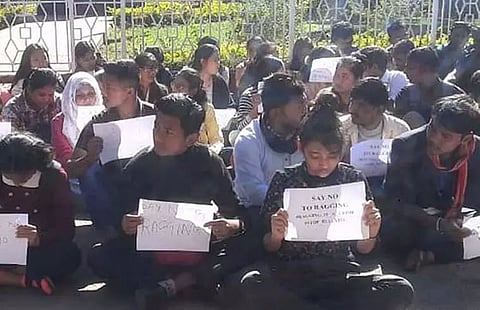
The horrifying incident of a student in Dibrugarh University jumping off a hostel building and critically hurt in an alleged case of ragging has exposed lax monitoring by the authorities. The menace of ragging which has raised its ugly head again in higher educational institutions in the state must be curbed with strong and exemplary punishment against the guilty. Alleged involvement of former students, including a former office bearer of the university students' body, in the incident of ragging point towards lax security of hostel inmates which the University authorities need to review and beef up security measures to ensure safe environment in the campus for bona fide students. Rustication of 18 students by the university authorities for their alleged involvement in physically and mentally torturing the student enrolled in the first semester of a post graduate course must be followed with deterrent measures to prevent recurrence of any form of ragging. The University Grants Commission (UGC) had notified "Regulations on Curbing the Menace of Ragging in Higher Educational Institutions, 2009" in pursuance to a judgement of the Supreme Court delivered on May 8, 2009, in Civil Appeal No. 887/2009 to root out ragging in all its form from universities, colleges and other educational institutions. According to these regulations, ragging means any conduct whether by words spoken or written or by an act which has the effect of teasing, treating or handling with rudeness any other student, indulging in rowdy or undisciplined activities which causes or is likely to cause annoyance, hardship, or psychological harm or to raise fear or apprehension thereof in a fresher or a junior student or asking the students to do any act or perform something which such student will not in the ordinary course and which has the effect of causing or generating a sense of shame or embarrassment so as to adversely affect the physique, psyche of a fresher or junior." In 2016, the UGC expanded the definition of ragging by including the amendment: "Any act of physical or mental abuse (including bullying and exclusion) targeted at another student (fresher or otherwise) on the ground of colour, race, religion, caste, ethnicity, gender (including transgender), sexual orientation, appearance, nationality, regional origins, linguistic identity, place of birth,place ofresidence or economic background." The recurrence of the menace of ragging point towards gaps in mechanisms taken by the authorities of educational institutions to enforce the regulations and lack of required awareness among students and parents about the UGC regulations and how their enforcement is critical to ensuring ragging-free campus. In September, the UGC issued a circular to vice-chancellors of all universities, principals of all colleges, directors of Higher Educational Institutions reminding them of multiple measures to ensure ragging free-campus such as constitution of anti-ragging committee, anti-ragging squad, setting up of anti-ragging cell, warning against ragging in prospectus and information brochure, e-admission booklet etc and installation of closed-circuit television cameras at vital points. The circular envisaged regular interaction and counselling with the students to detect early signs of ragging and identification of trouble-triggers, surprise inspection at hostels, students' accommodation, canteens, rest-cum-recreation rooms, toilets, bus stands and any other measure which would augur well in preventing/quelling ragging and any uncalled for, behaviour/incident. University and college authorities undertaking periodic review can ensure that these measures do not remain a mere formality and are effective in preventing ragging. The UGC regulations also require the Vice-Chancellor/Dean of Students Welfare/Director/Principal to send, at the end of every academic year, a letter to the parents/guardians of the students who are completing the first year informing them about law regarding ragging and the punishments, and appealing to them to impress upon their wards to desist from indulging in ragging when they come back at the beginning of the next academic session. The shocking incident of Dibrugarh University is a wake-up call for all universities and colleges in the country to take stock of compliance of this requirement, lack of which renders the anti-ragging affidavit and undertaking given by students and their parents/guardians at the time of admission and each academic year ineffective. Official data tabled by the central government in parliament in December 2021 show that altogether 2790 complaints of ragging had been received from students across the country since 2018 and action had been initiated in less than 50% of cases revealing worrying trend of perpetrators going unpunished in majority cases. Hostel wardens being accessible at all hours and be available on mobile phones as mandated by the Supreme Court is crucial for victims of ragging to seek emergency help. Hostel wardens being empowered to enforce strict discipline and provide adequate security staff to prevent unauthorized entry is equally important for generating confidence among boarders. Educational institutions, students, parents, and society joining hands for building a strong social movement only can make campuses ragging-free.