
- Home
- Live Blog
- Breaking News
- Top Headlines
- Cities
- NE News
- Sentinel Media
- Sports
- Education
- Jobs
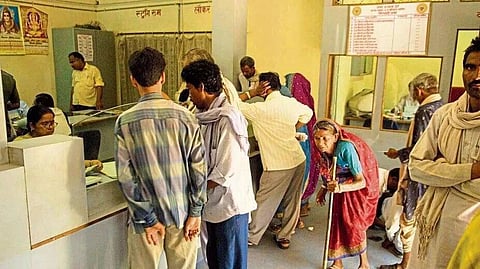
The Credit Deposit ratio in Assam has in creased to 57.5% but continues to be quite less than the all India average of 75%. The CD ratio in several districts is less than 40% which indicates regional imbalance in credit disbursement by banks. Reducing the gap district wise is critical to end regional disparity in growth. Poor CD ratio is also crucial indicator of overdependence on informal credit market by small and marginal farmers as well as landless farmers which is cause for concern. Because of high interest in the informal credit market of moneylenders the borrowers find it difficult to service their loans and are pushed to a debt trap. The Reserve Bank of India (RBI) advised banks to achieve a CD ratio of 60% in respect of rural and semi urban areas but ground realities in Assam paint a gloomy picture. As 78% of bank branches are located in rural and semi urban areas, improvement of CD ratio branch-wise can play crucial role in robust growth of agriculture and allied sectors. The RBI in a master circular insisted that while it is not necessary that CD ratio of 60% in respect of rural and semi urban areas should be achieved separately, branch-wise, district-wise or region-wise, the banks should, nevertheless, ensure that wide disparity in the ratios between different States/ Regions is avoided in order to minimise regional imbalance in credit deployment. Farm credit plays crucial role in boosting agricultural production and is considered to be a critical input in agriculture to achieve the goal of doubling the farmer’s income but official data shows low off take of farm credit in the state. The Revised Kisan Credit Card scheme provides adequate and timely credit support from the banking system under a single window to the farmers for their cultivation other needs such as meeting short term credit requirements for cultivation of crops, post harvest expenses, produce marketing loan, household consumption requirements, working capital for maintenance of farm assets and activities allied to agriculture, like dairy animals, inland fishery etc, and investment credit requirement for agriculture and allied activities like pump sets, sprayers, dairy animals etc. The National Bank for Agriculture and Rural Development (NABARD) in its State Focus Paper for Assam has estimated the credit projection for 2023-24 for crop loan at Rs 12,146 crore. The report reveals that for financial year 2021-22, under Priority Sector, the crop loans disbursed touched only Rs.1891 crore against a target of Rs.10,066 crore which indicates the real challenge to achieve the credit target for 2023-24. The bank has estimated the credit potential on the basis of area under cultivation, additional area that can be brought under cultivation and realistic scales of finance. Achievements falling far behind credit target speak volume of the untapped potential in the agriculture sector which sustain 70% of the rural work force. The NABARD report brought to the fore that performance of banks under Crop Loan was dismal in 2021-22, as only 18.79% of the Annual Credit Plan target was achieved. Assam has about 27 lakh households dependent on agriculture but operative KCC in the state is less than 7 lakh. Climate change impact manifested in the form of erratic rainfall has precipitated the problems for farm households who are ravaged by ravaging annual floods and erosion. Easy accessibility of the farm credit with interest subvention available under the KCC scheme can help farmers but quality seeds, either purchase or take on rent farm equipment to boost production, reduce post harvest losses and diversify into food processing for value addition to augment household income. Financial literacy plays a crucial role in building awareness to approach the banks for crop loans but decoding revised KCC scheme in simple language to farmers about the terms and conditions is essential. Under the scheme banks may consider sanctioning loans on hypothecation of crops upto card limit of Rs.3 lakh without insisting on collateral security but how many farmers in the state are aware of such provision. Banks are required to focus on proactive measures to make the revised KCC scheme popular among the farmers so that they stop approaching moneylenders for their credit requirement and approach the nearest bank branch for loan. Agriculture department undertaking special drive on KCC and importance of crop loan from banks can liberate small and marginal farmers as well as landless cultivators from clutches of moneylenders and should not leave the task only to banks. Increase credit flow to the farm sector will unlock huge livelihood opportunities for rural youth in the state in allied sectors which will reduce dependence of the household only on agriculture. Efforts to increase CD ratio needs go beyond routine periodic review by the State Level Bankers Committee meetings and fixing new targets. Assam needs a stronger policy push for CD ratio improvement.
