
- Home
- Live Blog
- Breaking News
- Top Headlines
- Cities
- NE News
- Sentinel Media
- Sports
- Education
- Jobs
World Day to Combat Desertification and Drought
Rising up from drought together
Ranjan K Baruah
(With direct inputs from UN/WHO publication and feedback may be sent to bkranjan@gmail.com)
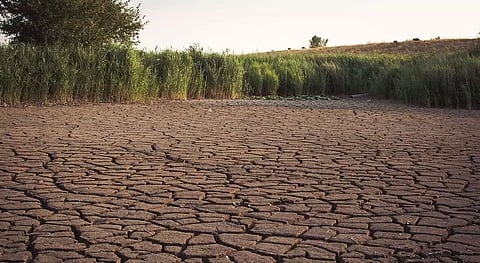
It's raining in many parts of the region at present but there are many places where rainfall is very less. Though we are getting more rain this year, that does not guarantee that rain shall be there every year. We have seen drought-like situations in the past when there was less rainfall. If we look at the global data then we shall find that since the year 2000, the number and duration of droughts has risen 29%; an estimated 55 million people globally are directly affected by droughts every year; by 2050, droughts may affect over three-quarters of the world's population; more and more of us will be living in areas with extreme water shortages, including an estimated one in four children by 2040; between 1900 and 2019, droughts impacted 2.7 billion people in the world, and caused 11.7 million deaths. All this data shows that we have more challenges in the near future if we do not act and take action.
The common word here is drought and desertification and we should know that desertification is a phenomenon that ranks among the greatest environmental challenges of our time. Desertification can include the encroachment of sand dunes on land, but it doesn't refer to the advance of deserts. Rather, it is the persistent degradation of dry land ecosystems by climate change and mainly human activities: unsustainable farming that depletes the nutrients in the soil, mining, overgrazing (animals eat away grasses and erode topsoil with their hooves) and clear-cutting of land, when the tree and plant cover that binds the soil is removed. Desertification may be where there is deforestation.
Desertification is a global issue, with serious implications worldwide for biodiversity, eco-safety, poverty eradication, socio-economic stability and sustainable development. We are aware that dry lands are already fragile as they become degraded, the impact on people, livestock and environment can be devastating. The issue of desertification is not new though — it played a significant role in human history, contributing to the collapse of several large empires, and the displacement of local populations. But at present the current trend is more challenging than the past as it may affect more than what happened in the past.
One of the important events observed globally is a day to combat desertification and droughts. It is interesting to learn that desertification, along with climate change and the loss of biodiversity were identified as the greatest challenges to sustainable development during the 1992 Rio Earth Summit. Two years later, in 1994, the General Assembly established the United Nations Convention to Combat Desertification (UNCCD), the sole legally binding international agreement linking environment and development to sustainable land management, and declared June 17 "World Day to Combat Desertification and Drought" by its resolution A/RES/49/115.
This year, the theme of the International Day against Desertification, and Drought is "Rising up from drought together". This day is observed every year to promote public awareness of international efforts to combat desertification. Droughts are among the greatest threats to sustainable development, especially in developing countries, but increasingly so in developed nations too.
Restoring degraded land globally could lock away three billion tonnes of atmospheric carbon into the soil every year – offsetting around ten per cent of the world's current annual energy-related emissions. Overall, actions to avoid, reduce and reverse land degradation can provide over one-third of the climate mitigation needed to keep global warming under 2° by 2030.
Land restoration is the ecological process to restore a natural and safe landscape for humans, wildlife, and plant communities. The economic benefits of land restoration are huge. A United Nations Environment Programme (UNEP) study revealed that half of the world's GDP is dependent on nature, and every dollar invested in restoration generates up to USD 30 in benefits.
There is no doubt that land is being degraded rapidly worldwide. Human activity has already altered over 70 per cent of all ice-free land. In most terrestrial habitats, native species have greatly diminished in the last century, and up to one billion species are now at risk of extinction. Some two billion people depend on ecosystems in dry land areas, 90% of whom live in developing countries. We have to take action like reforestation and tree regeneration which means more and more tree plantations and we have to be serious about water management. We have not seen severe droughts or desertification, but we might have to experience the same in our own region. If we do not want drought and desertification then we must care for our nature and take care of nature. All of us can make a difference to bring sustainable development.