
- Home
- Live Blog
- Breaking News
- Top Headlines
- Cities
- NE News
- Sentinel Media
- Sports
- Education
- Jobs
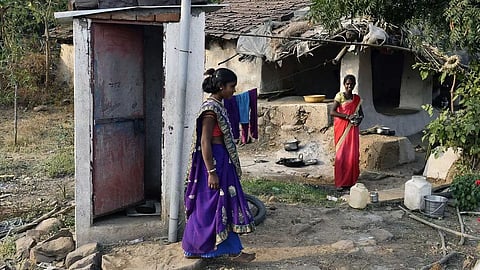
The 15th Finance Commission sounding the alarm on inadequate solid waste management in Open Defecation Free (ODF) villages in India is timely and crucial to sustain the achievements in sanitation efforts under the Swachh Bharat Mission (SBM). The commission in its report for financial years 2021-26 has flagged the concern that inadequate management of human excreta and faecal sludge have significant environmental and human health impact in the ODF villages and urgent intervention is needed for effective solid waste management. Over 5.6 lakh villages in 616 districts in the country have been declared as ODF under the SBM (Grameen) which, the commission noted, has brought about behavioural change in both the urban and rural areas and has resulted in people maintaining healthy sanitation practices. The commission has suggested that regional collection facilities can be developed where rural household waste, particularly human excreta, and faecal sludge, is temporarily stored until sufficiently large volumes accumulate for further processing. The mismatch between the availability of the sanitation services and safe drinking water has also left the commission worried. While there has been significant progress in achieving ODF, large parts of rural India continue to face shortage of drinking water facilities. The report brings to light that of the total ODF certified villages, only 41.53 per cent habitations have been provided with piped water supply schemes, as of 31 March 2019. Even though SBM has clear link with clean water and sanitation, around 3.04 crore households or 16 per cent of the total 19.01 crore rural households have tap water connections, and 15.96 crore (84 per cent) households still remain without a functional household tap connection. The commission has recommended that 30 per cent of the total grants to be disbursed to rural local bodies shall be earmarked for drinking water, rainwater harvesting and water recycling and 30 per cent of grants shall be earmarked for sanitation and maintenance of ODF status, and "this should include management and treatment of household waste, and human excreta and faecal sludge management in particular". The scientific management of human excreta and faecal sludge management is important to sustain the access to toilets in rural India. Implementation of the phase II of the SBM (Grameen) (ODF Plus), which includes ODF sustainability and solid and liquid waste management is therefore critical to prevent the SBM-I success story. Allocation of Rs 1.40 lakh crore SBM(G) Phase -II for the period from 2020-21 to 2024-25 shows there is no dearth of fund. The states need to sensitize the rural local bodies – the Panchayati Raj Institutions on the importance of creating the basic infrastructure of solid waste management and availability of safe drinking water in ODF villages. Building the capacity of rural local bodies for timely and judicious utilization of fund is also important. An ODF Plus village has been defined to be a village which sustains its ODF status and ensures solid and liquid waste management and is visually clean. For faecal sludge management, identification of a suitable land for the treatment plant for a cluster of villages with various treatment technology options are required to be explored. Safe emptying and transportation form the most critical components are a must. Technical advice from hydrogeologists is a must to ensure that water table in the identified location is not contaminated. Public health engineers and water scientists need to ensure that surface water body stayed protected. A legal framework and guidelines are necessary to ensure safe disposal. The ten-year strategy- From ODF to ODF plus Rural Sanitation Strategy 2019-2029 formulated by the Department of Drinking Water and Sanitation, Ministry of Jal Shakti Gram Panchayats (GPs) states that States will have the flexibility to adopt the appropriate technology best suited to the local conditions. Methodology and technology should be easy to operate and maintain and should have low operation and maintenance cost, it says. Sustained usage of individual household latrines, ensuring no one is left behind and providing sanitation access to new households, sanitation coverage of public spaces (through public and community toilets), implementation of solid and liquid waste management in rural areas and visible cleanliness, and solid and liquid waste management are the key elements of this strategy. It harps on for retrofitting wherever possible, existing toilets and in the construction of toilets for new households, the twin pit toilet technology as the preferred toilet technology option for on-site faecal sludge management. Clearly, the village panchayats will play the most crucial role in achieving the objectives of the SBM Phase II missions. The Finance Commission has emphasized the need for all the three levels of government – central, state, and local governments to join hands in the spirit of cooperative federalism for successful achievement of the mission from ODF to ODF plus. Active participation of the civil society organizations will ensure achieving the goal in time.
