
- Home
- Live Blog
- Breaking News
- Top Headlines
- Cities
- NE News
- Sentinel Media
- Sports
- Education
- Jobs
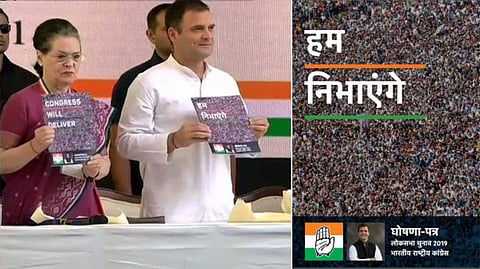
The Congress manifesto for the 17th Lok Sabha election, released on Sunday needs to be scrutinised by every voter of this country before actually making sure about which party or candidate every individual is going to vote for. The party has chosen five major themes on the basis of which it wants to attract the voters. These are (a) Garibi par waar, 72,000 (war on poverty with Rs 72,000 cash support), (b) employment to youth by filling 22 lakh government vacancies and employment to 10 lakh youth in gram panchayats, (c) guaranteeing jobs for 150 days under MGNREGA instead of 100 days, (d) six per cent GDP will be used in education and (e) no permission required for starting a new business (for three years). While releasing the party manifesto, Congress president Rahul Gandhi also promised to present a separate budget for the farmers on the lines of the now discarded railway budget and said if his party was voted to power, farmers who fail to return bank loans will no more face criminal but only civil cases.
At first glance the Congress manifesto looks great. But then, what Rahul Gandhi is trying to do is nothing but to repackage a promise or slogan coined by his grandmother Indira Gandhi probably just around the time the present Congress president was born –‘Garibi hatao’ – the one that many of the present-day first-time voters probably have not even heard of. The older citizens and voters of this country know it very well what exactly had happened to Indira Gandhi’s ‘Garibi hatao’ slogan. The slogan, which was also Indira Gandhi and her Congress pary’s major poll plank in the 1971 election, and the anti-poverty or poverty-alleviation programmes that came with it were designed in such a manner that it intended to give her an independent national support. Through this, she wanted to concentrate her party’s focus on the rural and urban poor, which in turn would enable her to by-pass the dominant rural castes across mainland India. She had of course also intended to by-pass the powerful urban commercial class. While Indira Gandhi also tried to make her slogan empower the voiceless poor, the ‘Garibi hatao’ programme in reality could not eliminate poverty from this country. Given this backdrop, there is little doubt that Rahul Gandhi’s re-invention of the wheel is also intended only to catch votes and voters, and noting beyond that. How the masses react to it again is a different matter, and people who read newspaper headlines or watch prime-time television news channel debates and discussions hardly have any mechanism to gauge the voter’s mind. Only the day of counting of votes will the nation know how much percentage of voters are actually going to vote on the basis of Rahul Gandhi’s allegation that prime minister Narendra Modi had wrecked the economy in the past five years, or on the basis of Rahul Gandhi’s claim that Modi was scared of engaging in a one-on-one debate with him on issues such as corruption, foreign policy, and national security.
Coming to the Assam and Northeast portion of Rahul Gandhi’s manifesto, one finds that the Congress party is trying to ride on the popular opposition to the Citizenship (Amendment) Bill (CAB) introduced by the BJP government, especially in Assam. Though the Congress often claims that it was because of Rahul Gandhi’s stand against the Bill that the Narendra Modi did not dare to place it in the Rajya Sabha, what Rahul Gandhi cannot probably explain is the stand taken by the All India Mahila Congress president Sushmita Deb. Rahul Gandhi has clearly said that if voted to power, the Congress would withdraw the Citizenship (Amendment) Bill. The Silchar MP has always asserted that she was in support of the Citizenship (Amendment) Bill, making it clear that she cannot win the election in her constituency if the Congress opposed it. The Congress party also said that it will ensure that no citizen of India is denied inclusion in the final National Register of Citizens (NRC). The Congress, he said, will address the issue of illegal immigration into the north-eastern states through consultation and evolve a consensus on the legislative measures that will secure the identity of the indigenous communities.
What Rahul Gandhi is probably doing is trying to tell the people that the Congress party was not responsible for the burgeoning illegal migrant problem of Assam. Senior Congress leaders from Assam like Tarun Gogoi and Ripun Bora have probably not briefed Rahul Gandhi on the fact that while his great grandfather Jawaharlal Nehru had virtually agreed to inclusion of Assam and the Northeastern region in Jinnah’s East Pakistan, the country’s first prime minister had also strongly opposed the stand taken by Lokapriya Gopinath Bardoloi, Bishnuram Medhi and Bimala Prasad Chaliha against large number of migrants who had arrived in Assam from East Pakistan in the wake of the Partition. Tarun Gogoi, Ripun Bora, Bhubaneswar Kalita and other senior Congress leaders from Assam probably have not briefed Rahul Gandhi on the fact that Indira Gandhi had enacted the notorious Illegal Migrants (Determination by Tribunals) Act in 1983, one that was intended not to detect the infiltrators but to actually protect them. Rahul Gandhi probably also needs to be briefed on what the hon’ble Supreme Court had said while scrapping the IM(DT) Act in 2005. What Rahul Gandhi also probably needs to be briefed about is that no government – whether Congress or BJP – has so far thought it worthwhile to engage the neighbouring countries, Bangladesh and Myanmar, to address and resolve the issues of illegal immigration into India. One simple question to Rahul Gandhi – why did not the Congress engage with Bangladesh in the past so many decades regarding solving the issue of influx?