
- Home
- Live Blog
- Breaking News
- Top Headlines
- Cities
- NE News
- Sentinel Media
- Sports
- Education
- Jobs
Rajlakshmi Barman
(Rajlakshmibarman24@gmail.com)
The famous mythologist, Devdutt Pattanaik, in his book, "The Book of Ram" mentions the difference between the geographical south and the south of Indian occult sciences (Vastu Sastra) vis-à-vis the demonic spirit of Ravana's abode (Lanka) and his intentions. The position of present Sri Lanka in the current times too has spiralled into the south and inquisitively again, the rulers are responsible for this unfortunate upheaval.
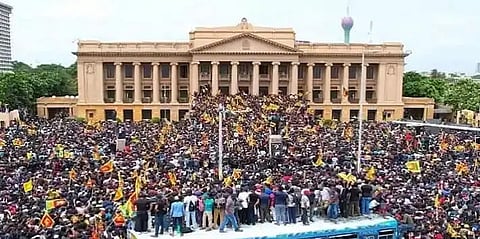
The recent visuals of public storming in the official President's residence that stood in all its grandeur amidst the unprecedented chaos that has surfaced on social media platforms and news channels remind us of such typically distraught and tyrannical toppled regimes of inflammable West Asia. When such movements are marred by religious proclivity, corruption of the puppet sovereigns or military dictatorships in India's extended neighbourhood in the west, the underlying tone of such political uprisings is essentially economical.
Who would have thought that this quaint little albeit strategically situated island which advertised itself as the Indian populace's pre-wedding photoshoots' hotspot just after Maldives and Mauritius, would find itself embroiled in the cursed junction of political and economic uproar? Who could have predicted this predicament for Sri Lanka which traces its religious and cultural roots with India from ancient times to the complicated entanglements with India in the present 2022?
It is not a simple answer to analyse when the solution was affected by the uneven level playing field in the backdrop of a two-year-long pandemic. It is unmistakable that nobody saw this country succumbing to its mistakes of the past with a myriad of collateral problems arising out from a decade-long civil war, alleged violation of human rights that was further aggravated by the authority's inaction as per UNHRC (United Nations Human Rights Council), a supposed animosity with India that was defined by Sri Lanka's dynastic politicians' intimacy with another Asian giant to outweigh its chequered episodes of the past, the unfortunate Easter attacks, an ill-timed and poorly thought chemical fertilizers ban, the ushering in of the 20th Amendment in its constitution to sporadically soar in the President's executive and legislative power and its inaction on the 13th Amendment and many such incidents that eroded the public trust on the government. However, the spill-over effects and subsequent waves of migration of Sri Lankan refugees will ripple through our country as well because borders don't limit a country's outreach or influence. It is the people of these nations that determine the history and its future.
It is not poor eyesight but the lack of will to see the foreseeable troubled future amongst the ruling class who became easy prey for China's debt-trap policy. Hambantota port went to the Chinese under a 99-year lease that further strengthened their prowess in materializing a shining pearl in Beijing's ambitious roadmap of the Maritime Silk Road by encapsulating India in "The String of Pearls" that will help them lay an uninhibited claim on the great waters of Indo-Pacific. Although India is still involved in the projects related to the Colombo port and Jaffna peninsula, there will be an uneasy presence of Chinese "Red Flags" in this strategic vantage point.
The ex-Prime Minister, Ranil Wickramasinghe after being ousted by the elder Rajapaksha in 2019, tried hard to hold in the reins of the country which already lies deep in shambles of high inflation, protests, a decline in agricultural productivity, unemployment and much more. President Gotabaya Rajapaksha's consistent talks with the IMF for a bailout package that would mean the need for restructuring the entire nation's economy seems to have reached a dead-end when Mr Wickramsinghe announced that Sri Lanka would be far from recovery until 2023.
A very philanthropic gesture came from the Chief Minister of Tamil Nadu for which he was profusely thanked by the ex-PM when the island nation received consignments of essential items and medicines. New Delhi, too immediately responded to the crisis with its spirit of "Neighbourhood First Policy" with over US $ 4 billion worth of credit lines, currency swaps and humanitarian assistance. India has fulfilled the role of a trusted neighbour and has even received Sri Lanka's economic refugees in Mannar. The ex-PM mentioned help coming in from all quarters of the world including oil from Russia and financial pledges from China as well.
When it comes to India's equation with Sri Lanka it is not a surprise why our past, present and futures are overlapping. A peaceful and untroubled neighbour is imperative for the collective growth of the region. We have no dearth of inter and intra-country border issues were conflicts, incursions and extremism have defined and moulded relationships through a kaleidoscopic view of suspicion and apprehension. India has time and again proved its ingenuity when it comes to Sri Lanka right from sending the UN Peace Keeping Forces in the past to financial aid in the present. Even time will have tales to tell as to who will be Sri Lanka's all-weather friend or tag its position as a swing state.
