
- Home
- Live Blog
- Breaking News
- Top Headlines
- Cities
- NE News
- Sentinel Media
- Sports
- Education
- Jobs
Deba Prasad Misra
(dpmisra00@gmail.com)
“Show me a family of readers, and I will show you the people who move the world,” said Napole on Bonaparte. Indeed, books are our windows to knowledge and wisdom. A book-fair, on the other hand, is a vibrant literary festival that brings together authors, publishers, booksellers, educators, researchers and readers on one single platform. Far more than a conventional marketplace for buying and selling books, it serves as a cultural and intellectual hub where knowledge, creativity and diverse perspectives find a common platform. It provides an opportunity for people from different backgrounds, age groups and academic disciplines to explore the world of literature, science and technology and develop a deeper appreciation for reading and lifelong learning. A book-fair is such a place where one gets the largest collection of books of one’s choice at a reasonable price. It provides a common platform where ideas are exchanged, knowledge is shared, literary traditions are celebrated and new dimensions of human thought are explored.
Since the beginning of human civilisation, books have played a vital role in shaping human society. They have preserved the wisdom of generations, documented historical events, communicated scientific discoveries, inspired social movements and provided a basic foundation for education. Every book carries within its pages the thoughts, experiences and knowledge of its authors. A book-fair brings innumerable such thoughts together under one roof.
In the modern world, where technology has transformed almost every aspect of human life, the importance of book-fairs has become even more significant. The widespread availability of smartphones, computers, tablets, e-books, audiobooks and digital libraries has changed the way of accessing information by the public. Nevertheless, traditional printed books continue to hold a place of their own in human civilisation. Book-fairs remind us that reading is not simply an activity of gathering information; it is a process of understanding, questioning, imagining and developing wisdom. A book-fair is, so to speak, a bridge between the past and the future, connecting traditional literary heritage with modern technological advancement. A book-fair brings the vast world of knowledge closer to readers by presenting an extensive collection of publications under one roof.
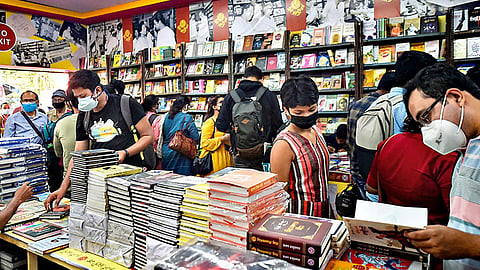
One of the most fascinating aspects of a book-fair is its lively, colourful and intellectually stimulating atmosphere. A book-fair is often accompanied by a festive environment that attracts all sections of people like families, students, teachers, educators and literature enthusiasts. Attractive hoardings, directional signs, announcements, reading corners, food stalls and interactive spaces contribute to the overall experience. Unlike a conventional shopping environment, a book-fair encourages visitors to spend time browsing, reading and engaging in conversations. Children can explore illustrated stories, students can discover academic resources, and adults can reconnect with their favourite authors and literary interests. The combination of learning, entertainment and cultural engagement makes a book-fair an inclusive public event.
Modern book-fairs are not restricted to the exhibition and sale of books. They incorporate several literary, educational, cultural and recreational activities that make the event more engaging and meaningful. New book launches and authors’ interactions are among the anticipated attractions of a book-fair. Interactive question-and-answer sessions allow visitors to understand the author’s creative journey, research process, writing challenges and perspectives on contemporary issues. Book-signing sessions further strengthen the relationship between authors and their readers by providing opportunities for personal interactions. Many competitions such as art competitions, poetry recitation, story-telling competitions, speech competitions, panel discussions and creative writing competitions are also held on the premises of book-fairs as a part of the celebration.
Book-fairs frequently attract visitors through special discounts, promotional schemes and bundled offers. Such offers make books more accessible to students, young readers and individuals who may find certain publications expensive. Book-fairs serve as important business and networking platforms for the publishing industry. These fairs contribute not only to literary development but also to the economic and commercial growth of the publishing ecosystem. One of the most important contributions of book-fairs is their ability to encourage reading habits among people of different age groups. A book-fair represents much more than a gathering of readers and publishers. It is a celebration of human civilisation, intellectual freedom, cultural diversity and the continuous search for knowledge.
From ancient manuscripts to the invention of the printing press, from the development of modern publishing houses to international book-fairs, the journey of books reflects humanity’s desire to preserve and share its experiences.
In our state, book-fairs have played a vital role in strengthening literary traditions and promoting languages and literary cultures. Over the years, the book-fair movement has expanded from Guwahati to several towns across the state. An important milestone in the organised book-fair movement came in 1984, when the Publication Board, Assam, in collaboration with the National Book Trust of India, organised a national-level book-fair in Guwahati. Following this success, the Publication Board, Assam, organised the 1st independent Guwahati Book Fair in 1987. From then onwards, the fair became a regular annual event and attracted publishers and booksellers from Assam as well as different parts of India. Another major development took place in 2021, when the Guwahati Book Fair and the North East Book Fair were brought together under one umbrella, ‘Assam Grantha Mela’. The initiative sought to provide a broader platform for publishers, booksellers and readers while bringing the various book-fair activities under a common identity.
In our age dominated by digital media and instant information, book-fairs remain relevant as they offer something more enduring: the opportunity to engage with ideas, knowledge and wisdom. They are not merely commercial events, but celebrations of our literary heritage and its continuing intellectual growth.
The success of a book-fair should not be measured solely by the number of visitors, books sold or participating publishers, but also by the curiosity it generates, the reading habits it inspires and the intellectual connections it creates. Let us, therefore, celebrate book-fairs, encourage reading habits, support authors and publishers, preserve our literary heritage and make books an inseparable part of our lives.
