
- Home
- Live Blog
- Breaking News
- Top Headlines
- Cities
- NE News
- Sentinel Media
- Sports
- Education
- Jobs
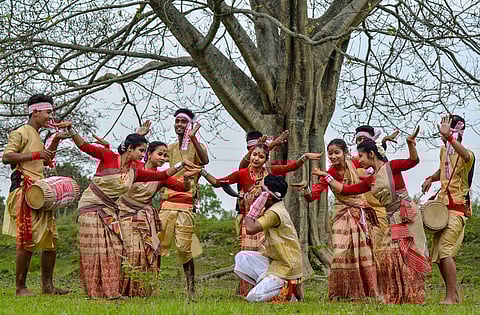
People of all ages in Assam enjoy the romance time together in a free and uninhibited manner. Manuh Bihu is about titillating Bihu dance. Youths dressed in the traditional attire, a ‘muga chador mekhela’ for the women and ‘dhoti gamocha’ for the menfolk.
‘Thrice welcome, darling of the Spring/Even yet thou art to me/
No bird, but an invisible thing, /A voice, a mystery’ wrote William
Wordsworth in his poem, ‘To the Cuckoo’.
All of us know that this mysterious cuckoo’s call heralds the onset of spring. Many imagine that this sweet voice is produced by the female cuckoo. But in reality, it is the male koel, which is black in appearance like a crow. The female cuckoo is of ash colour, and it has white spots on its body and it cannot create the musical sound like the male cuckoo.
Typically, the cuckoo starts singing at the end of spring and continues throughout the summer and it still sings almost through the rainy season and mostly at the crack of dawn. This singing is part of their courtship display, or in a more common term, a way of finding a mating partner. It is their breeding season like many other birds.
Depending on the frequency of the loud singing a female cuckoo chooses her partner. As it is their breeding season, the male cuckoo sings in order to attract female cuckoo for mating. Like human beings, animals are also destined to do their work as per the prescribed season and time. This romantic period goes on for a few days and mating takes place.
Generally, we hear this singing bird’s voice from April, which gradually increases but dies down from June. The main reason is that the spring season is the season of breeding, which even Chaucer, in his Prologue to the Canterbury Tales, mentioned. The male koel stops producing sound as soon as the mating is over. This is the main reason that we hear the sweet voice of koel only in the spring season.
Since the crows make their nests near the human colonies, therefore the female koel lays her eggs in their nests. After laying the eggs, the female koel flies away to the dense forests as it likes to live on big trees, full of leaves to hide it. Their eggs are hatched by the crow. Then the mysterious song of the cuckoo stops.
In Assam, the musical notes of the cuckoo are attuned perfectly with the titillating Bihu songs to the beating of ‘dhols’ and cymbals, accompanied by the mellifluous notes of bamboo flutes and buffalo horns, heralding the festival of Rongali or Bohag.
Poetry in Assam is replete with references to the singing of cuckoo. People of all ages in Assam enjoy the romance time together in a free and uninhibited manner. Manuh Bihu is about titillating Bihu dance. Youths dressed in the traditional attire, a ‘muga chador mekhela’ for the women and ‘dhoti gamocha’ for the menfolk.
The moves of the invigorating Bihu dance are such that they bring out the youthful spirit in everyone. Pelvic and chest movements dominate the Bihu dance as the youths display their vigour to attract each other in the festival.
Bhupen Hazarika had expressed concern about the lack of original Bihu sanctity in the Bihu performances of the new generation. This Bihu romance exhibited in the artificial pandals in the city and township lacks the melodious cuckoo singing that calls the Spring in the village meadows where a cuckoo becomes a part of our musical culture and literature, Bengali or Assamese, nay Indian..
Dr Ratan Bhattacharjee , a Senior Academician and Trilingual poet can be reached at profratanbhattacharjee@gmail.com mobile 8961688870