
- Home
- Live Blog
- Breaking News
- Top Headlines
- Cities
- NE News
- Sentinel Media
- Sports
- Education
- Jobs
Animation is the process of arranging a series of images in a way that stimulates our imagination and transports us on a fantastical adventure. These pictures can be created using any artistic technique such as drawing, painting or crafting. It is a little-known truth that the Indian animation business is among the oldest in the world, even among the major brands of Pixar and Disney.
When you think of the Indian film business, animation isn't the first thing that springs to mind. In fact, until recently, you hardly thought about animated movies in the context of India. Indeed, animated films were "imports" more than anything else for the majority of millennials when they were growing up (i.e., made abroad and distributed through various media here). Indians are unaware that animated movies were first produced back in 1934.
By presenting a series of static images quickly, animation gives the appearance of movement and form change. Artists who specialise in the creation of animation are known as animators. Animation, to put it simply, is the technique of quickly altering images to create the appearance of motion.
There are many different kinds of animation, but before that, we should specifically know which are good or bad.
A good animation has a generally smooth overall motion and attractive key frames.
A bad animation is one where everything seems to break down and the animation is choppy and awkward.
Indian Animation
Indian animation dates back to the first half of the 20th century. Before the invention of cinema, audiences were delighted with shadow puppets and slide presentations, which were the forerunners of contemporary animation.
Achievements in the Indian Animation Sector
When Clair Weeks visited the Films Division of India, it marked a turning point in Indian animation. He assisted in the establishment of the first animation studio in India and trained a group of Indian animators. He was a Disney animator who had worked on Disney hits like Bambi and Snow White and the Seven Dwarfs. They continued by creating The Banyan Deer, India's first colour animated film, in 1957.
As filmmakers turned to animation to express their stories, the lack of film stock during World War II was a major factor in the growth of the animation business in India.
Even in its infancy, animation was regarded as a useful technique for teaching kids about their surroundings.
“Ek Anek Aur Ekta”, a brief animated educational film released in 1974 that was widely broadcast on Doordarshan, is a legendary animated film from the Films Division. Children were to learn the importance of unity from it. The first animated programme was Ghayab Aya, which was shown on Doordarshan in 1986 and featured the amiable ghost Ghayab.
Without any effort being made to expand the industry, the Indian animation sector came to a standstill in the 1980s. Without much success, some attempts were made in Bollywood. The Walt Disney Company's Indian subsidiary and Yash Raj Productions collaborated to create the country's first 3D animated movie, Roadside Romeo (2008).
Animation and Advertisements
The advertising sector leapt on board as India's commercial animated film industry remained stagnant. Certain animated characters from the 1960s and later are still popular today and have left a lasting impression on Indians.
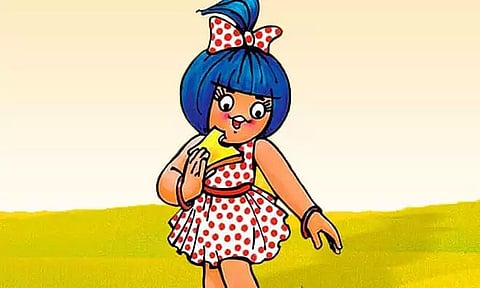
There are several notable characters. For instance, Sylvester daCunha created The Amul Girl in 1966, Umesh Rao created Air India's Maharaja in 1946 while Nandkishor created Mr. Chintaman for ICICI Bank.
In India, the word "anime" is becoming more popular. Animax India broadcast anime continuously from 2004 to 2017.
Downfall
Visit Cartoon Network or POGO to see the issue if you want to discover what is wrong with the Indian animation business. This issue has existed for the past six to seven years and is not brand new. The plots of these shows are dreadfully unattractive; there are hardly any interesting characters or feelings expressed in them, and the shows merely repeat themselves.
Are we to assume that a young child is abusing adults by devouring ladoos? The same storyline appears in every episode of the Indian television programme, Chhota Bheem. Also, the story doesn't pick up where it left off, which causes us to feel a little cut off from the show.
Storylines like this are what cause society to believe that animation is solely for children and that adults who enjoy watching animated television are immature.
Anime
In India, the word "anime" is becoming more popular. Animax India used to broadcast anime nonstop from 2004 to 2017, and the channel continued to air shows that catered to both young adults and adults. On the same day as Japan, the station would broadcast anime in real time. Animax India eventually stopped broadcasting in India.
You might be wondering why Animax ceased operations at this point. The answer is due to society's perception that anime is only appropriate for children and not adults. Owing to this, fewer people watched the show, which resulted in a generally low TRP for the station. Animax hasn't completely stopped operating; it simply stopped broadcasting in India due to low TRPs; otherwise, it's still running strong.
Pandemic
People were unable to travel because of the COVID-19 pandemic and the ensuing lockdown restrictions, so their only option was to binge-watch television episodes at home.
After so many years, people began to watch anime once more when there were inferior series to choose from. As a result, anime once again became popular in India.
Thankfully, even during lockdowns, animation could be created using remote working systems. Because of this, it was a strong contender for all platforms' content portfolio strategies. When the shutdowns started last year, we had two rather significant projects in the works, but we were still able to efficiently work through the pandemic with remote teams, minimising the inconveniences.
Why Anime Works
Everybody who has ever watched anime is aware of its effectiveness. It works because of its characters, fully developed plot and attention to detail, which mesmerises viewers like us.
It is not just about its gorgeous visuals and awesome soundtrack. Take Eren Yaeger from Attack on Titan as an illustration (Shingeki no Kyojin). A complete character arc shows how he changes from a naive boy who wants to see the world to a man who wants to destroy the world as a result of the world's history. He is the subject of a proper story that is centred around him.
Even the simplest scenes are given the necessary attention to detail, and every narrative turn is timed well. They miss all this when they watch programmes like Chhota Bheem.
Hollywood's collaboration with Indian production companies has made it possible for India to gain the skills necessary to understand how to approach it in a more professional way.
Many VFX businesses are currently in operation in India, serving a variety of clients both domestically and abroad. The Indian animation and film industries will keep working to improve their technical and creative abilities and advance with glimmering hope. Yet, the Indian film industry still needs to concentrate on a few important issues if it wants to grow steadily in the future.
It is our obligation to improve even more now that the major Hollywood production companies are working with the Indian film industry.
The longer we concentrate on our areas of competence, the more likely we are to advance and receive consistently high-quality employment. It is to be emphasised that society's perception of animated television should be modified and that India needs a legitimate anime-only streaming service so that people can legally watch anime.