
- Home
- Live Blog
- Breaking News
- Top Headlines
- Cities
- NE News
- Sentinel Media
- Sports
- Education
- Jobs
AHMEDABAD: In December 2025, Chairman of the diversified infrastructure major Adani Group, Gautam Adani, stood in the vast expanse of the Great Rann of Kutch in Gujarat. The landscape was stark. The intent was clear. This was the site of one of India's most ambitious renewable energy projects. The visit was not symbolic -- it reinforced a strategy centred on scale, speed and execution.
India's energy challenge is intensifying. The country is home to the world's second largest population. Its economy is expanding rapidly. Power demand is rising in step. Peak electricity demand grew from around 250 gigawatts (GW) in the financial year (FY) 2025 and is projected to reach nearly 388 GW by FY 2032.
According to the International Energy Agency (IEA), India's energy consumption will grow 1.5 times faster than the global average over the next 30 years. Power demand is expected to rise by 25 to 35 percent by 2030. Meeting this demand while decarbonizing the grid will require renewables to scale quickly and reliably.
Private sector participation has been critical in this shift. Government policy and clearances created the framework. Execution came from private enterprise. Efficiency, capital, technical expertise and project management have driven the pace of renewable deployment. Large developers have translated policy ambition into operating capacity.
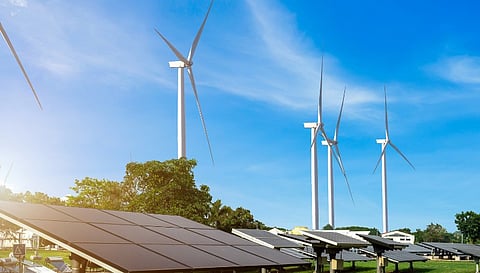
The Great Rann of Kutch reflects this model. The site visited by Gautam Adani is slated to host a renewable energy park with the potential to generate around 20 GW of wind and solar power. In an energy hungry economy, capacity at this scale is transformative. Industry experts increasingly see large contiguous parks as the most efficient path to decarbonization. Tariffs remain competitive. Vast arid land, strong wind corridors and high solar irradiance make projects like these commercially viable at global benchmarks.
This ambition is backed by capital. The Adani Group has pledged investments of up to $75 billion over five years to accelerate India's clean energy transition. At a time when global capital is becoming more selective, such long horizon commitments signal confidence. Not only in renewables. But in India's demand growth and policy stability. (IANS)
Also Read: Private equity investments in Indian real estate up 59% to $6.7 billion in 2025
