
- Home
- Live Blog
- Breaking News
- Top Headlines
- Cities
- NE News
- Sentinel Media
- Sports
- Education
- Jobs
Harpal Saikia
(The writer can be reached at
harpalsaikia15@gmail.com)
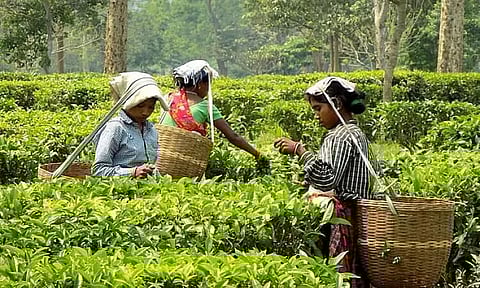
Life seems to be an idyllic one as I sit there sipping a cup of the finest Assam tea. The state of Assam has been unanimously been associated with a cup of tea, its alcoholic potency that has taken its roots in the Indian mainland and beyond. However, beyond the romanticized notions of drinking a cup of tea, and looking at the eponymous green leaves, there lies a larger human cost, the labourers belonging to the Tea Tribes in the state have been living in unimaginable conditions. Historically, despite decades of an economy centred around tea exports and production, the conditions are yet to see a change. It is the children who are often stuck at the crossroads between joining the labour force for generating livelihood and getting an education, which becomes a far cry for many of these children.
Education on tea estates
The right to education is a fundamental right, guaranteed by the Indian constitution to all its citizens. These rights somewhat remain inaccessible to many of these communities that have been historically marginalized. With profits taking paramount importance in a tea estate, largely students have only access to the primary level of education. While this pitfall surrounding access to education is not gender-specific, women have been doubly marginalized when it comes to education. Familial and societal conditions pose significant barriers and act as deterrents to choosing a career. Silonti Das, one of those young girls living in the tea estate puts across this dilemma; "I want to be a teacher in future and want to live outside the tea estate. Life is very boring here, and nothing is exciting here. I have lived here for 18 years of my life, and now I want to change. My education will help me in that."
Tea estates push girls to become labourers, and many of them are left with no choice. Many of them didn't have access to schools at the proximate distance of the tea estates. This status-quo of lack of accessibility to schools for those living in the tea estates has remained a recurring problem, despite the Plantation Labour Act (PLA) making it clear that there has to be a school within 1.5 km of the 'labour line' at the tea estates. However, the words of the Act have not necessarily been translated into actions, with children being forced to cycle vast distances to have access to their right to education.
The COVID-19 pandemic and the resulting containment measures have sounded a death knell for the families living in the tea estates and have pushed them into mere subsistence. The pandemic certainly exposed the digital divide and vulnerabilities that many of these students have to deal with. With schools closing down, the learning process has been severely disrupted and has pushed progress back. A survey by the Purva Bharati Educational Trust has indicated that teaching processes took a complete backseat in some tea gardens, and teachers were not adequately equipped towards making a transition to online teaching.
The decision to start high schools in tea estates
In a landmark decision taken by the government, for the first time in over a span of 75 years of India's independence, high schools will start functioning in the tea estates. The academic year of the 97 newly-established Model High Schools in the tea gardens, alongside the 13 others will begin on the 10th of May this year. This will lead to the convergence of different mediums, and through the construction of facilities in time, it will elevate the academic environment in the tea estates. This will allow the vulnerable communities to have access to facilities at their doorstep and realize their dreams. Chief Minister Himanta Biswa Sharma made it clear that his government is planning to set up another 81 schools in the plantations. Sharma also stated; "The newly-established model high schools will also be upgraded to higher secondary schools and the government is planning to provide breakfast apart from mid-day meals to the students of these schools."
The economic and societal dilemma of the tea-garden workers
The state is the largest tea-producing region in the world, more than 50% of the workers in these tea plantations are women. The daily wages are extremely low and they live in squalid conditions often forced to defecate in the open without any running water. As per reports, workers collect on an average 22 kg of tea leaves and still earn 137 rupees a day, which is much lower than the mandated 250 rupees a day. Tea companies, governments and political unions have over the years created this vicious circle, where despite regulations workers are being pushed into artificially created poverty traps for maximizing profits.
The labour standards don't seem to apply in the tea estates of Assam, where workers toil for hours and are forced to live in deplorable conditions. Our morning cup of tea comes at a human cost unparalleled in History. There is an urgent need for the stakeholders to come together to augment its strategies in the face of changing socio-economic conditions and uplifting the societies who live in these plantations, rather than merely seeing it through a philanthropic approach.
Assam is the largest state in the Northeast and home to 31 million people, a third of whom are considered to be poor. Just like most states, there was a decline in poverty observed between 1994 and 2005, but the poverty incidences have remained consistently higher than the national average. There is a widening inequality now being observed in consumption patterns and income levels between the urban and rural areas. Assam emulates the rural-urban contrast as observed across other Indian states, the trends point out that there has been a worsening of rural poverty, though urban poverty has seen a steady decline. Even though data remains sketchy but estimates point out that almost 90% of incidences of poverty in Assam are concentrated in rural areas.
The economic dilemma is shrouded in a larger social dilemma, wherein caste politics comes to the fore and how caste is becoming an important point in the complicated tenor of the fragile state, marred by ethno-nationalistic tendencies. Power, caste and politics will continue to take precedence, and it has become imperative to explore the divisions that casteism is bringing into the politics of Assam. The Northeast of India has been seen as free of caste-based discrimination, but somewhat this has become far-fetched from reality, as powerbrokers have steadily tried to reinvigorate the caste lines.
The way forward
The decision to start high schools in the plantations is an important step toward solving the educational divide and allowing families to aspire for better economic conditions with time. There are contestations in this space, the most significant being access to teachers and facilities. The roadmap will be a difficult one and comes with numerous challenges starting from social to economic. Looking at the RCTs (Randomised Controlled Trials) conducted by Nobel laureates Abhijit Banerjee and Esther Duflo for research has pointed out how sometimes even factors like teacher absenteeism in developing countries impact the last-mile connectivity, leaving the beneficiaries out of the equation. The approach here needs to be participatory and community-driven, where the beneficiaries feel empowered to take forward the mission. If at all, the human cost of a cup of tea has to be mitigated, education remains a key plank toward creating spaces for children and accessing their guaranteed fundamental right to education.
