
- Home
- Live Blog
- Breaking News
- Top Headlines
- Cities
- NE News
- Sentinel Media
- Sports
- Education
- Jobs
Bivash Modi
(modi.bivash@yahoo.in)
Urban Naxals, “Demagi Naxals” and “Naraj Fufas” may make catchy headlines. But are we allowing political vocabulary to become more important than the changes taking place around us?
Indian politics has always had a remarkable talent for inventing expressions. “Urban Naxal” became a familiar political description; now we hear newer expressions such as “Demagi Naxal” and, more amusingly, “Naraj Fufa”.
The last one seems to have acquired a life of its own. A naraj fufa—the perpetually offended uncle at a family function—may actually be more relatable than the supposedly intellectual “Demagi Naxal”. At least the fufa is easy to understand: he is unhappy because he did not get the chair he wanted, the food he expected or the attention he deserved.
The danger, however, is not in the words themselves. It is in allowing such words to occupy the entire public conversation.
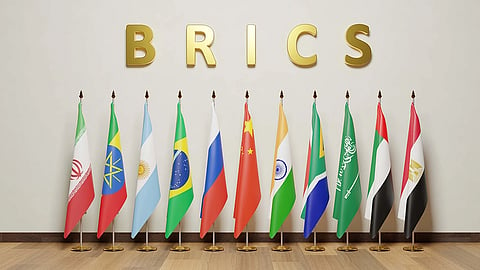
Consider the recent BRICS summit in New Delhi. An international gathering involving major emerging economies naturally raises questions about geopolitics, trade, technology, energy, global governance and the future of the Global South.
Yet a significant part of the domestic conversation turned into a food fight over the vegetarian dinner served to visiting leaders. The menu included dishes such as khandvi, paneer, millet pulao and Indian desserts. Political leaders exchanged arguments over whether the menu adequately represented India’s dietary diversity.
Then came discussions about seating arrangements and who sat where.
One wonders: have we become a nation where even a BRICS chair can produce more political heat than a BRICS discussion?
The New Delhi Declaration actually covered issues of trade, global value chains, technology, artificial intelligence, digital cooperation and economic resilience. It also discussed expanding cooperation in AI and digital infrastructure. Those are subjects capable of influencing the lives of millions.
The same tendency was visible during the India AI Impact Summit in February. A group of Youth Congress workers entered the Bharat Mandapam venue and staged a shirtless protest against Prime Minister Narendra Modi. Police subsequently arrested participants, and the incident became a political controversy. There is nothing unusual about political protest in a democracy. Protest is a legitimate democratic instrument. But an international summit devoted to artificial intelligence, attended by global political and technology leaders, is hardly an ordinary political meeting.
The irony was almost cinematic.
Inside the venue, India was discussing the future of AI, computing, cybersecurity and responsible technology. The summit eventually saw participation from more than 118 countries and investment commitments across the AI value chain exceeding $250 billion, according to the government. Outside—or rather, inside the same venue—politics briefly returned to the language of spectacle.
Perhaps the protesters wanted international attention. They certainly received it. But the more important question is whether India itself should have received more attention for what the summit was actually trying to accomplish. India’s technology story deserves a larger conversation.
Assam is now part of India’s semiconductor journey. Tata Electronics is building a semiconductor assembly and testing facility at Jagiroad with an investment of about Rs 27,000 crore. The project is designed around advanced packaging technologies and has an announced capacity of up to 48 million units a day.
Only a few years ago, the very idea of Assam becoming part of a global semiconductor supply chain would have sounded extraordinary. Yet instead of asking how Assam can build the necessary engineering talent, ancillary industries, logistics, housing and research ecosystem, the conversation sometimes descends into political suspicion and criticism.
That is a missed opportunity. A semiconductor plant is not merely a building. It can become the nucleus of an industrial ecosystem.
Look at the numbers before looking for the controversy
There are several other developments worth discussing. Indian Railways carried a record 1,670 million tonnes of freight in 2025–26, up 3.25 per cent from the previous year. Freight loading has risen from 1,098 million tonnes in 2014–15 to 1,670 million tonnes in 2025–26.
UPI processed 2,450.9 crore transactions in August 2026, worth nearly Rs 29.82 lakh crore. In FY 2025–26, UPI recorded more than 24,162 crore transactions in volume, according to official data.
India’s foreign-exchange reserves stood at about $780.8 billion in the week ending September 11, 2026, after touching a record around $785 billion. Defence exports reached a record Rs 38,424 crore in 2025–26, a 62.66 per cent increase over the previous year.
India’s space programme has also continued to expand. ISRO says that between July 2023 and June 2026, India successfully launched 12 launch-vehicle missions, 11 national satellites and nine satellites for international customers; the SPADEX mission also made India the fourth country to demonstrate space docking.
These numbers do not mean that everything is perfect. Far from it. GDP methodology can be debated. Employment, inequality, inflation, agricultural distress, education and healthcare require continuous scrutiny. Infrastructure projects must be judged for quality, cost and outcomes. Self-reliance cannot mean isolation.
But criticism becomes more meaningful when it engages with facts rather than merely searching for the next “fufa moment”.
From Naraj Fufa to
nation-building
There is an old political saying, with many variations, that when the house is being rebuilt, someone will complain about the colour of the curtains. That may be the eternal role of the naraj fufa.
But India today is dealing with questions much larger than seating arrangements and dinner menus: Can we become competitive in semiconductors? Can we lead in AI? Can UPI become a global digital public infrastructure model? Can hydrogen become a practical energy option? Can railways reduce logistics costs? Can our space and defence industries become globally competitive? Can Atmanirbhar Bharat produce products that the world wants to buy?
These questions deserve our political energy. Words will continue to be coined. Governments will continue to be criticised. Opposition parties will continue to oppose. That is democracy. But perhaps our public conversation should occasionally rise above the vocabulary of the day.
Let the Urban Naxal, the Demagi Naxal and the Naraj Fufa have their moment of fame. The real India, meanwhile, should remain busy building chips, writing code, launching rockets, moving freight, developing infrastructure, strengthening its reserves and preparing its young people for the next century. That India is far more interesting than the latest political phrase. And, perhaps, far more important.
