
- Home
- Live Blog
- Breaking News
- Top Headlines
- Cities
- NE News
- Sentinel Media
- Sports
- Education
- Jobs
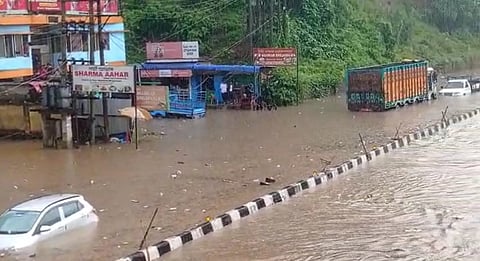
Pre-monsoon rains during March-May in the Northeastern states sound the seasonal alarm bell for preparedness for floods and landslides during the monsoon season. Official data shows that the economic cost of damage caused to railway assets by the twin disaster in the region remains high. The damage to the railway tracks and structures that took place in Northeast Frontier Railway due to floods and landslides in the last five years is assessed to be over Rs 200 crore, which is a substantial amount. The railway ministry claims that geological weakness is always accounted for at the stage of design and implementation of railway projects, as the geology of the region is prone to landslides. Recurrence of the damage, however, calls for dynamic improvement in the design to reduce the damage so that the amount saved can be better utilised for expediting new and ongoing railway projects. The central government informed the Lok Sabha that due care is taken in the planning and execution of works so that there is minimum damage to the sensitive geological formations of the Eastern Himalayas. Monitoring and evaluation of the execution of the mitigation measures is pivotal to ensure that scientific studies and recommendations for design improvement are fully applied to achieve targeted improvement. The government's assertion that rail transport is inherently more environmentally friendly due to its lower carbon footprint, energy efficiency and reduced congestion as compared to roads bears great significance for the fragile ecology of the region. Official estimates show that rail transport costs less than half of road transport, and its carbon dioxide emissions are 90 per cent less than road transport. Shifting more traffic from road to rail plays a crucial role in decarbonising passenger and goods transport in the region. Information tabled in the parliament gives an idea of the quantification of decarbonisation through rail transport. As compared to the 2014 level, 2672 MT more freight has been shifted from road to rail, which has resulted in saving 143.3 million tonnes of carbon dioxide emissions. This itself is equivalent to planting more than 100 crore trees, the Lok Sabha was told by the government. This brings to light the importance of railway expansion and expeditious execution of various ongoing railway projects in the region. The N. F. Railway achieving more than 96% of electrification of railway tracks under its jurisdiction is a commendable improvement to railway infrastructure in the region, not just to facilitate faster movement of passengers and freight but also to significantly bring down carbon emissions through the phasing out of diesel use. The N. F. Railway planting more than 9 lakh tree saplings during the five years is also a laudable initiative, but survival of the trees remains crucial to achieve the objectives. The view held by the Parliamentary Committee on Home Affairs that required railway connectivity is still lacking in the region, and better mobility of people and goods is socially and economically important to integrate the Northeastern Region with the national railway network. The parliamentary recommendation for close coordination between the Ministry of DoNER and the Ministry of Railways for expediting the ongoing railway projects for reducing the carbon footprint of the logistics sector and seamless integration of the Northeastern cities into the national rail grid is a solution rooted in lived realities. The Railways say that it undertakes studies and assessments of the environmental and geological impact, which specifically assess slope stability, rock and soil characteristics, vegetation cover and hydrological patterns before going ahead with construction, and findings of the studies are used to anticipate the risk of landslides that can result from construction activities. Mitigation of potential risk of landslide, and also to control soil erosion, include slope stabilisation measures through provision of retaining walls, soil nailing, and adoption of geo-synthetics in hilly terrain. Plantation of grass and shrubs on slopes to stabilise loose soil is also done. Besides, the construction of catch drains and check dams to guide and control debris flow is also taken up. In addition, construction of embankments has been carried on to manage flow and prevent flooding, while tracks are constructed at higher elevations in flood-prone areas to avoid inundation, with the provision of adequate culverts, side drains, and waterways to allow smooth discharge of floodwaters. Greater transparency on the quality of construction work and strict adherence to scientific recommendations for mitigating risks can create the space for more independent experts on disaster risk mitigation to enrich the scientific studies towards strengthening of the mitigation measures. The Railway Ministry insists that to avoid disturbance to hill slopes in the geologically weak formations in the region, underground tunnels have been built for railway tracks. Recurrence of blockages in some tunnels due to heavy rains, however, points to critical design gaps. As the region is located in a strategic zone, strengthening such mitigation measures against natural disaster should be treated as a national priority.
