
- Home
- Live Blog
- Breaking News
- Top Headlines
- Cities
- NE News
- Sentinel Media
- Sports
- Education
- Jobs
An amendment to “The Assam Fixation of Ceiling on Land Holdings Act, 1956” has opened the path for families residing in the labour
lines of tea estates to obtain ownership of the land they have inhabited for generations. This landmark reform is certain to have far-reaching implications for these communities – Bijendra Gogoi
The recent winter session of the Assam Legislative Assembly marked a historic step towards securing the rights of the state’s tea tribe and Adivasi communities. An amendment to “The Assam Fixation of Ceiling on Land Holdings Act, 1956” has opened the path for families residing in the labour lines of tea estates to obtain ownership of the land they have inhabited for generations. This landmark reform is certain to have far-reaching implications for these communities.
The history of tea cultivation in Assam is inseparable from the contributions of the tea tribe and Adivasi communities. This history began in 1823, when Singpho chief Singpho Gam, or Bisa Gam, gifted the first tea plant to Major Robert Bruce of the East India Company, enabling the British to discover the tea variety indigenous to Assam. In the early years of cultivation, Singpho labourers were engaged first, followed by Kacharis, Nagas and subsequently workers from China. Later, labourers were brought from Bihar, Bengal, Odisha, Madhya Pradesh, Andhra Pradesh and other regions. According to historian H.K. Barpujari, the workers brought from Bihar and Chotanagpur in 1841 were the first migrant labourers recruited from outside the region for Assam’s tea estates.
During the “Advantage Assam 2.0: Investment and Infrastructure Summit” held in February this year, the state’s 200-year industrial history initiated by the tea industry was prominently highlighted. Tea was the first industry to bring both the motor car and the aeroplane to Assam. The expansion of road networks, the arrival of the railways and the rise of urban centres such as Doomdooma, Moran, Sonari, Rangapara, Dhekiajuli and Biswanath Chariali are all rooted in the growth of the tea sector. The contribution of tea to Assam’s economy has been extensively analysed across various forums.
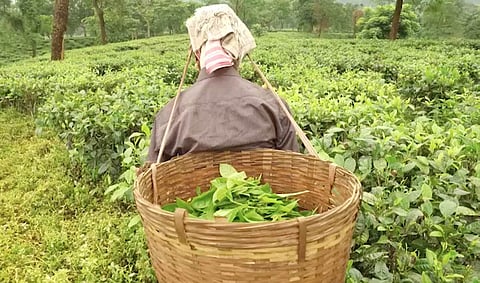
Tea is Assam’s state drink, but more importantly, it is a cultural emblem shaped by the toil, hope and emotional bond of the tea tribe and Adivasi communities. Yet, despite being integral to Assam’s social and cultural life, these communities did not progress as they should have over past decades. On almost every socio-economic indicator, including education and healthcare, tea garden areas have remained among the most disadvantaged regions of the state.
It is in this context that the opening of model schools in tea garden areas in May 2022 by the Assam government stands out as a transformative step. For the first time in 75 years of independence, 120 model schools were set up to strengthen educational infrastructure and empower a new generation from these communities. Chief Minister Dr Himanta Biswa Sarma has already announced that foundation stones for another 100 such schools will be laid in January next year.
The number of reserved seats for tea tribe and Adivasi students in the MBBS course has recently been increased from 27 to 30. Three per cent of Grade III and Grade IV posts under the OBC quota in government jobs have been reserved for these communities. More than 1.58 lakh students have received pre- and post-matric scholarships and other financial assistance. Additionally, 250 seats have been reserved in various paramedical courses for students from these communities.
To commemorate 200 years of Assam tea, the state government waived electricity dues amounting to Rs. 150 crore for around three lakh tea workers. With effect from 1 October 2023, the minimum daily wage for tea garden workers has been raised to Rs. 250 in the Brahmaputra Valley and Rs. 228 in the Barak Valley. Over 30,000 youths have received grants of Rs. 25,000 each under the Swahid Dayal Das Panika Swaniyojan Scheme, and several thousand women’s self-help groups have been provided financial assistance for livelihood activities. Further, nearly seven lakh tea workers have received one-time assistance worth Rs. 5,000 each. Under the Adivasi Peace Accord, the Adivasi Welfare and Development Council has been constituted, with a funding commitment of Rs. 500 crore.
Jhumoir, the vibrant cultural expression of the tea communities, remains a powerful symbol of their resilience and identity. On 24 February, nearly 8,000 artistes performed Jhumoir in the presence of Prime Minister Narendra Modi at the Arjun Bhogeswar Baruah Sports Complex. The Chief Minister has also announced that Jhumoir will be showcased next year in New Delhi before ambassadors from across the world. A cultural integration centre for the tea communities is being developed on 30 bighas of land in Kaziranga. The government has also sanctioned Rs. 1.5 crore each for the construction of 500 Jagannath Community Halls-cum-Skill Centres in tea garden areas, amounting to a total investment of Rs. 750 crore.
In the health sector, 80 mobile medical units have been providing services in tea gardens since 2017, covering 583 estates and benefitting nearly 1.65 crore people. Another 80 Sanjeevani vehicles were rolled out on 16 October for deployment in tea garden areas. Since 2018, pregnant tea garden workers have been receiving Rs. 15,000 as wage compensation, benefitting over 1.71 lakh women. The government is also establishing 354 Ayushman Arogya Mandirs in tea gardens, with 240 already operational. Additionally, 183 tea garden hospitals are being supported with Rs. 10 lakh annually under the PPP mode, and 15 hospitals have been established in Assam Tea Corporation estates.
Parallel to these initiatives, the long-awaited aspiration for land ownership among tea garden workers is finally being realized. Under the amended Act, the allotted land will remain non-transferable by way of sale, lease, gift or any other form of alienation for 20 years or for a period notified by the government. Even thereafter, any transfer must be made only to tea garden workers as defined in the Act and only to individuals residing in the same tea garden. This safeguard ensures that land granted to tea tribe and Adivasi families remains within the community.
Just as the tea industry has evolved, the tea tribe and Adivasi communities too are undergoing profound transformation. Increasing numbers of young people are stepping beyond traditional plantation work and entering respected professions, though their numbers remain modest. Expanding this number is essential for the true empowerment of the community. Education is the most decisive catalyst in this journey. Only through modern, advanced and technology-driven learning can the overall development of these communities gain momentum. While the government has built educational infrastructure and broadened access to higher education, the opportunities must be embraced with greater awareness and resolve. Leading organizations of the tea tribe and Adivasi communities must take on the responsibility of strengthening this awareness. A strong, educated generation is the only foundation upon which these communities can overcome historical disadvantages and social challenges and advance toward real progress, dignity and empowerment.
(The author can be reached at bijendragogoidme@gmail.com.)
