
- Home
- Live Blog
- Breaking News
- Top Headlines
- Cities
- NE News
- Sentinel Media
- Sports
- Education
- Jobs
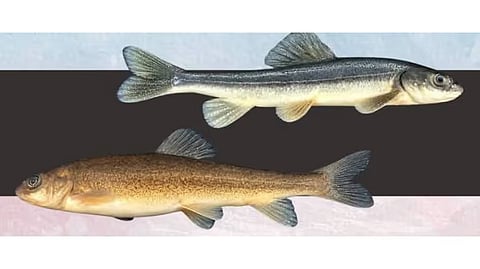
Northeast India is a major hotspot for freshwater biodiversity, home to several exclusive, rare, and endemic fish species found nowhere else in the world. The discovery was proved once again last week when scientists successfully recorded a rare Himalayan fish—Schizopygopsis waddellii—in thein India for the first time after finding specimens in a natural high-altitude lake in Tawang district of Arunachal Pradesh, at around 12,800 feet above sea level. This discovery not only adds a new species to India’s freshwater fish diversity but also, at the same time, expands the known range of the species, previously associated with high-altitude freshwater systems of the Tibetan and China Plateaus. In July of this year, researchers from the ICAR-Central Institute of Coldwater Fisheries Research (ICAR-CICFR) collected specimens of this rare fish species at Bhimtal in Uttarakhand, in collaboration with the Arunachal Pradesh fisheries department and members of the Shar-Tso Committee of Tawang. As has been mentioned in a prominent front-page news story of the Saturday edition of this newspaper, this particular species of fish belongs to the Cyprinidae family and is adapted to the harsh environmental conditions of high-altitude freshwater ecosystems. The scientific world had known about its distribution earlier, which was largely associated with the Tibetan Plateau, with Yamdok Lake in Tibet recorded as its type locality. Given this backdrop, the discovery at Tawang therefore represents a very significant extension of its known geographical range. The fish has an elongated, cylindrical body, with a dark greyish to olive-coloured upper side and a lighter, silvery to creamy-white underside. It has a complete lateral line, a blunt snout, a distinctive hard plate-like structure around the lower lip and snout, a sub-terminal mouth and a deeply forked caudal fin. These features are among the characteristics used in its identification. It is important to note that the finding is significant not only as a new addition to India’s freshwater biodiversity but also as a means of adding to India’s freshwater biodiversity and being of immense help in understanding the biological links between the Eastern Himalayas – a major biodiversity hotspot of the world – and the wider trans-Himalayan region. The discovery also highlights the largely unexplored fish diversity of Arunachal Pradesh and the entire Northeastern region. It was only early this year that a tiny fish species called Gitchak nakana was found in a hand-dug well in the Goalpara district of Assam by an international team. A team of researchers from Gauhati University, on the other hand, discovered Schistura densiclava–a new species of cave-dwelling loach–inside a limestone cave near Mawsynram in the East Khasi Hills in Meghalaya.
