
- Home
- Live Blog
- Breaking News
- Top Headlines
- Cities
- NE News
- Sentinel Media
- Sports
- Education
- Jobs
Siddharth Roy (siddharth001.roy@gmail.com)
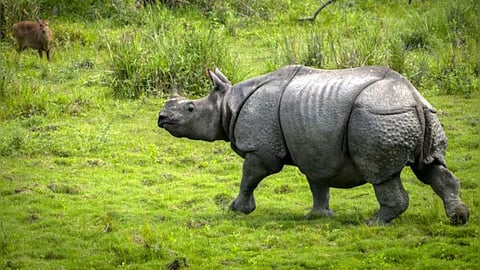
The greater one-horned rhinoceros is no longer merely a symbol. It tests whether India can move from protecting animals to managing landscapes. The launch of Project Rhino, and Assam's announcement that no rhino was poached in 2025, are significant milestones. The question is: can a growing rhino population survive in a landscape whose rivers, grasslands, corridors and human settlements are themselves under mounting pressure?
The numbers explain both. The global population is estimated at 4,075, up from 4,014 in 2022. Assam holds about 3,260, nearly 80% globally. Kaziranga has more than 2,600. This reverses the early 20th-century crisis, when fewer than 100 greater one-horned rhinos were thought to survive globally. Assam's population, about 600 in the 1960s, has crossed 3,000. The trajectory shows that protection can reverse decline.
Yet conservation success creates an engineering problem: concentration. When four-fifths of a species is in one State, the risks of that concentration become national risks. A disease outbreak, catastrophic flood, drought, habitat fragmentation or renewed trafficking network in Assam can affect a large share of the species at once. Project Rhino should therefore be a national strategy for building several viable populations across India.
Its focus on protection, habitat management, genetic improvement and population dynamics is therefore important. India's rhino conservation story has already moved beyond Kaziranga. Manas, where rhinos were once wiped out, has seen their return through reintroduction and protection efforts. Rhinos are also found in Orang and Pobitora in Assam, while populations persist or are being strengthened in Bihar, West Bengal and Uttar Pradesh. Such geographic diversification is ecological risk management. It spreads risk, giving the species more room to adapt and recover.
Assam's anti-poaching campaign offers a lesson. In 2013 and 2014, 27 rhinos were killed each year in the State. Between 2000 and 2021, at least 191 were poached. The subsequent decline followed stronger intelligence, surveillance, equipment, inter-agency action and field protection. In 2025, Assam recorded zero rhino poaching. The destruction of 2,479 seized rhino horns has signalled that wildlife crime will not be treated as an ordinary forest offence.
But zero poaching is a floor, not the ceiling of conservation. A rhino can be safe from a gun and unsafe from a degraded landscape.
Kaziranga illustrates the paradox vividly. The park is a floodplain ecosystem shaped by the Brahmaputra. Seasonal inundation is part of the ecological process that renews grasslands and wetlands. But extreme floods can kill animals, while roads, embankments, settlements and other infrastructure can restrict escape routes to higher ground. In the 2024 floods, nine rhinos were among more than 150 animals reported killed. The response cannot be to make Kaziranga flood-proof. The wider landscape must remain permeable during floods.
This requires treating animal corridors as infrastructure. The proposed 35-km elevated corridor along the Kaliabor-Numaligarh stretch, within a larger 90-km connectivity project, is intended to reduce vehicle-wildlife collisions and preserve movement routes. Nine animal corridors have been identified around Kaziranga. Such projects should be judged by whether animals can move across fragmented landscapes. Culverts, underpasses, elevated roads, restored wetlands and protected highlands should be planned as one connected system.
The same principle applies to habitat. Assam has expanded the Kaziranga protected-area complex to about 890 sq km through successive additions, while habitat expansion has also occurred elsewhere. The reclamation of parts of Laokhowa-Burachapori and expansion of Orang show that conservation can increase carrying space rather than simply intensify protection inside existing boundaries. Habitat quality and connectivity matter as much.
Population growth demands better science. The 2026 global estimate of 4,075 is encouraging, but wildlife populations are not inventories in a warehouse. Age structure, sex ratio, breeding rates, genetic diversity, disease, dispersal and mortality determine whether a population remains viable. Project Rhino should produce long-term datasets, common monitoring standards and independent scientific review. Camera traps, drones, satellite imagery and genetic sampling can complement field-based ecological knowledge.
Conservation statistics also conceal people. Protected landscapes are not islands; farmers, fishers, tourism operators and forest-dependent communities live around them. As rhino numbers rise, encounters with wildlife can increase. Compensation for crop damage, rapid response to conflict, livelihood alternatives and community participation must therefore be treated as core conservation expenditure, not peripheral welfare.
Assam's experience with former poachers becoming conservation partners in the Manas landscape is instructive. The lesson is not to relax enforcement, but that local legitimacy can reinforce it. A model giving communities an economic stake in wildlife protection is more resilient than one relying only on fences and patrols.
Project Rhino thus arrives at an important moment. India has shown that a species can be brought back from the edge. The next challenge is to prevent that success from becoming trapped inside a few protected islands. The rhinoceros needs grasslands, wetlands, flood refuges, migration routes and connected populations. It needs secure habitats in more than one State, and communities that see conservation as an opportunity rather than a restriction.
The real measure of Project Rhino will therefore not be another celebratory population number. It will be whether India can make the rhino less dependent on a handful of exceptional landscapes. Saving the rhinoceros now means saving the landscape that allows it to move, breed, survive floods and coexist with people. The horn made the animal a target; its future depends on everything around it.
