
- Home
- Live Blog
- Breaking News
- Top Headlines
- Cities
- NE News
- Sentinel Media
- Sports
- Education
- Jobs
A practical way to manage flood finance in Assam is to introduce a flood cess-an extra tax added to existing tax infrastructure that is strictly set aside for a specific public purpose. Under Article 270 of the Constitution, money collected from a cess goes into the Consolidated Fund of India but does not have to be shared with other states, ensuring the government spends it exclusively on its designated goal rather than general expenses. Flood insurance is another tool that can act as a critical financial safety net that protects households' assets, local business owners, and agricultural communities from the devastating losses caused by floods
- Madhurjya Saikia
A recent major flood in Assam, caused by a sudden cloudburst, has clearly
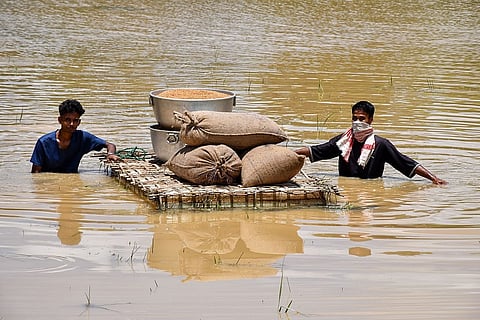
shown how powerful nature can be and how vulnerable people become due to unsustainable development. The flood, along with fast-moving mud and soil, caused serious damage to human and animal life, as well as heavy loss of livelihoods. This calls for an urgent rethink of how disaster risk finance is managed and channelled in order to find a lasting solution to such natural disasters.
Disaster finance is a system that uses saved-up funds, insurance, and government budgets to pay for damage caused by natural disasters like floods, earthquakes, and droughts. It helps people and countries recover quickly, instead of waiting for slow donations after a disaster happens. This system works through three main tools: first, risk retention, where governments use their savings and emergency budgets to handle smaller or regular disasters; second, risk transfer, where financial risk is shared with outside parties through insurance, insurance pools, or special loans and bonds; and third, anticipatory action, where money is released early-based on weather forecasts-before a disaster strikes, to protect homes and farms in advance. Disaster finance in India is mainly guided by the Disaster Management Act, 2005, and the recommendations of the Finance Commission. Over time, this system has changed from simply giving relief after a disaster to actively working on reducing risk and building resilience before disasters strike. There are two main types of funds: response funds and mitigation funds. The State Disaster Response Fund (SDRF) and National Disaster Response Fund (NDRF) provide money to states and the country for responding to disasters like floods, cyclones, earthquakes, and heatwaves. States get funding in a 75:25 ratio, while special category states, including those in the Northeast, get a more generous 90:10 ratio. The National Disaster Mitigation Fund (NDMF) and State Disaster Mitigation Fund (SDMF) focus on reducing future risks, such as building stronger infrastructure and early warning systems. Furthermore, the 16th Finance Commission, covering 2026 to 2031, has recommended a large total fund of Rs 204,401 crore for states, split so that 80% goes to response and 20% goes to mitigation. The national-level fund is set at Rs 79,406 crore, with 75% for response and up to 25% for mitigation. The Commission has also added heatwaves and lightning to the official list of disasters and expanded the Disaster Risk Index to cover ten types of hazards.
Risk is now measured using a new formula that multiplies hazard, exposure, and vulnerability together, replacing the older method of simply adding these factors. A practical way to manage flood finance in Assam is to introduce a flood cess-an extra tax added to existing tax infrastructure that is strictly set aside for a specific public purpose. Under Article 270 of the Constitution, money collected from a cess goes into the Consolidated Fund of India but does not have to be shared with other states, ensuring the government spends it exclusively on its designated goal rather than general expenses. A real-world example of this is the Kerala Flood Cess, a temporary 1% local tax launched in 2019 to rebuild after severe flooding. Similarly, an Assam Flood Cess could serve as a valuable legal tool to secure funding, lower risks, and build long-term disaster resilience and permanent infrastructure before floods hit. An Assam Flood Cess would create a dedicated pool of money that cannot be used for anything else, allowing the state to prepare for floods before they happen rather than just reacting after the event. This steady funding could directly pay for high-tech early warning systems-like real-time AI-driven satellite tracking, river sensors, and instant phone alerts-so vulnerable communities get timely warnings to evacuate safely. Additionally, it would ensure reliable funding to strengthen riverbanks, build raised storm shelters, and keep local rescue teams well equipped without waiting for emergency financial aid from the central government.
In flood-prone Assam, flood insurance will act as a critical financial safety net that protects households' assets, local business owners, and agricultural communities from the devastating losses caused by the annual overflowing of the Brahmaputra and its tributary river systems. Standard property insurance policies usually exclude flood damage, leaving victims entirely reliant on limited government post-disaster relief; however, dedicated flood insurance shall cover structural repairs to homes and shops, compensates for damaged personal belongings and commercial inventory, and safeguards farmers against loss of crops and livestock through schemes like the Pradhan Mantri Fasal Bima Yojana. Modern practical solutions make this protection easier by automatically giving out agreed payments as soon as certain environmental limits-like specific river heights or rainfall amounts measured by satellites-are exceeded, removing the need for long damage assessments and ensuring that affected families get quick cash to rebuild without falling into high-interest debt. Assam's location makes it naturally prone to severe disasters. It is surrounded by the Himalayan foothills, where soft, unstable soil easily causes massive soil erosion and landslides during rains. Additionally, being in Seismic Zone 5 puts the region at a very high risk for intense earthquakes. To tackle these serious risks, Assam needs a disaster management strategy built on long-term sustainable development and solid scientific research. Because effective risk reduction requires continuous, reliable money, the state must set up a permanent legal funding framework-combining dedicated government mitigation funds with accessible flood insurance-to ensure financial support is always ready when disaster strikes.
(The writer can be reached at madhurjyatu15@gmail.com.)
