
- Home
- Live Blog
- Breaking News
- Top Headlines
- Cities
- NE News
- Sentinel Media
- Sports
- Education
- Jobs
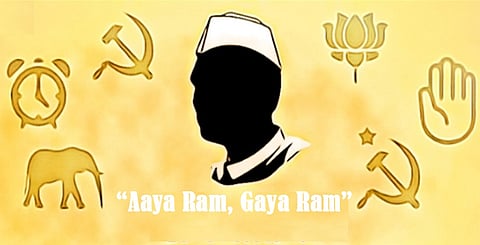
Way back in 1967, an MLA in Haryana by the name of Gaya Lal created a record of sorts when he switched party allegiances three times within a single fortnight. This led to the coining of the phrase “Aaya Ram, Gaya Ram” (Ram has come, Ram has gone) to describe political turncoats in India. His actions triggered significant political instability, leading to the imposition of President’s rule. Political pundits say that Gaya Lal not only hit headlines and caused unprecedented political drama but also prompted the government to ultimately bring in the anti-defection law in 1985. Gaya Lal was a dedicated defector – he continued switching parties throughout his career, including joining the Janata Party in 1977, before his passing away in 2009. The tragedy with Indian politics is that the anti-defection law has been reduced to a joke over the years. The staunch defender of secularism from the morning becomes the champion of a new, saffron-hued, “development-focused” ideological front by teatime. The public, naive fools that they are, might call it a “betrayal”, but the politician knows better. It is definitely not defection; it is a “strategic, democratic pivot”. When confronted by the omnipresent media, the turncoat does not blush or shy away. In some cases, he engages one of his trusted aides not only to call the media but also to ensure that he gets enough time in the bulletins throughout the day. He looks into the cameras with profound solemnity and says, “I left because of a lack of inner-party democracy.” He talks about his “conscience”. It is truly heartwarming how active the consciences of politicians become only when the party which they had so badly criticized in the morning offers them a ticket in the afternoon. And what of the voters, the gana-devata? They merely observe this magnificent, high-stakes game. They vote for a symbol, but they get a representative who treats that symbol like a rental car, driving it until the lease is up before switching to a faster model. “Aaya Ram, Gaya Ram” isn’t a phenomenon; it has become a lifestyle. It ensures that no matter who loses the election, the same, tireless individuals always seem to win the power. After all, why stick to one party when you can have a “season pass” to all of them?
