
- Home
- Live Blog
- Breaking News
- Top Headlines
- Cities
- NE News
- Sentinel Media
- Sports
- Education
- Jobs
Dipak Kurmi
(The writer can be reached at dipakkurmiglpltd@gmail.com.)
The dramatic killing of Ali Khamenei, reportedly confirmed by both Iranian state media and Donald Trump, marks one of the most consequential turning points in the history of the Islamic Republic. Coming within hours of coordinated US and Israeli airstrikes on Iranian territory, the development has pushed an already volatile Middle East into uncharted territory. For a regime built around the central authority of the Supreme Leader, the sudden removal of the man who has dominated Iran’s political and strategic direction for decades creates profound uncertainty. The implications extend far beyond Tehran, raising urgent questions about regional stability, global energy flows, and the safety of millions of expatriates, including a vast Indian diaspora.
To understand the magnitude of the moment, it is necessary to recall the centrality of the Supreme Leader’s office in Iran’s political architecture. The Islamic Republic itself was founded in 1979 by Ruhollah Khomeini following the Iranian Revolution that toppled the Pahlavi monarchy. Khamenei, who first served as president and then succeeded Khomeini as Supreme Leader in 1989, has been at or near the apex of Iranian power for roughly 45 of the Republic’s 47 years. Under his stewardship, Iran evolved into a resilient regional power and an entrenched adversary of both the United States and Israel. His tenure saw the steady expansion of indigenous military capabilities, the consolidation of the Islamic Revolutionary Guard Corps as a parallel power centre, and the entrenchment of a security-heavy internal order that repeatedly crushed dissent.
Externally, Khamenei’s Iran mastered the art of asymmetric deterrence. Through missile development, proxy networks, and strategic depth across the Levant and Gulf, Tehran positioned itself as a formidable actor despite technological gaps compared to Western militaries. Internally, however, the regime’s resilience came at a cost. Years of US-led sanctions inflicted severe economic pain on ordinary Iranians, fuelling waves of protest. The unrest that erupted in December 2025 and January this year — described as among the largest since the revolution — exposed deep social fissures. The regime responded with characteristic force, reportedly killing thousands. Against this backdrop, the reaction to Khamenei’s death has been sharply divided, with social media showing scenes of celebration in cities such as Isfahan, Tehran and Shiraz even as state television broadcast images of mourning crowds.
The immediate question confronting Iran is succession. Although the killing of the Supreme Leader and other senior figures represents an unprecedented shock, the Iranian system has long anticipated this moment. The constitutional mechanism is clear: the 88-member Assembly of Experts will select a new Supreme Leader. Until then, a temporary council that includes the president has been tasked with overseeing the transition. This institutional preparedness suggests that the regime’s first instinct will be continuity rather than rupture. Tehran’s clerical establishment understands that any perception of a power vacuum could invite both domestic unrest and external pressure.
Speculation about potential successors has intensified since the death of former president Ebrahim Raisi in a helicopter crash in May 2024 removed the most widely discussed heir apparent. Names circulating within Iranian policy circles include clerics closely aligned with Khamenei: Hojjat-ol-Eslam Mohsen Qomi, Ayatollah Mohsen Araki, Ayatollah Gholam Hossein Mohseni Ejei, and Ayatollah Hashem Hosseini Bushehri. All are considered loyalists shaped by the existing system, suggesting that ideological continuity remains the default trajectory. Another figure occasionally mentioned is Hassan Khomeini, the founder’s grandson, whose symbolic lineage carries weight in revolutionary legitimacy debates. Yet none of these figures possesses Khamenei’s combination of political longevity, institutional control and strategic authority, making the transition inherently delicate.
Alongside clerical succession, a second scenario looms: a more overt consolidation of power by the security establishment. The Revolutionary Guard and the Basij paramilitary have long functioned as the regime’s coercive backbone, especially during episodes of domestic unrest. The death of senior commanders, including Maj. Gen. Mohammad Pakpour and veteran adviser Ali Shamkhani, complicates the picture but does not eliminate the Guard’s central role. Some analysts see Ali Larijani, a seasoned insider with deep ties to the security apparatus, as a potential bridge figure if the system leans toward a more security-centric leadership model. Such an evolution would formalise trends visible since the Iran-Iraq War, where military influence steadily expanded within Iran’s hybrid political order.
The third, and most uncertain, possibility is systemic rupture or regime change—an outcome openly encouraged by President Trump, who has urged Iranians to “seize control of your destiny.” Yet history offers sobering lessons about the difficulty of externally induced regime transformation. Airpower, even when precise, rarely translates into political collapse without sustained ground dynamics. Iran’s layered security state, extensive intelligence networks, and mobilised paramilitary forces present formidable obstacles to any rapid popular overthrow. Moreover, the opposition within Iran remains fragmented, lacking the unified organisational structure that would be necessary to challenge the state’s coercive machinery.
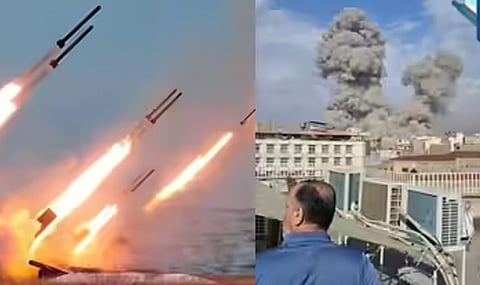
Meanwhile, the regional security environment is deteriorating rapidly. Tehran has already launched retaliatory strikes against US-linked facilities across the Gulf, targeting bases in Qatar, Bahrain, the United Arab Emirates, Kuwait, Saudi Arabia and Jordan. These actions signal a calibrated strategy: impose costs without immediately crossing thresholds that would trigger overwhelming retaliation. The widening theatre has injected fresh anxiety into Gulf capitals, prompting unusual diplomatic choreography. Reports of coordination between Mohammed bin Salman and Mohamed bin Zayed underscore how quickly regional rivalries can be reshaped by shared security fears.
Perhaps Tehran’s most potent lever is not military but economic. The reported closure of the Strait of Hormuz — a narrow chokepoint through which roughly one-fifth of global oil shipments pass — has already rattled energy markets. Even the threat of prolonged disruption could send oil and gas prices sharply higher, with cascading effects across the global economy. For Washington, the prospect of having to deploy naval assets to reopen the strait introduces the risk of maritime escalation. For energy-dependent economies, the stakes are even higher.
India sits squarely in this zone of vulnerability. Nearly nine million Indians live and work across the Gulf and wider Middle East, forming the backbone of remittance flows to several Indian states. Estimates indicate that roughly 38 per cent of India’s total remittances originate from this region. Any prolonged instability — whether through missile exchanges, airspace closures or economic disruption — directly threatens both the livelihoods of expatriate workers and the financial stability of households back home. New Delhi’s diplomatic calculus must therefore balance strategic caution with proactive contingency planning.
Energy security presents an equally pressing concern. Approximately 60 per cent of India’s energy imports originate in the Gulf region, including about half of its crude oil and a large majority of its LNG supplies. With India already constrained in its ability to purchase discounted Russian oil amid tariff pressures from Washington, a sustained Middle Eastern conflict could tighten supply options at precisely the wrong moment. Price volatility, shipping disruptions, or insurance spikes in Gulf waters would reverberate through India’s inflation, fiscal planning, and growth trajectory.
Beyond immediate economics, the geopolitical map confronting New Delhi is becoming more complex. India has historically maintained working relationships across rival camps in West Asia, cultivating ties with Iran, Israel, the Gulf monarchies and the United States simultaneously. The sudden removal of Khamenei and the possible emergence of a new power configuration in Tehran will require careful recalibration. Whether Iran moves toward clerical continuity, security-state consolidation or political fragmentation, each pathway will demand a different diplomatic response from India.
The broader international system is also entering a period of heightened strain. Europe remains preoccupied with its own prolonged conflict environment, while the Afghanistan-Pakistan theatre continues to generate instability. A full-scale Middle Eastern war layered atop these crises would stretch global crisis-management capacity. Countries hosting large expatriate populations — particularly the UAE, Qatar and Bahrain — face the additional burden of protecting millions of foreign workers even as they navigate their own security dilemmas.
In the final analysis, the killing of Ali Khamenei may prove less decisive than its architects hope. Iran’s political system was deliberately engineered for resilience, with overlapping institutions designed to absorb shocks. The coming weeks will reveal whether that architecture holds under extreme pressure. What is already clear, however, is that the conflict has entered a far more dangerous phase. The real test ahead is not merely who succeeds the Ayatollah, but whether regional and global powers can prevent escalation from hardening into a prolonged, system-shaking war whose consequences would extend far beyond the Middle East.
