
- Home
- Live Blog
- Breaking News
- Top Headlines
- Cities
- NE News
- Sentinel Media
- Sports
- Education
- Jobs
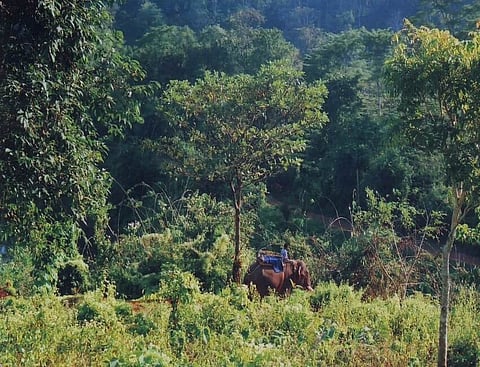
A news-item that has caught the attention of tax-payers of the North-eastern region’s largest city in the past few days says a section of unscrupulous officials in the Assam government has been working overtime at the behest of a powerful lobby to change the very map of the Amchang Wildlife Sanctuary in order to provide legal sanction to hundreds of encroachers who have literally pushed to the brink this rich biodiversity hotspot adjoining Guwahati. While the 78.64 sq km Amchang Wildlife Sanctuary has been under tremendous pressure of encroachers, what was seen as a ray of hope was a Gauhati High Court order – based on reports submitted to the Court by a city-based environment protection group called Early Birds – asking the authorities to remove the encroachers and save it from extinction. But then, while the government has found out ways to delay the eviction process – an attitude that only smacks of an attempt to provide protection to the encroachers at the cost of the wildlife sanctuary already under threat, probably with an eye on a few hundred votes because the Lok Sabha election is round the corner.
Law-abiding citizens of Guwahati have been witness to how similar unscrupulous government officers had, in the not-so-distant past, helped encroachers regularize and legalize land belonging to the wetlands and hills in and around the city. This time round, while the BJP-led government had initially taken steps to remove encroachment from the city’s hills, it has gradually started showing tendencies of taking a more dangerous stand than did its predecessor, the Congress government.
While encroachment in Amchang Wildlife Sanctuary is one example of how we have collectively contributed towards wiping out a rich biodiversity hotspot, the authorities – that includes the state government, the forest department, GMC and GMDA – are all also collectively responsible for the destruction of most of the eight beautiful hills that form part of the Guwahati landscape. Encroachment on all the hills as well as the wetlands – which should ideally have been protected and conserved – have already contributed to flash floods and water-logging in Guwahati, making India’s “Gateway to South-east Asia” one of the most unlivable cities in the country. It was only a couple of weeks ago that the Union Ministry of Housing and Urban Affairs had released the latest list of cities of India in the descending order in terms of ease of living, where Guwahati ranked very low, at 85 out of 111 taken into consideration.
Encroachment in Amchang Wildlife Sanctuary and the Khanapara Reserved Forest, coupled with massive deforestation and indiscriminate earth-cutting in the other adjoining hills in the Khanapara-Panjabari-Amchang-Jorabat-Sonapur axis has already proved what is in the future; Jorabat, Khanapara and Panjabari have experienced a series of flash floods in the current monsoon season. There is no denying the fact that the 18 once-beautiful hills in Guwahati city are now all bursting with population – most of them encroachers, and a sizeable section of them probably people of doubtful nationality. While the 2001 Census had put the number of people living in Guwahati’s 18 hills at about 1.23 lakh – which incidentally was the total population of the city in 1971 (just before the capital shifted from Shillong to Dispur) – the same must have gone up manifold in the past one and a half decade, this contributing to rapid destruction of ecology and environment of the city.
Why should the majority population of the city, all of whom are tax-payers, suffer just because of these encroachers? Why shouldn’t the government protect Amchang Wildlife Sanctuary, Deepor Beel, the several reserved forests, and the 18 hills of the city? Why should encroachers, law-breakers, illegal migrants and criminal elements get priority over providing basic amenities to the tax-payers, protecting the wetlands, environment and ecology and taking positive steps to tackle climate change? Why should a government elected by the aw-abiding citizens relent to the lure of a few votes and ignore the interests of the larger section of voters?
While the matter related to protection of Amchang Wildlife Sanctuary is currently before the Gauhati High Court, all tax-payers, law-abiding citizens, people who are concerned about the environment and ecology, people who are worried about climate change and rising temperature – all are naturally looking towards the hon’ble court for saving Guwahati. At this juncture, it is definitely a cause of worry that a section of unscrupulous officers in the state government have been reportedly trying to redraw the map of Amchang as part of a conspiracy to provide legal settlement to the encroachers in the homeland of herds of wild elephants and a whole variety of wildlife. Law-abiding citizens are also looking eagerly towards the High Court as the last resort to protect the entire environmental landscape of this premier city, after successive governments have only played into the hands of the encroachers. The government must not forget that Amchang – and for that matter Deepor Beel, Silsako Beel, Borsola Beel, Sarusola Beel and Bondajan and all other wetlands, the 18 hills within the city – does not belong only to Assam. They all belong to humanity, and once Amchang is lost, once Deepor Beel is lost, no government, however powerful it may be, will be able to restore it and give it back to this earth, our only planet.