
- Home
- Live Blog
- Breaking News
- Top Headlines
- Cities
- NE News
- Sentinel Media
- Sports
- Education
- Jobs
Siba K. Gogoi
(The writer is a journalist. He can be reached at sibagogoi@gmail.com)
Assam is at the crossroads, and thereby hangs a tale. Assam is hardly your pride and joy, especially when your Assamese credentials, even if you are a native, come under unprecedented scrutiny. The Assamese national identity has been well and truly challenged, and what has made this identity narrative more intriguing is the question of indigeneity.
Who is a genuine, or rather indigenous Assamese? One could go on intellectualizing about this for ages. Why is it that we have been made to face a unique identity test on our own homeland? Is it we, or for that matter the protagonists of the anti-foreigner movement, who have brought it upon ourselves? Will the authorities question the Marathas, the Bengalis, or the Nagas as to who they are originally or whether they are indigenous to the states they live in? Certainly not, for they don’t have an Assam Accord.
The reincarnation of the Citizenship Act (1955), now (un)popularly known as CAA 2019, means that the Assam Accord (1985) is almost dead and buried. Probably, the Assam Accord had a miscarriage on 15 August 1985, which should have been diagnosed on 25 March 1971 itself. Now, with the disease of 31 December 2014 afflicting one and all, we have to make do with Clause 6, thinking that we can still achieve what we couldn’t achieve during the past 34 years.
The garb of beautiful words that Clause 6 is presented in is enough to keep us hoping against hope. Clause 6 of the Assam Accord says “Constitutional, legislative and administrative safeguards, as may be appropriate, shall be provided to protect, preserve and promote the cultural, social, linguistic identity and heritage of the Assamese people”. There is no doubt at all that we need “constitutional, legislative and administrative safeguards”, but do they come the way we want? Our ‘safeguards’ are always conditioned by ‘as-may-be-appropriate’ considerations, and that is precisely the name of the game. One wonders if the leaders of the much-glorified Assam movement made concessions and compromises.
Only the powers that be know how long it will take to decide how ‘appropriate’ our ‘safeguards’ should be. Where have the history-makers of the early 1980s gone? Assam has no dearth of leaders who swear by the names of Lachit Borphukan, Lokpriya Gopinath Bordoloi, or Hem Baruah. They would have done well if at least they, without going too far, had tried to learn some lessons about protection of land rights from our neighbours, such as Meghalaya, Nagaland, or Arunachal Pradesh. We always talk about our linguistic identity being under threat, but the saddest part of it is that Assamese has not yet been fully established as the official language of the State under the Assam Official Language Act, 1960.
We have been told by the Central government that our ‘safeguards’ are subject to an appropriate definition of ‘indigenous Assamese’; and that is what has let us twitch in the wind, considering the fact that the term ‘indigenous’ is curiously absent in the Assam Accord.
The issue of indigenous Assamese has inevitably generated lots of disputations across the sociopolitical spectrum in the State. A sizable section of the Assamese people think that the definition of indigenous Assamese can be based on the National Register of Citizens (NRC) 1951, but it can still be problematic because nearly 40 per cent of the people of Assam will not have the means to trace their origins to 1951 in that the records of the first citizenship register have been either lost or damaged in several districts in the state. However, indigeneity is a thorny enough issue to be decided by citizenship alone. It will be interesting to see how the high-level committee, formed by the government, on Clause 6 of the Assam Accord attempts to resolve the issue.
If I am an Assamese I know I have been legitimately living in Assam for a reasonable period of time, speak Assamese, have adopted Assamese culture and have, in the process, integrated well into the larger edifice of Assamese ethos. If I am an indigenous Assamese I lay claim to it by nativity, by ethnicity, by multi-generational pride, and, of course, by what goes into the making of an Assamese in the broader sense of the term.
Assam is a land of ethnic, linguistic, religious, and cultural diversities; and that’s what has brought the Assamese national identity into question. The idea of who is an Assamese has connotations of homogeneity that explain why it should be implicitly inclusive. However, the idea of indigenous Assamese, founded on the premise of exclusivity, is a tricky proposition with the potential to open a Pandora’s box. The finer points of the issue need to be factored in for an honourable consensus.
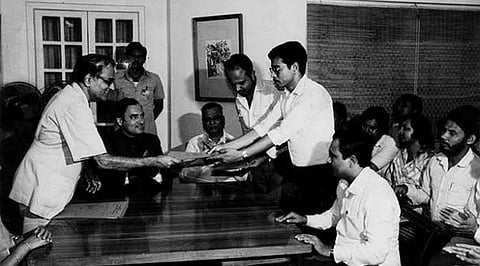
We have come a long way since the time the Assam Accord was signed between leaders of the Assam movement (1979-1985) and representatives of the governments of India and Assam, on 15 August 1985, to be precise. One of the key terms of the agreement was identification and deportation of Bangladeshi immigrants who had illegally entered Assam after 25 March 1971. The issue has, since then, been an unending game of whataboutism for governments of all hues, both in the State and at the Centre. The parties, especially the Congress, the BJP, and the AGP, have been using the foreigner issue of Assam to further their politics of convenience and appeasement. It’s not hard to understand why the Assam Accord implementation department of the State government has been such a hot arena for political shadow-boxers.
Ironically, the AGP, which was born out of the AASU that had steered the anti-foreigner agitation, did precious little in this regard despite ruling the State for two terms. Had the AGP, led by Mr Prafulla Kumar Mahanta, earnestly gone about implementing the Assam Accord straightaway after assuming power at Dispur for the first time, in December 1985, the issue wouldn’t have taken on such disastrous proportions as it has today. It would have been relatively easier for the AGP government to deal with the foreigners that might have entered Assam without authorization over a period of, say, 15 years. Of course, a young and inexperienced government, led by someone hailed as the youngest chief minister of the State, did tell us subtly that the purple is too hot to handle, that politics is, after all, a different ball game.
The AGP had another opportunity to redeem itself when it returned to power (1996-2001), but this time also the party preferred to drag its feet over the matter. It’s not unforgettable that the AGP had its representatives in the Central governments headed by Mr V.P. Singh, Mr H.D. Deve Gowda, and Mr I.K. Gujral. More interestingly, notification of the contentious CAA 2019 has come at a time when the AGP shares power with the BJP, now headed by Mr Atul Bora, in Assam under Mr Sarbananda Sonowal, who was also a mascot of Assamese nationalism not too long ago.
The NRC of Assam, which was recently revised, that too under the supervision of the Supreme Court, with 25 March 1971 as the cut-off date, has been almost rendered invalid with the coming of the C(A)A 2019. The new citizenship law provides for the granting of citizenship to even those immigrants who had entered Assam by 31 December 2014. This has put a big question mark over the Assamese brand of nationalism that should have otherwise, and by now, given legitimacy to the Assam Accord and an updated NRC of Assam. The so-called Assamese nationalists would have a lot to answer for, even if the Supreme Court strikes down the CAA 2019.
Today, most of the flag-bearers of the six-year-long Assam movement, who used to grandstand about being regionalists, are champions of disparate political camps, the BJP or the Congress in particular. The people of Assam that had given their heart and soul to the movement against illegal immigrants feel that they have been backstabbed by their own heroes. This is, of course, not the first time that political opportunism and spurious nationalist campaign have defiled the sociopolitical landscape in Assam.
The time is ripe for us to revisit our past by reflecting on and dissecting why we have long been short-changed by Delhi, why we have been betrayed again and again by our own leaders, and how we can rescue ourselves from this quagmire of lies and hypocrisies.
This is an ideal time to find out who is playing whose game; and, probably, it’s the best time we made a transition from as-may-be-appropriate to we-can-make-it-happen nationalists.