
- Home
- Live Blog
- Breaking News
- Top Headlines
- Cities
- NE News
- Sentinel Media
- Sports
- Education
- Jobs
Arup Saikia
(arupsaikia07@gmail.com)
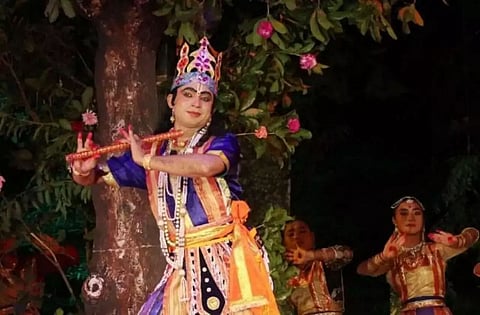
Assam is the land of multi-ethnic, multi-racial, and multi-lingual people, who have been inhabiting this land from time immemorial and sustaining different identities. All ethnic groups enriching Assamese culture transformed Assam into like a piece of multicolor, symmetrical mosaic while the whole people of the Northeast were sleeping. Tantricism of Buddhism and Hinduism (a kind of sorcery) gained control over religion, and even human sacrifices were done in temples. Sankerdeva emerged as a heavenly soul in mediaeval India for social reformation. To purify society, Sankerdeva used various means, including a prominently dramatic presentation, namely Ankiya Naat.
The Vaishnavite preacher and epoch-making artist St. Sankerdev is the father of Assamese drama. Although it was written for social reformation, it contributed highly to Assamese literature as a golden dome. To teach illiterate people through audio-visuals is the best medium, as he thought to cultivate the Bhakti (devotion) movement through Ankiya Bhaona, or drama. At the age of nineteen, Sankerdeva staged Chihnayatra (a drama of symbol or drawing) in Tembuwani, near Borduwa. This drama of drawing not only heralded a new chapter of future Assamese drama but also became a frontrunner in the history of India and world theatre for its precious treasure and uniqueness.
The word ‘Ankiya can’t be described precisely. Ankiya is itself a pronoun. In Sanskrit drama, anka denotes a symbol. But it’s not known why later, gradually, it became a synonym for drama or naat. Even two great saints, Sankerdeva and Madhavdeva, haven’t used the term anka in their drama. Moreover, the term ‘Bhaona’, an Assamese traditional drama, hadn’t been used during the lifetimes of Sankerdeva and Madhavdeva. Ankiya Naat, being the first drama of Assam Sankerdeva, got ingredients or an idea to write. The theme of Ankiya was mostly from the Bhagawat Puran. But for dramatic presentation, he utilised his artistic skill by imitating traditional Assamese, Indian folk shows, and Sanskrit drama.
Sankerdeva was much influenced by the traditional Assamese folk culture prevalent in Assam since the first century. These partially theatre-like folk cultures were obviously part of the pan-Indian pre-theatrical movement. Popularly available musical plays before Sankerdeva in Assam:
KUSHAN GAAN: A Ramayan-based folk drama originated in the erstwhile Koch Kingdom, traversing North Bengal, West Assam, and the undivided Rangpur district of Bangladesh.
BHARI GAN: This is also one kind of musical drama narrating episodes from the Ramayana and Mahabharata with some dramatic presentation, practised by the Patirabhas of the Rabha community in Kamrup and Goalpara districts.
Palagan: Palagan is a living performing art form of Assam, found in West Bengal and Orissa as well.
OJAPALI: It’s one of the oldest art forms of Assam, found in Kamata and Darrangi Kingdoms, which king Dharmanayarana once patronised. The show was led by one person called Oza and joined by a few others called Pali. Remarkably, the continuous playing of the cymbal by Pali became the quintessential orchestra in Ankiya Naat. Ozapali, which traces its lineage to the Kathakata tradition of West Bengal, has much in common with Ankiya Naat.
PUPPET DANCE: Known as Putala Nach in Assam, it has a presence in the whole Indian subcontinent. Puppet dance may not have contributed much to the growth of Indian or Assamese drama, but the string holder of puppet dance, it is said, added imagination to Sanskrit playwrights and helped Sankerdeva invent the character of Sutradhara. The literal meaning of Sutradhara is string holder.
DHULIYA/KHULIYA BHAONA: These are the kinds of folk entertainments popular in Darrang and Kamrup districts. The theme is taken from Epic. In a sombre mood, a group sings a story of epic proportions in narrative style, and characters wearing wooden masks dance with arobatic manoeuvres to the beat of drums and cymbals, devoid of any dialogue.
In all the above-mentioned shows that existed before Ankiya Naat maintained sequence during performances like Ankiya, i.e., orchestra, prastavana (preamble), prorochona (persuasion), mangalcharan (praise of deity), pala (main story), acting, dancing, song, comedy, etc. Starting from Purbaranga to Muktimangalam, all the above-mentioned dramatic phases were maintained by Sankerdeva. This is for the influence of local folk-type theatre. Dhemali or Purbaranga performed in Ankiya has much in common with the Dhuliya performance of Darrang, including the legs and body movements of Gayan and Bayan.
On the other hand, in Sanskrit drama, a little different kind of Purbaranga is also available, like Pratyahara (withdrawal, bringing of musical instruments), Avatarana (placing of singers), Arambha (beginning of the rehearsal), Asravana (tuning of instruments), and the recitation of benediction by Sutradhara. The presentation of Sutradhara is based on the structure of Sanskrit drama or folk drama; it’s not confirmed. But it’s worthwhile to mention that Sutradhara doesn’t remain on stage from beginning to end in Sanskrit drama, unlike in Ankiya, where Sutradhara appears during the whole episode. Therefore, the sutradhara of Ankiya is similar to that of ozapali, or puppet dance.
Influence OF Sankriti Drama: Prior to Sankerdeva, no written drama was available in Assam. So it’s natural for all playwrights in India other than Sanskrit to get influenced by existing Sanskrit drama. Ankiya Naat, which begins with Nandi Sloka (verse), is originally the product of Sanskrit drama. Sankerdeva uses two nandi slokas in his drama. Moreover, for prastavana (preamble), prorochona (persuasion), and Muktimangalam bhatima (panegyric), Ankiya Naat is indebted to Sanskrit drama.
Influence OF Contemporary Indian Drama: Notwithstanding more indigenous influence being evident in Ankiya, the influence of contemporary Indian drama can’t be overlooked. More and less, the yakshagana of Karnataka, Kathakali of Kerela, Bhagwat Mela of Tanjore, Bhavai of Gujarat, and Ramleela of North India are prominently conspicuous. During his two pilgrimages, Sankerdeva closely came into contact with Indian scholars.
GLIMPSE OF ANKIYA NAAT: Only six written dramas are found of Sankerdeva, excluding Chihnayatra for its unwritten form. These are Patni Prasad, Kaliya Daman, Keligopal, Rukmini Horon, Parijat Horon, and Ram Vijay. It’s disputed whether Patni Prasad or Kaliya Daman is the first drama written during his stay in upper Assam, and the rest are in Kamrup and Cochbihar. Some scholars hypothesised Parijat Horon to be his second drama. Finally, Ram Vijay is his last drama.
Analysis of the Ankiya drama:
Patni Prasad (offering of wife): Maybe being the first drama, Patni Prasad has only one Nandi verse, without a second verse (opis), and even Muktimangalam Bhatima (a panegyric to the Lord) is also not available.
KALIYA DAMAN (Submission of Serpent Kali): This is another important drama story taken from Bhagawat, Haribansha, and Bishnupuran. No imaginary character has been created. The main theme of Bhagawat is kept intact, maintaining his fundamental genre.
3. KELIGOPAL (the playful lord): It’s actually Rasleela, one of his prominent dance dramas. The scene of the monster Sankhasur was additionally added for dramatic perfection. Full of dance and song, no other Sankerdeva drama has focused so much on Sringar Raas (erotic flavour).
PARIJAT HORON (abduction of parijat flower): Most importantly, the greatest and unique creation of Sankerdeva is parijat horon. Upon returning from his second pilgrimage, Sankerdeva wrote this one. In regard to dialogue and characterization, dramatist Sankerdeva had overcome all limitations for the greater acceptability of all characters during dramaturgy. There are three main male and female characters: Lord Krishna, Narad, and Indra, and Satyabhama, Rukmini, and Sachi, respectively. The main story of Parijat Horon has been altered to adjust the dramatic sequence. In terms of literary value, beauty of composition and terrestrial taste contributed to adding extra flavour for the audience and readers. Not only of Sankerdeva, but also one of the valuable treasures of Assamese literature.
RUKMINI HORON (Abduction of Princess Rukmini): It’s the longest drama. Although the theme is taken from the Bhagawat Puran, Sankerdeva moulded the drama in his own way. A well-crafted reflection of characters is a matter of attraction. Lord Krishna plays the central character as the pious, yearning suitor of princess Rukmini. On the other hand, Rukmini is shown as a lady of patience with a presence of mind and a devoted fiancee. The imaginary characters of Madanmanjuri and Lilawati as friends of Rukmini earn applause from the audience. Notwithstanding Bedanidhi’s being a simple messenger, he shows selfless fatherly affection to the would-be couple.
RAM VIJAY (Victory of Lord Rama): The last drama of Sankerdeva is Ram Vijay or Sita Sayambar (the marriage of Sita). Unlike other dramas, this story is taken from the Ramayan and ascribes the ideal of Bhagawat to Lord Rama.
Finally, all Ankiya dramas are song-based. If the dramatic part is removed, only song can carry forward the story of drama with the expression of all upheavals and emotions. Ankiya Naat, or the dramas of Sankerdeva, showers a flow of devotion, light, knowledge, and entertainment on the people of Assam for eternity. Ankiya Naat taught Assamese to elevate life morally to worship the beauty of the Almighty.
