
- Home
- Live Blog
- Breaking News
- Top Headlines
- Cities
- NE News
- Sentinel Media
- Sports
- Education
- Jobs
Dipak Kurmi
(The writer is a journalist and commentator based in Guwahati, and can be reached at dipaknewslive@gmail.com)
The BJP led government in Assam, under the leadership of Himanta Biswa Sarma, is preparing to make the upcoming Bihu celebration on April 14th a grand spectacle. They are conducting a large-scale publicity campaign in the national capital, as well as in Kolkata and Mumbai, to promote the event that will take place in Guwahati.
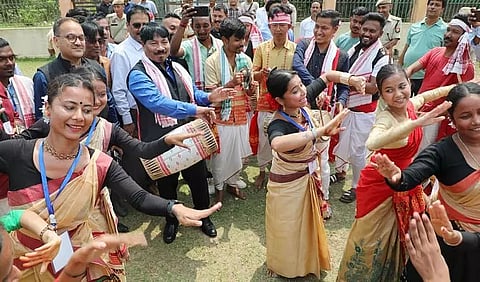
The state government is putting in maximum effort to ensure that the Bihu event becomes an exceptional show with the participation of over 11,000 Bihu dancers and drummers. The government is also aiming to set a Guinness World Record for the largest recital of this traditional folk dance form.
The event at Sarusajai Indoor Stadium in Guwahati will be graced by Prime Minister Narendra Modi. Invitations are sent to Governors, Chief Ministers, Union Ministers, diplomats from G20 and ASEAN countries, and other dignitaries to attend the upcoming event.
Chief Minister Dr. Himanta Biswa Sarma is closely monitoring all the preparations for the upcoming event to ensure its success. According to a senior State Government official who is aware of the development, the Chief Minister is paying close attention to even the smallest details to ensure that the Bihu celebration, which is the lifeline of Assamese culture, gains global recognition.
Chief Minister Sarma took to Twitter to announce that preparations are underway for the upcoming event on April 14th, where over 11,000 Bihu dancers will perform together at Sarusajai Stadium in the august presence of Honorable Prime Minister Narendra Modi. He reviewed the arrangements at the venue and urged officials to make the event a truly memorable one.
Several master trainers have been trained to teach the intricate details of the Bihu dance form to numerous dancers who have been recruited from every district across the state.
The Chief Minister himself was present at the Sarusajai Sports Complex, which is the venue for the biggest Bihu event, during the training of master trainers. He expressed his happiness at being present at the stadium and mentioned that the training for the grand Bihu event is currently taking place. Assam is ready to create a world record with the participation of 11,000 dancers in the event, which will be graced by the honorable Prime Minister Narendra Modi on April 14th.
The government has sent a sample video of the Bihu dance, featuring a limited number of dancers, to the Guinness World Records, which has given its initial approval. According to another official, if everything goes according to plan, this will be the largest Bihu dance performance at a single venue, with the duration of only 15 minutes.
Each participant will receive an allowance of Rs. 10,500 from which they will purchase two pairs of costumes. Hoardings have been installed in the waiting sheds of bus stops in prominent areas of the national capital to invite everyone to join the biggest Bihu festival and to create history together. Even on the yellow and blue lines of Delhi Metro, all coaches have been decorated with Bihu hoardings. Hoardings are visible on the major roads leading to the Indira Gandhi International Airport. The government has launched a massive publicity campaign in Mumbai and Kolkata, including metro trains, in addition to Delhi-NCR.
Following the conclusion of the year-long 400th birth anniversary celebrations of Ahom General Lachit Barphukan in November last year, the upcoming event is set to take place shortly.
Every year on April 14-15, the Assamese, as well as those in parts of Manipur and Bengal, celebrate Rongali or Bohag Bihu, which heralds the Assamese New Year. The Assamese people celebrate Bihu thrice a year, each representing a distinct cycle of farming: Bhogali/Magh Bihu in January, Bohag/Rongali Bihu in April, and Kongali Bihu in October.
The springtime folk festival is known for its vibrant colors and is linked to agricultural prosperity, seasonal changes, and the rearing of livestock. It is also closely tied to the way of life in agrarian societies.
In addition to being a vibrant and cheerful festival, Bihu is also a reflection of the traditional value of showing respect to elders. During the festival, the younger generation expresses their respect by offering bihuwan or gamucha, a colorful cloth with hand-woven motifs, and touching the feet of their elders.
The Bihu songs, seemingly innocuous, are a treasure trove of Assamese oral literature. Typically consisting of quatrains, the first two lines of these songs often focus on nature, while the latter two lines explore themes such as love, courtship, springtime flowers, birds, daily life and activities, and people’s experiences of their environment, culture, and history.
While the origin of Bihu songs and dances is unclear, it was recognized as a form of performing art by the Ahom king, Rudra Singha. He invited Bihu dancers to perform in the open field of Asia’s largest amphitheater, the Rang Ghar, located in Upper Assam’s Sivasagar district. The Ahom dynasty’s reign in Assam, which lasted for 600 years, witnessed the highest level of support and promotion for Bihu songs and dances. As a result of the Ahom’s patronage, Bihu has become an inseparable part of the Assamese society.
On the day of Bihu, various Assamese delicacies such as tilor pitha, narikolor laddoo, murir laddoo, ghila pitha, and poka mithoi are prepared. Women, men, and children sing and dance joyfully to the beat of traditional drums (dhol), cymbals (taal), buffalo horn instruments (pepa), bamboo instruments (gagana), flutes (baahi), and more. People also exchange gifts, wear new clothes, and perform the traditional Bihu dance on open fields and stages while feasting on the delicious food.
The handwoven gamucha is an essential part of the Bihu festival. Even Mahatma Gandhi, during his visit to Assam in January 1946, praised Assamese women weavers for their skill in “weaving fairy tales on their looms.” It is customary to greet any visitor to Assam with a gamucha as a symbol of welcome.
The Assam Government has initiated a special campaign to curb the sale of traditional clothing items of the state such as gamucha, mekhela sador, and aronai, which are produced using power looms.
The state has witnessed adverse impacts on local artisans and weavers due to the availability and sale of machine-made traditional garments, primarily sourced from outside the state.
The Chief Minister of Assam, Himanta Biswa Sarma, has stated that the ban on machine-made traditional garments is part of a larger effort to raise awareness about the state’s traditional weaving industry and to discourage the sale and purchase of such products. In the past, efforts have been made to prevent the sale of power loom-manufactured traditional items, and now the CM has instructed District Commissioners and Superintendents of Police to intensify the campaign against the sale of such items. Additionally, the CM has urged textile merchants’ associations not to procure such items from outside the state, as they will be seized upon arrival.
The complete efforts of the BJP Government led by Himanta Biswa Sarma to promote Bihu on the global stage are truly praiseworthy.
