
- Home
- Live Blog
- Breaking News
- Top Headlines
- Cities
- NE News
- Sentinel Media
- Sports
- Education
- Jobs
Siddharth Roy (siddharth001.roy@gmail.com)
The author argues that Assam’s elephant crisis requires ecological planning, not reactive response. He highlights habitat fragmentation, the need to secure elephant corridors and integrating conservation into development.
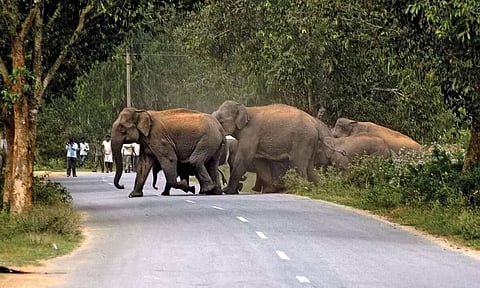
Every time a herd of wild elephants enters a village in Assam, the immediate response is predictable. Forest officials scramble to drive the animals back, frightened residents try to protect their homes and crops, and news reports describe yet another episode of “human-elephant conflict”. Such incidents are increasingly viewed as isolated crises requiring rapid intervention. In reality, they are manifestations of a deeper ecological imbalance that has been unfolding over decades. The conflict is not simply between humans and elephants; it is between development that fragments landscapes and conservation that struggles to keep pace.
Assam is home to one of India’s largest populations of the endangered Asian elephant (Elephas maximus), a species classified as Endangered by the International Union for Conservation of Nature (IUCN). India supports nearly 60% of the world’s remaining wild Asian elephants, and the forests of the Northeast constitute one of their most significant strongholds. These elephants are not confined to protected areas. They move across vast landscapes following traditional migratory routes that have evolved over centuries, connecting forests, grasslands and riverine ecosystems. Their movement is essential for maintaining ecological balance, dispersing seeds, regenerating forests and sustaining biodiversity.
The growing frequency of encounters between elephants and humans reflects the steady erosion of these ecological pathways. Assam’s forests have undergone profound changes owing to expanding agriculture, tea plantations, highways, railway lines, mining, urbanisation and other infrastructure projects. While these developments have contributed to economic growth, they have also fragmented habitats into isolated patches. Elephant corridors that once enabled seasonal migration have been narrowed, blocked or degraded, forcing herds to move through villages and cultivated fields in search of food and water.
This is not merely a conservation concern but a governance challenge. Wildlife cannot be managed in isolation from land-use planning. Infrastructure decisions that ignore ecological connectivity inevitably transfer costs to both people and wildlife. When railway tracks cut through elephant habitats without adequate mitigation measures or highways dissect migration routes without wildlife crossings, conflict becomes an expected consequence rather than an unfortunate accident.
The ecological significance of elephants often receives less attention than the damage associated with their movement. As one of nature’s foremost ecosystem engineers, elephants shape the landscapes they inhabit. By dispersing seeds across long distances, opening dense vegetation, creating water holes and maintaining forest diversity, they support countless other species. The health of tropical forests is closely linked to the survival of large herbivores such as elephants. Their decline would have cascading consequences that extend far beyond the loss of a single species.
Climate change has added another layer of complexity. Erratic rainfall, prolonged dry spells and recurring floods increasingly influence the availability of food and water within forests. Assam’s annual floods, while ecologically important, often displace wildlife, including elephants, from protected areas into nearby human settlements. Simultaneously, changing vegetation patterns and habitat degradation reduce natural forage, compelling herds to seek highly nutritious crops such as paddy, maize and sugarcane. What appears to be crop raiding is often an adaptive response to shrinking ecological resources.
The consequences are severe for both communities and wildlife. Farmers lose crops that represent months of labour and household income. Damage to homes, granaries and livelihoods deepens rural distress, while tragic encounters claim human lives every year. Elephants, too, face growing threats. Electrocution from illegal fencing, train collisions, poisoning, retaliatory killings and accidental injuries continue to account for significant mortality. Poaching remains an additional concern. Although ivory trafficking has declined compared to previous decades, illegal hunting for tusks and, increasingly, for meat continues to threaten elephant populations in parts of the Northeast. Organised wildlife crime networks exploit weak enforcement, porous international borders and persistent demand, underscoring the need for stronger intelligence-led conservation.
The response to these challenges cannot rely solely on reactive measures such as driving elephants back into forests. Such interventions may offer temporary relief but fail to address the underlying causes. The long-term solution lies in restoring ecological connectivity. India has identified more than one hundred elephant corridors, several of them located in the Northeast. Yet many remain without adequate legal protection. Securing these corridors through land acquisition, voluntary relocation where appropriate, conservation agreements and careful regulation of infrastructure development must become a national priority.
Equally important is the integration of conservation into development planning. Environmental impact assessments should evaluate not only the immediate footprint of projects but also their implications for wildlife movement over decades. Where roads and railway lines intersect elephant habitats, scientifically designed overpasses, underpasses and sensor-based warning systems should become standard practice rather than exceptional measures. Experience from countries such as Kenya and Botswana demonstrates that development and wildlife conservation can coexist when ecological planning informs infrastructure design from the outset.
Technology also offers new opportunities. GPS collars, satellite tracking, artificial intelligence-based monitoring, thermal drones and mobile phone alert systems can provide communities with advance warning of elephant movement. Assam has already begun experimenting with some of these tools, but their deployment remains uneven. Technology, however, is only as effective as the institutions and communities that use it. Strengthening local response teams, improving coordination among forest departments, district administrations and village committees, and ensuring timely dissemination of information are equally critical.
The human dimension of conservation deserves far greater attention. Communities living near forests often bear disproportionate costs while contributing significantly to wildlife protection. Compensation for crop losses, property damage and human casualties frequently suffers from procedural delays and inadequate valuation. A more transparent and time-bound compensation mechanism would not only reduce hardship but also strengthen public support for conservation initiatives. Equally valuable is involving local communities in habitat restoration, monitoring and eco-tourism programmes that generate sustainable livelihoods alongside conservation outcomes.
One such example of grassroots commitment can be found in Assam itself. Dr Shatabdee Roy, Medical Officer at G.B. Primary Health Centre in Kukurmara, Chaygaon, has often witnessed how environmental disruptions influence public health in rural communities. While her primary responsibility is healthcare, her engagement with local populations illustrates the interconnectedness of ecological stability and human well-being. Communities facing recurring encounters with wildlife also experience psychological stress, economic insecurity and disruptions to daily life, reminding policymakers that conservation and development cannot be pursued in isolation.
Ultimately, Assam’s elephant crisis is neither an inevitable consequence of population growth nor an unavoidable conflict between humans and wildlife. It is the outcome of policy choices that have undervalued ecological connectivity in the pursuit of development. Reversing this trajectory will require viewing forests not as isolated protected islands but as living landscapes linked by functional corridors. Conservation must move beyond protecting species to protecting the ecological processes that sustain them.
India has demonstrated through initiatives such as Project Tiger that determined political commitment, scientific management and community participation can transform conservation outcomes. A similarly ambitious vision is now required for elephants. The future of Assam’s forests, biodiversity and rural communities will depend not on how effectively elephants are chased away from villages but on whether the landscapes they have inhabited for millennia are restored to ecological health. Protecting elephant habitats is therefore not simply a conservation imperative; it is an investment in environmental security, climate resilience and sustainable development itself.
