
- Home
- Live Blog
- Breaking News
- Top Headlines
- Cities
- NE News
- Sentinel Media
- Sports
- Education
- Jobs
Dipak Kurmi
(The writer can be reached at dipakkurmiglpltd@gmail.com.)
The sharp rise in fatalities of both humans and elephants in Assam has turned human-elephant conflict into one of the gravest ecological and governance challenges facing the state. This crisis is not merely an outcome of sporadic encounters between people and wildlife but the cumulative result of decades of fragmented planning, relentless expansion of linear infrastructure and a failure to align development priorities with ecological realities. Assam today carries nearly fifty-six per cent of the Asian elephant population found in the northeast, a statistic that by itself conveys the magnitude of responsibility resting on the state. Yet this very concentration of elephants has become a source of escalating conflict as habitats shrink, corridors fracture and elephants are pushed into revenue areas, agricultural fields and human settlements.
The conflict cannot be understood through numbers alone. While official data records lives lost, houses destroyed and crops ravaged, it fails to fully capture the irreversible biodiversity loss unfolding quietly across the landscape. Elephants are long-ranging animals whose survival depends on unhindered movement across large, connected habitats. In Assam, however, nearly eighteen and a half per cent of the elephant population now lives outside designated elephant reserves, a direct reflection of habitat degradation and fragmentation. Corridors that once allowed seasonal migration between forests are increasingly blocked by railway lines, highways, expanding settlements and other infrastructure. As climate change intensifies pressure on ecosystems, the erosion of these natural pathways also weakens the region's resilience against floods, heat stress and erratic rainfall.
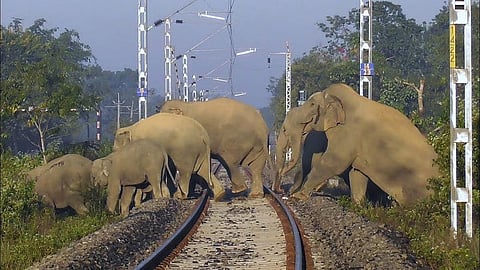
Nowhere is this crisis more starkly illustrated than in the tragic incident that unfolded in the fog-laden early hours of a Saturday in Sangjurai village, in Assam's Hojai district. A herd of around one hundred and fifty elephants was moving through paddy fields and habitations when eight were struck by the Mizoram-Delhi Rajdhani Express. Seven elephants, including five calves, died instantly, while the lone survivor succumbed to injuries the next day despite veterinary intervention. Dense fog severely compromised visibility, and although the locomotive pilot applied emergency brakes, the collision derailed the engine and the first five coaches, stranding the train for nearly four hours. As has become customary after such incidents, blame was exchanged between the Forest Department and the Railways, while the deeper structural causes remained largely unaddressed.
Sangjurai is not officially notified as an elephant corridor, yet local communities insist that elephant movement through the area is routine, particularly between November and February when herds leave forested zones in search of paddy and sugarcane. This tragedy exposes a fundamental disconnect between official classifications and ecological realities on the ground. Assam's Chief Wildlife Warden, Dr Vinay Gupta, has acknowledged that several elephant corridors in the state are already recognised, with trains required to slow down to twenty kilometres per hour and movements monitored through technological systems. At the same time, he has argued that it is impractical to declare every railway stretch in Assam an elephant corridor. In the Sangjurai case, he pointed out that the railway track runs elevated through paddy fields, leaving elephants little time or space to escape once on the track. Promises of future brainstorming sessions between railway and forest officials, however, offer scant comfort in the face of repeated fatalities.
Accounts from local forest officials further complicate the picture. The Range Forest Officer of Kampur Division has stated that the collision site lies barely three-fourths of a kilometre from a recognised potential crossing point near pillar number one hundred and twenty-five. While AI-enabled intrusion detection systems have been installed on some vulnerable stretches in Assam, the nearest such system to Sangjurai is located thirty-two kilometres away, between Hawaipur and Limdung on the route connecting central Assam to the Barak Valley and Mizoram. Villagers argue that had a similar system been installed at Sangjurai, the tragedy might have been avoided. Their repeated warnings to authorities about elephant movement along this route, they claim, were ignored.
The Sangjurai incident is part of a grim and persistent pattern. Since the 2019-20 period, at least ninety-four elephants have been killed in train collisions in Assam alone. Comparable, and in some cases even more severe, situations exist elsewhere, notably in the Jalpaiguri belt of West Bengal, where elephants remain acutely vulnerable to railway accidents. A comprehensive national assessment titled Suggested Measures to Mitigate Elephant and Other Wildlife Train Collisions on Vulnerable Railway Stretches in India has identified one hundred and twenty-seven vulnerable stretches covering more than three thousand four hundred and fifty kilometres. Of these, seventy-seven stretches across fourteen states have been prioritised for mitigation. That accidents continue unabated despite such detailed studies points to alarming gaps in implementation, monitoring and coordination.
The Project Elephant Division of the Ministry of Environment, Forest and Climate Change, in collaboration with the Wildlife Institute of India, has already outlined a suite of mitigation measures for Assam. These include installing Distributed Acoustic Sensing-based intrusion detection systems on sensitive railway stretches, erecting clear signboards to alert locomotive pilots of wildlife crossing zones, scheduling goods trains during periods of minimal wildlife activity, clearing vegetation up to thirty metres on either side of tracks to improve visibility, and ensuring joint patrolling and real-time information sharing between railway and forest staff. Additional recommendations focus on insulating electric infrastructure to prevent electrocution, conducting regular sensitisation workshops for railway personnel, and constructing barriers on wildlife-friendly ramps to discourage human use while allowing elephants to pass. With more than one hundred railway stretches cutting through elephant reserves and adjoining areas in Assam, the consistent implementation and regular review of these measures is not optional but imperative.
Yet technological fixes alone cannot resolve a crisis rooted in landscape-level fragmentation. The relentless expansion of linear infrastructure remains the single most disruptive force in elephant habitats across India. Roads, railways and canals slice through forests and migration routes, often justified in the language of economic growth and connectivity. In Assam, large tracts of forest have been fragmented not only by infrastructure but also by agricultural expansion and historical episodes of deforestation, including damage inflicted during periods of political unrest such as the Bodo agitation. Across the northeast, shifting cultivation continues to disturb large landscapes, ensuring that even regenerated forests remain in a constant state of flux. What survives as relatively intact habitat is often confined to hilltops, leaving elephants with limited and disconnected spaces.
The implementation of the Forest Rights Act of 2006 has further complicated the situation. While the Act was designed to correct historical injustices faced by forest-dwelling communities, its misuse in several regions has led to widespread encroachment beyond the stipulated cut-off date of December 13, 2005. Large areas of forest have been cleared and burnt under questionable claims, accelerating deforestation and habitat loss. More than two decades after the cut-off, such practices continue, making the Act, in practice, one of the significant drivers of forest loss in post-Independence India, with profound consequences for wildlife.
Experiences from other parts of the country underline how institutional priorities often tilt against ecological concerns. Railway projects through forests in Jharkhand and Odisha, initially rejected due to environmental risks, were later approved, resulting in sharp increases in elephant fatalities and human-wildlife conflict. Elsewhere, projects such as the Hubballi-Ankola railway line in Karnataka's Uttara Kannada district and the Sharavathi pump storage project in the Western Ghats continue to resurface despite repeated rejections, threatening biodiverse landscapes and local livelihoods alike.
The pragmatic path forward lies in integrating conservation into development planning rather than treating it as an afterthought. New roads and railway lines in elephant landscapes must incorporate adequately spaced underpasses and overpasses, while existing lines require retrofitting with modern detection systems, strict speed regulation and real-time coordination. Protecting crops through solar-powered fences, bio-fences and prompt compensation to affected farmers is essential to secure local cooperation, a provision already supported under schemes such as Integrated Development of Wildlife Habitats, Project Tiger and Project Elephant. The costs of such measures are marginal when weighed against the irreversible loss of wildlife and biodiversity.
Ultimately, the deaths of elephants on railway tracks are not isolated accidents but stark symptoms of a deeper failure to reconcile development with ecological responsibility. Forests and wildlife are integral to climate regulation, capable of absorbing a significant share of human-generated greenhouse gas emissions. As the global transition away from fossil fuels falters, destroying these natural buffers for short-term gains is a perilous gamble. Unless Assam, and India at large, urgently restore balance between progress and preservation, the tracks of development will continue to bear witness to avoidable tragedy, written in the silent loss of some of the planet's most magnificent beings.
