
- Home
- Live Blog
- Breaking News
- Top Headlines
- Cities
- NE News
- Sentinel Media
- Sports
- Education
- Jobs
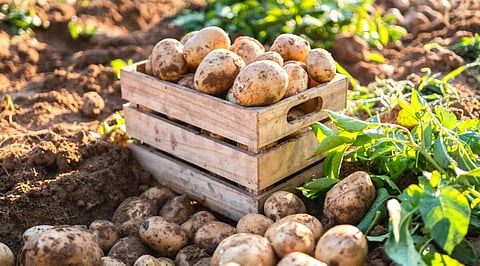
Consumer packaged food multinational giants operationalising buy-back contracts with potato growers in Assam tell a new story: that potato is no longer just a seasonal crop in the state but a key entry point for the modernisation of its value chain. Yet, dependence on other major potato-growing states to meet the annual demand exposes the retail consumers of the state to price volatility at the source and increases in transportation costs driven by increases in fuel costs. It remains a striking paradox that Assam's own potato production meets less than one-fourth of what the state consumes despite steady expansion of area under the crop to over one lakh hectares. Increasing productivity is essential to boost production, as the state's potato productivity is persistently lower than the national average. Existing potato growers will be keen to invest in better seeds only when they are assured of a remunerative price. Buy-back guarantees assure a predicted market, but they often fail to address the issues of sudden rises in input costs, labour costs, irrigation costs and other unforeseen costs. The farmers, especially those with small land holdings getting a remunerative price, are critical to strengthening their negotiating power. Assured markets and remunerative prices influence a farmer's investment decision for both the expansion of area under a particular crop and procuring good-quality seeds for a bumper harvest. As potato is a highly perishable crop, cold storage is not optional, but it is the structural anchor of the modern value chain from farm to market. Preventing post-harvest losses through long-time storage and the timing of potato releases from cold storage are key determinants of market prices. Ironically, even though rental charges for cold storage for potatoes are affordable to growers, the non-availability of cold storage near their farms increases transportation costs, which erodes profitability. The state currently has 49 cold storages with a total capacity of 2.45 lakh MT, but as these are mostly concentrated in certain pockets, it becomes difficult for the majority of potato growers to utilise those. A pragmatic solution to this problem is establishing more cold storage with funding support from the Agriculture Infrastructure Fund (AIF) scheme. This fund has a provision of a collateral-free term loan up to Rs 2 crore and an interest subvention of 3% for the creation of post-harvest infrastructure, including the establishment of cold storage. The central government has so far sanctioned 12 cold storages for Assam under the AIF scheme. Protecting farmers growing perishable fruits and vegetables from distress sales is pivotal to creating a positive mindset among them for adopting modern farming practices, new seed varieties and improved technologies. During winter, when the production of vegetables exceeds the market demand, the farmers have little scope for negotiating the farm-gate prices with traders and selling the perishable produce at lower prices. Establishing food processing units closer to farm gates in potato-growing clusters can increase the demand for potatoes, reduce post-harvest losses and protect the remunerative prices. Another central government intervention to prevent distress sales is the implementation of the Market Intervention Scheme for the procurement of perishable agricultural and horticultural produce. As northeastern states are required to bear 25% of the procurement cost (50% for other states) for implementing the scheme, the state government can leverage the scheme to prevent distress selling of potatoes during the winter season. The states also have an option, under the Price Differential Payment (PDP) component of the Market Intervention Scheme (MIS) from the 2024-25 season, to choose either physical procurement of perishable commodities or to make direct payment of the price difference between the Market Intervention Price (MIP) and the selling price. Use of digital technology has now made it possible to ascertain authentic claims, establish identities through Aadhar linking, and directly benefit transfer to accounts of genuine farmers; direct payment of the price difference to potato growers can go a long way in motivating them for transformative changes in farming practice and marketing strategies. The state government can urge the central government to implement localised reimbursement of storage and transportation costs under the MIS for farmers in producer states, allowing them to transfer their excess harvested potatoes to consuming states during isolated gluts, such as the one witnessed in Sadiya, where potato growers dumped their produce on the road in protest after prices crashed. Boosting the production of agricultural and horticultural commodities plays a crucial role in augmenting the income of farm households and generating livelihood opportunities, as agriculture is the backbone of Assam's rural economy. Expanding the area under potatoes and increasing productivity, therefore, must remain central to bridging the demand-supply gap and moderating the retail price. Unlocking the optimal potential of potato production within the state hinges on local potato growers getting convenient access to cold-storage facilities to prevent wholesale traders from stockpiling potatoes procured from other states to manipulate market prices and compel local growers to sell their produce instantly.
