
- Home
- Live Blog
- Breaking News
- Top Headlines
- Cities
- NE News
- Sentinel Media
- Sports
- Education
- Jobs
Mita Nath Bora
(mitanathbora7@gmail.com)
For decades after Independence, Northeast India lived with a quiet paradox. It was geographically integral to the nation, yet emotionally distant from the Centre. Policies arrived late, recognition arrived rarely, and understanding arrived least of all. When unrest broke out, it was often met with force; when peace returned, it was fragile. Into this complex landscape stepped Atal Bihari Vajpayee, a leader who did something rare in Indian politics: he listened before he acted and felt before he ruled.
Vajpayee’s engagement with the Northeast was not transactional. It was shaped by a deeper conviction: that India cannot be strong unless its frontiers feel secure, respected, and honoured. His approach combined three strands that rarely come together: development with dignity, security with restraint, and national integration through cultural recognition. Together, they reshaped how New Delhi looked at the Northeast and how the Northeast began to look back at India.
Seeing the Northeast Not as a problem, but as a partner
Long before Vajpayee became Prime Minister, he had already begun thinking about Assam and the Northeast in a way few national leaders did. In 1981, when the Assam agitation was at its peak, Vajpayee wrote a slim but powerful book: “Assam Problem: Repression Is No Solution.” At a time when the dominant instinct of the state was to clamp down harder, Vajpayee argued that political problems rooted in identity and history cannot be solved through force alone.
This was not an abstract idea. It reflected his broader philosophy that democracy must be persuasive, not punitive. When he later came to power, this belief would guide his policies across the Northeast. When Vajpayee assumed office, the Northeast suffered from a crippling sense of isolation. Roads were poor, bridges were few, and connectivity, physical and psychological, was weak. Vajpayee understood that development is not just about infrastructure; it is about belonging.
One of his most important interventions was strengthening the Ministry of Development of North Eastern Region (DoNER). For the first time, the Northeast was treated not as an afterthought to national planning but as a region requiring focused institutional attention. This shift mattered. It ensured continuity, funding, and accountability, three things the region had long lacked.
Projects that took shape during or because of his tenure carried both economic and strategic weight. The Bogibeel Bridge, whose foundation stone was laid during Vajpayee’s prime ministership, was envisioned as more than a bridge. It was a statement that Upper Assam and Arunachal Pradesh would no longer remain cut off during emergencies, floods, or security threats. The Numaligarh Refinery anchored industrial growth in Assam, while the Naranarayan Bridge strengthened internal connectivity.
These were not isolated projects. They were part of a larger vision to pull the Northeast into the national economic bloodstream without erasing its distinct identity.
Security, China, and the
Question of Strength
To understand Vajpayee’s impact on the North-East, one must also understand his views on national security, particularly in relation to China. The Northeast is not merely a cultural region; it is a strategic frontier, sharing long and sensitive borders.
In 1964, when China conducted its first nuclear test, just two years after attacking India, most Indian leaders hesitated, uncertain how to respond. Vajpayee, then a Rajya Sabha MP, did not. He rose in Parliament and declared with chilling clarity:
“The answer to an atom bomb is an atom bomb.”
This was not bravado. It was foresight. Vajpayee understood that peace without deterrence is an invitation to aggression, a lesson painfully learnt in 1962. For regions like Arunachal Pradesh and the eastern Himalayas, this insight would prove crucial.
That clarity culminated decades later in May 1998, when Prime Minister Vajpayee authorised the Pokhran-II nuclear tests. With a single decision, India ended decades of strategic ambiguity. Sanctions followed, criticism poured in, but Vajpayee stood firm. He wrote to world leaders calmly, explaining that India sought peace but would never compromise on its security.
For the Northeast, this decision had deep implications. A nuclear-capable, confident India meant reduced vulnerability to coercion along the China border, greater willingness to invest in border infrastructure, and space for political dialogue instead of perpetual militarisation. External Affairs Minister Dr S. Jaishankar would later describe this decision as Vajpayee’s “most enduring contribution”. It was a contribution that quietly strengthened India’s frontier regions.
Peace through Dialogue,
Not the Gun Alone
Vajpayee rejected the idea that insurgency could be crushed into submission. His government initiated dialogue-based peace processes, most notably the 1997 ceasefire with the NSCN (IM), bringing the Naga issue to the negotiating table after decades of bloodshed.
This approach flowed from Vajpayee’s belief in insaniyat, humanity in governance. The aim was not just to silence guns but to restore democratic space. Over time, this shift allowed civil society, education, and development to take root in areas once dominated by fear.
Cultural Recognition:
Healing through Honour
Perhaps Vajpayee’s most subtle yet profound contribution to the Northeast lay in the realm of cultural recognition. He understood that neglect is not only economic; it is also symbolic.
During his tenure, there was a conscious effort to ensure that achievers from Assam and other Northeastern states received Padma awards across fields, including literature, music, social service, education, and public life. These honours did more than reward individuals; they validated entire cultures that had long felt invisible.
Vajpayee believed that national integration is incomplete unless people see their heroes reflected in the nation’s honours. This ethos extended naturally to the Bharat Ratna, India’s highest civilian award. While very few personalities from the Northeast have received it, Vajpayee’s tenure helped build the moral and cultural climate in which such recognition became possible.
His admiration for Dr Bhupen Hazarika, the bard of the Brahmaputra who united regions through music, was well known. Hazarika’s receipt of the Padma Vibhushan during Vajpayee’s era, and later the posthumous Bharat Ratna, symbolised a long-overdue national acknowledgement of North-Eastern civilizational contribution.
For Vajpayee, awards were not ceremonial. They were instruments of national memory.
A Poet’s Touch in Statecraft
What set Vajpayee apart from most leaders was his poetic sensibility. India’s only poet Prime Minister, he brought empathy into governance. His verses spoke of resilience, doubt, duty, and hope, emotions deeply familiar to the people of the Northeast.
He once wrote: “Ho kuch bhi, magar haar nahi maanoonga.” (Whatever happens, I will not accept defeat.)
That line could well describe his relationship with the region, a refusal to accept that geography or history should condemn any part of India to perpetual marginality.
A Relationship Built
on Trust, Not Control
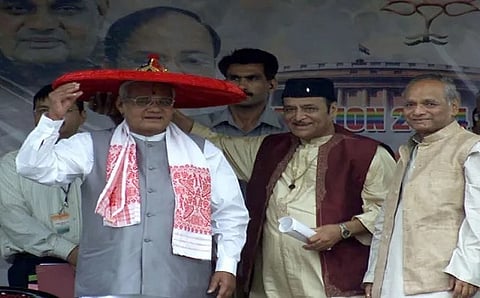
Atal Bihari Vajpayee did not try to dominate the Northeast; he tried to understand it. He strengthened it through roads and bridges, protected it through strategic resolve, healed it through dialogue, and honoured it through recognition.
In doing so, he transformed the Centre–Northeast relationship from one of suspicion to one of partnership. His legacy in the region lives not only in infrastructure or policy but in something far more enduring: trust. That is why Vajpayee is remembered in the Northeast not merely as a prime minister, but as a statesman who saw India whole.
