
- Home
- Live Blog
- Breaking News
- Top Headlines
- Cities
- NE News
- Sentinel Media
- Sports
- Education
- Jobs
Udayan Hazarika
(The writer can be reached at udayanhazarika@hotmail.com)
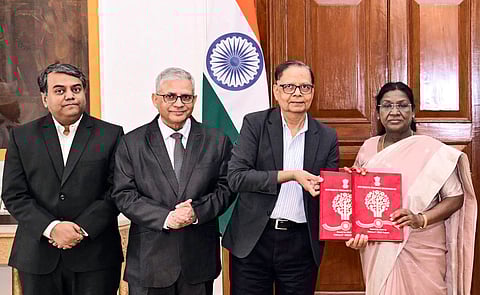
The Sixteenth Finance Commission (SFC, 2026-2031) presented their final report in November last year, containing recommendations and guidelines for both Centre and State for maintaining fiscal discipline. The centre, after a thorough check, has recently accepted the recommendations as disclosed by the Union Finance Minister on the day of presenting her Budget 2026-27.
As per the terms of reference, the first task of the Commission is to identify the size of the divisible pool of resources (vertical sharing) out of the net tax revenue of the Union which is shareable with the states. While setting up this pool, the Commission needs to examine carefully how big the size of the excluded items, such as surcharge, cess, etc., is and how the volume of these items is growing over time, which finally exclusively remains with the Union government. Government data shows that the surcharge and cess have been growing at a rapid rate for the last five years, and the finance commission should have a look at this stock with the Union Government while determining the divisible pool. Unfortunately, the SFC, who was in a better position to take this into account, remained neutral towards this, and the divisible pool was just set up at the same rate, keeping aside advantages accrued to the Union from the collection of surcharges, cess, collection charges, etc. The last Finance Commission (15th FC or FFC) had fixed the divisible pool at 41 percent of the net central taxes. There were hints from the Government of India that this should not be enhanced further. On the other hand, the non-BJP states have been pressuring Mr Panagariya to enhance the pool from the present 41 per cent to 50 per cent. But the 16th FC preferred to follow the guidelines of the Government of India, and a reading of their report clearly shows that it has tilted towards the Central expectations.
For the horizontal fixation of the share of each state, the SFC has rearranged the criteria adopted by the FFC. It has replaced the tax effort criterion with the contribution to GDP criterion. As a result, the states with high GSDP are coming to the forefront, and those with low GSDP are taking a backseat. It also changed the weightage of four criteria, namely, income criteria or the ‘GSDP distance’ from 45 per percent to 42.5 per percent; ‘population’ from 15 per percent to 17.5 per percent; ‘demographic performance’ from 12.5 per percent to 10 per cent; and ‘area’ from 15 per cent to 10 per cent. Then a new criterion, ‘contribution to GDP of India’, has been added, replacing the ‘tax and fiscal effort’ with a weightage of 10 per cent. Depending on these criteria, the Commission has calculated the proportion that a state is entitled to of the divisible pool. The highest proportion goes to Uttar Pradesh with 17.62%, followed by Bihar with 9.95%, Madhya Pradesh at 7.35%, West Bengal at 7.22%, Maharashtra at 6.44%, Assam at 3.26%, etc.
The government proposes to transfer an amount of Rs 15.26 lakh crore from the divisible pool of resources to the States in the year 2026-27. Of this amount, the highest amount will go to UP with Rs 2.69 lakh crore, followed by Bihar with Rs 1.52 lakh crore, MP with Rs 1.12 lakh crore, West Bengal with Rs 1.10 lakh crore, Maharashtra with Rs 98274 crore, Assam with Rs 49748 crore, etc.
The SFC has recommended discontinuation of three grants usually provided to the States by the previous FCs under the head of 1) revenue deficit grants, 2) sector-specific grants and 3) state-specific grants. The 15th FC had allocated an amount of Rs 2.9 lakh crore under deficit grant to 17 states which could not make up their budgetary gaps created due to revenue deficits. Similarly, under sector-specific grants, the FFC had allocated an amount of Rs 1.3 lakh crore for the development of health, school education, higher education, agricultural reforms, judiciary, statistics, etc. Another developmental grant recommended by the FFC was the state-specific grant to be allocated for the development of areas such as social needs, administrative governance and infrastructure, water and sanitation, etc., covering an amount of Rs 49,599 crore. The states getting the benefits of these three grants will be deprived of these funds during the SFC period due to their discontinuation.
The other grants, like local body grants and disaster management grants, are to continue as before with slight changes here and there. In respect of the local body grants, the Commission has imposed several strict conditions to be fulfilled by both the government and local bodies before releasing the specified share recommended for this purpose. The SFC has divided the local body grants into three parts – 80 per cent of the grants are named as basic grants, and 50 per cent of this basic grant is untied, while the remaining 50 per cent is tied to spending on sanitation and solid waste management and water management. The remaining 20 per cent are performance grants. The release of ten per cent of the total is related to the performance of the state government, while the remaining ten per cent is subject to the performance of the local governments. The Commission recommended an amount of Rs 4,35,236 crore for rural local bodies, of which Rs 3,48,188 crore is for basic grant and Rs 43,524 crore each for performance grant. Similarly, Rs 2,90,157 crore is the basic grant in respect of urban local bodies, of which Rs 29,016 crore is the performance grant for urban local bodies and the government. As usual, the highest amount, Rs 83,262 crore, will go to Uttar Pradesh, followed by Rs 32,819 crore to Maharashtra, which is even less than half of the amount of UP. The government has budgeted a lump-sum amount of Rs 55,909 crore as a basic grant for rural local bodies and Rs 37,272 crore for urban local bodies. The fund for the other two components of ULBs, viz., the special infrastructure and the urbanisation premium, has also been accommodated in the budget as Rs 6,000 crore and Rs 2,000 crore, respectively, for the coming year.
The Commission accepted the principle of allocation of funds for disaster management grants so far followed and allocated an amount of Rs 2,04,401 crore for this purpose. 80 per cent of this fund (Rs 163,521 crore) has been earmarked for the State Disaster Response Fund (SDRF), and the remaining Rs 40,880 crore is for the State Disaster Mitigation Fund (SDMF). Of the total fund, 25 per cent is the state’s contribution (10 per cent in respect of NE states). Thus, the total central fund comes to Rs 155,916 crore for the whole five-year period. The highest amount is allocated against Maharashtra with Rs 29,619 crore, followed by UP with Rs 15,321 crore, Bihar with Rs 13,615 crore and Rs 5,243 crore for Assam. The government has budgeted the full amount, as allocated by the Commission for SDRF and SDMF for 2026-27, i.e., Rs 28216 crore.
