
- Home
- Live Blog
- Breaking News
- Top Headlines
- Cities
- NE News
- Sentinel Media
- Sports
- Education
- Jobs
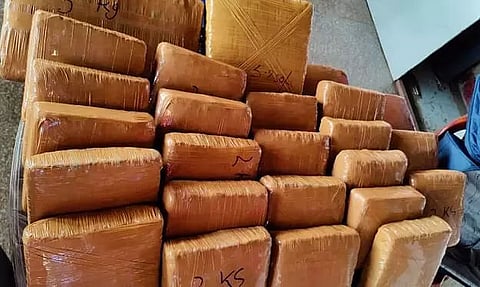
The seizure of a huge consignment of illicit drugs and narcotics in the northeast region tells both about the success of law-enforcement agencies in destroying the supply network and the magnitude of the menace in the region. Drug syndicates exploiting bank accounts and postal addresses of some traffickers of Myanmar and drug smugglers from the region colluding with Nigerian drug smugglers are the new modus operandi that worries the central and state governments. Drug consumption in the region is a serious problem, and effective implementation of the National Action Plan for Drug Demand Reduction (NAPDDR) is crucial to reduce the demand for illicit drugs and narcotics substances to supplement collaborative efforts by central and state governments to destroy the supply network. Across the country, cases registered in connection with drug seizure and smuggling have increased by 152% to 3172 over the past eight years from 2014 from 1257 cases registered between 2006 and 2013. This speaks volumes about the determined efforts. Till the first week of October, the number of arrests increased to 4888 registering an increase of 260% over 1362 arrests during 2006-2013 which is indicative of a huge network operating in the country. Drugs worth Rs 20000 crore have been seized over the past eight years which marked an increase of 25 times over the seizure of drugs worth Rs 768 crore which points towards the expanding market size of illicit drugs in India and is a prime destination for drug smugglers and syndicates. Constitution Anti-Narcotics Task Force by north-eastern states as a single nodal point for all issues related to narcotics, the Narcotics Control Bureau (NCB) setting up a regional office in Guwahati and sharing satellite imageries of illegal cultivation of cannabis and poppy in the region are some of the synergized initiatives for curbing drug menace in northeast region that has led to more seizure of drugs and destruction of the supply network. Union Home Minister Amit Shah, while chairing a meeting with Chief Ministers, Chief Secretaries and Director Generals of Police of all North-eastern States on 'Drug Trafficking and National Security in Guwahati last month emphasized appropriate measures to check the flow of money through detailed investigation of the financial resources of drug trafficking and coordination among the bank authorities. He described drug trafficking as "a borderless crime" and called for better coordination not only among all drug law enforcement and intelligence agencies but among all the border area districts in the region to tackle it effectively. He called for going beyond catching the 'faces' like drug abusers and distributors involved in any seizure and trying to nab the masterminds who send drugs from outside the border to India and demolishing the spread of drug networks in the country which outlines the drug-free northeast mission. The Ministry of Home Affairs has adopted the three-pronged formula of strengthening the institutional structure, empowerment and coordination of all narco-agencies and a comprehensive awareness campaign to tackle narcotics which brings NAPDDR for drug demand reduction into the focus of anti-drug initiatives by the central and state governments. The Ministry of Social Justice and Empowerment has been providing financial assistance to altogether 535 projects across the country under NAPDDR. The scheme with a total outlay of Rs 200 crore for the entire country focuses on preventive education, awareness generation, identification, counselling, treatment and rehabilitation of individuals with substance dependence, training and capacity building of the service providers through collaborative efforts of the central and state governments and Non-Governmental Organization. Other key objectives of NAPDDR include creating awareness and educating people about the ill effects of substance dependence on the individual, family, workplace and society at large, reducing stigmatization of and discrimination against groups and individuals dependent on substances to integrate them back into society, developing human resource and building capacity to provide for a whole range of community-based services for identification, motivation, counselling, de-addiction, after care and rehabilitation for whole person recovery of dependents and formulate and implement comprehensive guidelines, schemes, and programmes using a multi-agency approach for drug demand reduction. Increasing the number of projects in the northeast region is essential to push the drug demand reduction efforts to address all forms of illicit use of any substances in the region. Allocation under the scheme needs to be increased so that demand for drugs can be significantly reduced to sustain synergized and collaborative efforts of law-enforcement agencies in cutting down the supply of drug syndicates. Substance use and related disorders among youth influenced by adverse childhood experiences, peer pressures, curiosity to urge experimentation etc., are major problems affecting children and youth in school and out of school/college, school authorities, parents and communities have prime responsibility in protecting the children from falling prey to drug pedlars. Using NAPDDR in scaling up the awareness drive will go a long way with people becoming volunteers in the war launched by the government in making the Northeast drug-free.