
- Home
- Live Blog
- Breaking News
- Top Headlines
- Cities
- NE News
- Sentinel Media
- Sports
- Education
- Jobs
Debika Dutta
(debika.dutta2015@gmail.com)
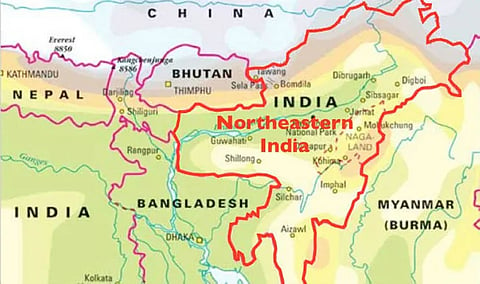
For India’s Northeast, Bangladesh is not simply a neighbouring country separated by an international boundary. It is part of the region’s strategic geography, its connectivity architecture and its access to the Bay of Bengal. With Dhaka now signalling its desire for a reset in relations with New Delhi, the moment calls for neither excessive optimism nor unnecessary apprehension. It calls for strategic clarity: India must engage Bangladesh constructively, but it must do so from the firm foundation of its own national interests, security requirements and larger vision for the Northeast.
Bangladesh State Minister for Foreign Affairs Humaiun Kobir’s statement that Dhaka wants to reset ties with India through direct bilateral discussions and build the relationship around mutual interests came immediately after the controversy surrounding Bangladesh Prime Minister Tarique Rahman’s absence from the BRICS Summit in New Delhi. Whatever the immediate diplomatic circumstances, the larger reality is unmistakable: India and Bangladesh cannot escape their geography. Their interests may diverge on several issues, but proximity creates permanent incentives for dialogue, trade, connectivity and security cooperation.
For India, however, a reset should not mean a return to an earlier template. It should mean a more mature relationship in which cooperation is strengthened where interests converge and differences are addressed through established bilateral mechanisms. India has legitimate concerns relating to border management, security, illegal activities, trade and water resources. Bangladesh, as a sovereign neighbour, has its own interests and expectations. A durable relationship cannot be built by ignoring either side’s concerns.
The Northeast gives this relationship an importance that extends well beyond bilateral diplomacy. Bangladesh’s geographical position creates connectivity possibilities for India’s northeastern states that a few other neighbours can offer. India has already developed arrangements for movement of goods through Bangladesh and access to the Chattogram and Mongla ports. The Agartala-Akhaura rail link has added another dimension to this connectivity architecture. Government documents have specifically highlighted Bangladesh-linked routes as important for reducing distance and logistics costs for the Northeast.
This is not merely an infrastructure story. It is a transformation of India’s economic geography. For decades, the Northeast was too often described primarily through the language of remoteness. That description is becoming increasingly inadequate. The expansion of national highways, railways, airports, waterways, digital infrastructure and border connectivity is gradually changing the region’s relationship with the rest of India and with its eastern neighbourhood. The Government of India has placed the Northeast at the centre of its Act East Policy and identified physical, digital, economic and people-to-people connectivity as key drivers of growth.
The strategic implication is significant. The Northeast should not merely be connected better; it should be positioned better. A road ending at a border is infrastructure. A road connecting producers to markets, industries to ports and young people to employment opportunities is economic strategy. The distinction is crucial. India’s objective should be to ensure that the Northeast is not simply a transit corridor through which goods move between the mainland and neighbouring countries, but a region that produces, processes, trades and exports.
Assam has a particularly important role in this transformation. Its geographical position, road and railway networks, river systems and proximity to Bangladesh give it the potential to emerge as a major economic and logistics hub in eastern India. The Brahmaputra and Barak are not merely geographical features; in an appropriately planned multimodal transport architecture, they can become components of a larger connectivity network. But connectivity alone will not transform Assam. It must be accompanied by industrial investment, food processing, modern agriculture, warehousing, cold chains, tourism, technology, skill development and reliable logistics. The real success of connectivity will be measured not by the volume of traffic passing through the Northeast, but by the economic value created within it.
This is precisely why Bangladesh should be viewed as one element of a much larger Indian strategy. The Act East Policy extends beyond Bangladesh towards Myanmar and Southeast Asia. Projects such as the Kaladan Multi-Modal Transit Transport Project and the India-Myanmar-Thailand Trilateral Highway are designed to strengthen the Northeast’s links with the wider eastern neighbourhood. The Government of India’s own policy framework makes clear that the region is intended to be an important gateway to Southeast Asia.
India therefore needs connectivity diversity, not connectivity dependence. Bangladesh can provide important routes to the Bay of Bengal, while Myanmar and the wider Act East architecture can provide additional pathways towards Southeast Asia. Strong internal connectivity within the Northeast is equally essential. The Government of India has reported substantial expansion of the region’s national highway network—from 10,905 km in 2014 to 16,207 km by March 2025—along with significant investment in railway connectivity. These developments matter because strategic resilience comes from having multiple reliable routes rather than depending excessively on any single corridor.
The security dimension cannot be overlooked. India and Bangladesh share a long international boundary, and effective border management remains indispensable. Smuggling, trafficking, illegal movement and transnational crime require surveillance, institutional coordination and firm enforcement. Yet security and legitimate commerce need not be opposing objectives. A modern border should be secure precisely because lawful movement can be efficiently identified, regulated and facilitated. Stronger formal trade channels and modern border infrastructure can simultaneously promote economic activity and reduce the space available for illicit networks.
The wider geopolitical environment makes this strategic balance even more important. The Bay of Bengal is assuming greater significance in the Indo-Pacific, while major powers are expanding their economic and diplomatic engagement across South Asia. China’s growing presence in the region deserves careful observation, but India need not view every Bangladesh-China interaction through the prism of confrontation. Bangladesh is a sovereign country entitled to pursue its own interests. India’s response should therefore not be a demand for exclusive influence. It should be the creation of a stronger Indian proposition—better infrastructure, greater economic integration, reliable development partnerships, stronger regional connectivity and sustained diplomatic engagement.
For the Northeast, the potential dividends are substantial. Better access to ports can reduce logistics costs. Improved rail and road links can widen markets. Cross-border trade can create opportunities for local producers. But the Northeast must be prepared to convert connectivity into productive capacity.
This is why the present diplomatic moment deserves to be viewed from Guwahati as much as from Delhi. A development in Dhaka can affect the movement of goods through the Northeast. A change in border policy can influence markets in Assam and Tripura. A new transport route can alter the economics of entire regions. And developments in the Bay of Bengal can influence India’s wider eastern strategy. Foreign policy and regional development are no longer separate compartments.
The larger opportunity lies beyond the immediate diplomatic moment. India is building a Northeast that is better connected internally, more closely integrated with the national economy and increasingly positioned as a gateway to Southeast Asia. The Government of India’s Act East framework has already placed the region at the centre of this eastern vision. Bangladesh can strengthen that architecture, particularly through access to the Bay of Bengal and alternative connectivity routes, but the strategic objective remains fundamentally Indian: to make the Northeast secure, connected, economically productive and indispensable to India’s engagement with the wider Asian neighbourhood.
The map has already given India an extraordinary strategic opportunity. The task now is to convert that geography into national strength. Bangladesh is an important part of the equation, but it is not the equation itself. The ultimate goal must be a Northeast that does not merely sit at the edge of India’s map but stands at the centre of its eastern strategy—a region that connects India to Asia while drawing investment, enterprise and opportunity into its own communities.
