
- Home
- Live Blog
- Breaking News
- Top Headlines
- Cities
- NE News
- Sentinel Media
- Sports
- Education
- Jobs
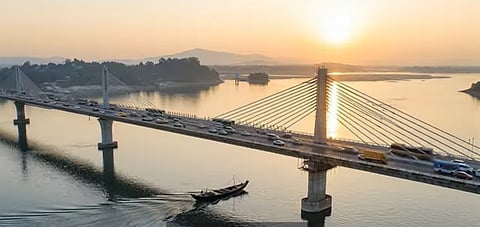
Naming the latest bridge on the Brahmaputra, strengthening communication between Guwahati and North Guwahati, after Kumar Bhaskar Barman is a befitting tribute to one of the greatest kings of Assam. With the inauguration of the Rs 3,030-crore bridge by Prime Minister Narendra Modi, Assam Chief Minister Dr. Himanta Biswa Sarma has not only drawn the attention of the country to the story of Kumar Bhaskar Barman but has also triggered a process of renewed consciousness among the people of Assam about their past glory, especially the chapter authored by the great king. Kumar Bhaskar Varman, who ruled in the ancient kingdom of Kamarupa from 600 CE to 650 CE, was the most illustrious and powerful monarch of the Varman dynasty. The area ruled by this dynasty, it must be remembered, not only covered what is Assam today. Rather, his rule extended over most parts of Bengal as well as what is now known as Bangladesh. While the king, being a bachelor, was often referred to as the Kumara-Raja, his fifty-year rule, like that of the rule of Samudragupta of the Gupta dynasty in central India, is said to be “the golden age” of ancient Assam. Such was his political and administrative acumen that most kings of the neighbourhood literally accepted him as their master and protector. Though ignored by mainstream historians who wrote the history of India, Kumar Bhaskar Barman also played a very significant role in the all-India politics of the seventh century CE. He was a great ally and friend of Harshavardhana, and had defeated Sasanka, the king of Gauda (a portion of Bengal) for the latter’s enmity with the central India king. Bana’s ‘Harshacharita’ has several very significant references to the Kamarupa king, including the position he enjoyed in central India. While Kumar Bhaskar, a renowned scholar, had connections with Nalanda University, the Kamarupa capital was also a centre of learning during his reign. It was during his time that Xuanzang, the great Chinese traveler visited Kamarupa, and had, among other aspects, documented the academic environment of the capital city.
