
- Home
- Live Blog
- Breaking News
- Top Headlines
- Cities
- NE News
- Sentinel Media
- Sports
- Education
- Jobs
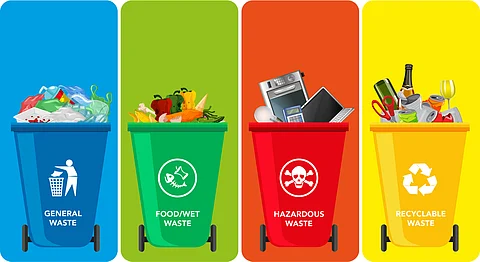
The Solid Waste Management (SWM) Rules, 2026, require mandatory four-way segregation of solid waste to ensure that cities transition from a “collect and dump” approach to a “segregate, recover, and process” model every quarter, regardless of compliance or non-compliance. Three-and-a-half months after the state government notified measures for proper implementation of the SWM rules, Guwahati Municipal Corporation’s collection of unsegregated waste from households shows the capital city remains nowhere near SWM compliance. Without households adopting four-bin segregation and GMC replacing all pull carts with tippers equipped with four separate colour-coded compartments for collecting segregated wastes, the notification will remain a mere paper mandate, not in practice. The notification issued by the state government on May 1 authorises District Commissioners to conduct infrastructure audits of SWM facilities within their jurisdiction and ensures that problems, as well as steps taken by stakeholders identified during the audit, are communicated to the Chief Secretary and to relevant State and Central authorities in a timely manner. They are also empowered to review the performance of urban and rural local bodies in terms of the implementation of SWM rules once every quarter and ensure that compliance, part or non-compliance, is reported to the Chief Secretary along with documented compliance status and escalation where required. It also required the Nodal Officers to send monthly reports on four-stream waste segregation and Extended Bulk Waste Generator Responsibility (EBWGR) compliance to the Member Secretary of the State Level Committee set up under the SWM Rules, along with photos showing proof of compliance. The harsh realities of households continuing to hand over mixed garbage to GMC garbage collectors, who themselves collect it in mixed form in pull carts across different wards, show that awareness of four-way segregation – four-stream segregation of wet, dry, sanitary and special care waste – has received little attention. A rudimentary form of segregation occurs with garbage collectors hanging large plastic bags on their pull carts to pick out plastic and other waste items that can be sold to scrap dealers. Even some garbage transporting vans equipped with separate compartments for segregated dry and wet wastes are seen in crude segregation practice. Garbage collectors employed by GMC undermine a core objective of SWM rules by allowing solid waste to reach informal scrap dealers, which prevents hazardous waste from entering safe handling and recycling chains. The reluctance among households to adopt four-bin segregation reflects the classic chicken-and-egg problem: residents expect GMC to introduce vans with segregated compartments, while GMC waits for households to start the segregation practice. District administration invoking its powers and conducting infrastructure audits is essential to bridging such a gap and ensuring the optimal utilisation of vans with segregated compartments already procured by GMC. The notification from the state government also grants the Co-District Commissioners the authority to inspect and review solid waste management facilities in their areas and to make sure that urban and rural waste management systems, like landfills and processing plants, work together effectively. It also mandates that elected Ward Representatives shall act as lead facilitators for citizen awareness, household-level participation, and source segregation compliance, and that the Urban Local Bodies and the Panchayat & Rural Development Department shall ensure their active engagement through structured information, education, and communication, as well as capacity-building initiatives. Such awareness-building initiatives rise above routine and must go beyond tokenism to drive real behavioural changes in waste disposal, and the GMC aligns its waste management with the occupants of city households, both owners and tenants. All local bodies (urban and rural) in the state must ensure, as laid down in the official notification, that four-stream segregation of wet, dry, sanitary and special care waste is practised in all households and the same is reflected in the action plans and enforced as a mandatory compliance requirement. Streamlining door-to-door waste collection won’t ensure recyclable recovery and sustained recycling if the city lacks sufficient waste-processing capacity. Making all local bodies use digital, real-time monitoring and reporting systems that connect to central platforms is a beneficial idea, but its success will largely depend on how well the oversight system works. The notification states that non-compliance with the SWM Rules shall attract immediate fines, criminal prosecution for continued violations, and liability for responsible officials for failure of oversight. The concerned Urban Local Bodies, District Commissioners, and regulatory authorities, including the APCB, shall be responsible for enforcement under the supervision of the State Level Committee. Strong enforcement powers are ineffective unless waste generators voluntarily change their waste disposal behaviour and the GMC aligns its waste management practices with the SWM Rules. No rule, audit, or penalty can substitute for the everyday behavioural discipline that citizens and the GMC must internalise.
