
- Home
- Live Blog
- Breaking News
- Top Headlines
- Cities
- NE News
- Sentinel Media
- Sports
- Education
- Jobs
Siddharth Roy
(siddharth001.roy@gmail.com)
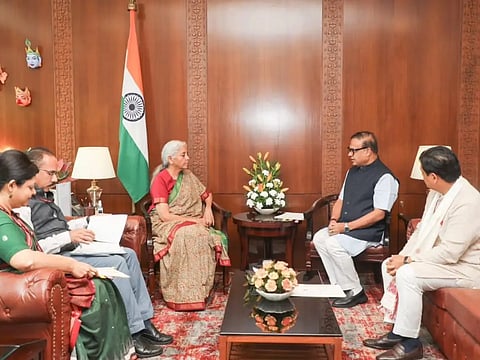
Assam and Meghalaya’s renewed push for Externally Aided Projects (EAPs) is more important than the meeting that triggered it. When the Chief Ministers of the two States met Union Finance Minister Nirmala Sitharaman in New Delhi seeking a fresh impetus to EAPs, they were effectively asking for a different model of infrastructure financing in the Northeast. The question is not simply how to borrow more. It is how to use long-term external capital and technical expertise to overcome infrastructure bottlenecks that ordinary State budgets struggle to address.
The timing is significant. In June, the Centre said EAP support to the Northeastern States had risen from about Rs 9,000 crore in 2014 to around Rs 76,000 crore. Meghalaya alone currently has 15 EAPs under implementation, with an estimated cost of Rs 12,100 crore, 90% funded by the Centre and 10% by the State. These figures suggest that external assistance is no longer a marginal source of development finance. It is becoming an important instrument for building infrastructure and institutions in a region where terrain, remoteness and climate risks make projects unusually expensive.
For Assam, the potential is particularly large. Its existing EAP portfolio has covered inland water transport, roads, urban water supply and sewerage, power transmission and distribution, agribusiness, health, public-finance reform and flood and river-erosion management. This breadth matters because Assam’s infrastructure deficit is not a single-sector problem. A highway without logistics, reliable electricity or urban services does not automatically create an industrial economy. EAPs can help finance precisely these interconnected systems.
Their greatest advantage is not merely cheaper or longer-term money. Development agencies such as the World Bank, Asian Development Bank and Japan International Cooperation Agency bring project-preparation standards, procurement systems, environmental safeguards, institutional reforms and technical expertise. For States with limited capacity to prepare complex projects, this knowledge can be as valuable as the loan itself. A well-designed externally aided project can therefore leave behind both a physical asset and a stronger public institution.
The Assam government has already recognised this. Its financial documents have envisaged a dedicated Lead EAP mechanism to help departments develop projects and engage with agencies such as the World Bank, ADB, JICA, AIIB and the New Development Bank. That approach should now be strengthened. Instead of waiting for individual departments to formulate projects, Assam should maintain a rolling pipeline of investment-ready proposals based on a clear assessment of its largest economic constraints.
Connectivity should be high on that list. Assam is the gateway between the rest of India and the Northeast, but the economic value of connectivity depends on more than roads. Multimodal transport, inland waterways, bridges, logistics parks, border infrastructure and last-mile links need to function as one network. The Assam Inland Water Transport Project shows the kind of intervention EAP financing can support. The next generation of projects should connect production centres to markets, ports and international corridors, reducing both travel time and logistics costs.
Climate resilience deserves equal priority. Assam’s annual floods and riverbank erosion repeatedly destroy public assets and private livelihoods. Existing EAPs in integrated river-basin management and climate-resilient flood and erosion control point towards a better approach. External finance should increasingly support basin-level planning, drainage, wetland conservation, flood forecasting, resilient bridges and flood-proof public infrastructure. Spending on resilience may appear expensive before a disaster; rebuilding the same roads, schools and embankments after every disaster is more expensive.
Meghalaya’s experience offers another lesson. Its EAP portfolio includes community-led water harvesting, livelihoods and climate adaptation, while its infrastructure programme is increasingly linked to tourism, agriculture and connectivity. This is important for Assam too. Infrastructure should not be designed only around major urban centres. Secondary towns, border districts, tourism circuits and rural production clusters need reliable roads, water, digital connectivity and skills if growth is to spread beyond Guwahati. The economic logic extends to private investment. Investors rarely come because of one highway or industrial plot. They come when transport, power, water, skills and governance work together. EAPs can finance the public goods that make private investment commercially viable. This is especially relevant as Assam seeks to translate investment proposals into actual factories, jobs and supply chains. Recent reviews of Advantage Assam 2.0 have already focused on sectors such as cement, power and renewable energy. Better infrastructure financing can help convert commitments into productive capacity.
Yet EAPs are not free money. External loans ultimately create repayment obligations, and projects can fail through cost overruns, land delays, weak procurement or inadequate maintenance. The Northeast cannot afford infrastructure that becomes a fiscal liability after inauguration. Every proposed project should therefore undergo rigorous economic appraisal, including life-cycle costs, climate risks, expected users, revenue potential where applicable and measurable social benefits.
There is also a case for greater regional coordination. Assam and Meghalaya share transport corridors, watersheds, markets and tourism circuits. Their EAP proposals should not be developed in isolation. A regional pipeline involving neighbouring Northeastern States could make projects more attractive to multilateral institutions while reducing duplication. Shared logistics, power, tourism and environmental projects can generate returns that individual State projects cannot.
The renewed push should therefore be judged not by the amount sanctioned but by what the money enables. If EAPs help Assam and Meghalaya build stronger institutions, resilient infrastructure and economically connected communities, external finance can become a force multiplier. The Northeast does not merely need more capital. It needs better-prepared capital, deployed where geography and climate make conventional financing insufficient.
The meeting with the Finance Minister is an opportunity to move from project-by-project requests to a long-term development-finance strategy. Assam and Meghalaya should use it to build a pipeline of bankable, climate-resilient and regionally connected projects. Done well, EAPs can provide something more valuable than infrastructure: the institutional capacity to maintain it, the economic activity to justify it and the resilience to ensure that tomorrow’s development is not washed away by the next flood.
