
- Home
- Live Blog
- Breaking News
- Top Headlines
- Cities
- NE News
- Sentinel Media
- Sports
- Education
- Jobs
Siddharth Roy
(siddharth001.roy@gmail.com)
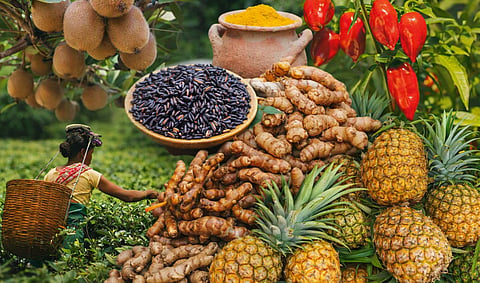
India's Northeast has often been described as an agricultural treasure waiting to be unlocked. Blessed with abundant rainfall, fertile soils, diverse agro-climatic zones and a rich tradition of organic and low-input farming, the region possesses enormous potential to become a hub for high-value agriculture. Assam's tea, Meghalaya's turmeric, Nagaland's king chilli, Tripura's pineapple, Arunachal Pradesh's kiwi, Manipur's black rice and Mizoram's ginger have all earned recognition for their unique quality. Yet, despite this natural advantage, agriculture continues to contribute far less to the region's prosperity than it should. The problem lies not in production but in what happens after the harvest.
The Northeast's agricultural challenge is increasingly becoming a market challenge. Farmers are able to grow crops, but they often struggle to access remunerative markets, efficient supply chains and reliable buyers. Without stronger market linkages, the region risks remaining trapped in a cycle where agricultural output rises but farm incomes stagnate. If India's ambition is to transform the Northeast into a growth engine under the Act East Policy, connecting farmers to markets must become as important as increasing production.
Over the past decade, governments have invested significantly in improving agricultural productivity through better seeds, irrigation support, Farmer Producer Organisations (FPOs), and horticulture missions. While these interventions have yielded positive results, they have not adequately addressed the structural disconnect between producers and consumers. Agriculture cannot become profitable merely by increasing output when marketing systems remain fragmented.
The Northeast's geography compounds this challenge. Mountainous terrain, dispersed settlements and long transportation routes raise logistics costs significantly. A farmer cultivating oranges in Arunachal Pradesh or pineapples in Tripura may produce an excellent crop but still receive a fraction of the retail price because transportation, multiple intermediaries and post-harvest losses consume much of the value. In several districts, inadequate warehousing and cold-chain facilities force farmers to sell immediately after harvest, precisely when prices are at their lowest.
This paradox is visible across several commodities. Assam's horticulture production has expanded considerably, yet many vegetable growers continue to experience seasonal price crashes because local markets cannot absorb sudden increases in supply. Similarly, Meghalaya's farmers frequently report distress sales during peak harvest seasons despite growing demand for fresh produce in metropolitan cities. These examples illustrate that production without market integration does little to improve rural livelihoods.
The region's agricultural diversification offers another untapped opportunity. Consumer preferences across India are shifting towards premium, healthy and region-specific food products. Organic spices, indigenous rice varieties, exotic fruits and medicinal plants command higher prices than conventional staples. The Northeast is uniquely positioned to cater to this growing demand. However, premium products require premium marketing systems. Branding, quality certification, traceability, attractive packaging and consistent supply are becoming as important as cultivation itself.
Farmer Producer Organisations were expected to bridge this gap by aggregating produce, strengthening bargaining power and connecting farmers directly with buyers. While the number of FPOs has increased across the region, many remain financially weak and managerially inexperienced. They often lack working capital, professional marketing expertise and access to digital trading platforms. As a result, they continue to depend on traditional middlemen instead of functioning as independent market institutions.
Digital agriculture presents an opportunity to overcome some of these structural barriers. Electronic marketplaces can reduce information asymmetry by allowing farmers to compare prices across markets and negotiate directly with buyers. Mobile-based advisory services can provide real-time information on demand, prices and weather conditions. However, digital platforms alone cannot substitute for physical infrastructure. Efficient roads, refrigerated transport, grading facilities and collection centres remain indispensable if agricultural produce is to reach distant markets without significant quality deterioration.
Cross-border trade represents another underutilised avenue for expanding market access. Sharing international borders with Bangladesh, Bhutan, Myanmar and China, the Northeast occupies a strategic location unmatched by any other Indian region. Bangladesh already imports several agricultural commodities from India, while Southeast Asia offers growing demand for horticultural products, spices and processed foods. Yet cumbersome border procedures, inadequate integrated check posts and limited export-oriented infrastructure prevent farmers from fully benefiting from these opportunities. Trade facilitation must therefore become an integral component of agricultural policy rather than being viewed solely through the prism of foreign commerce.
Value addition is equally critical. Much of the region's agricultural produce leaves farms in raw form, allowing processing industries elsewhere to capture higher profits. Food processing clusters located closer to production centres can create employment while increasing farmers' share of consumer spending. Processing also extends shelf life, reduces wastage and enables producers to reach distant domestic and international markets. The success of Assam's tea industry demonstrates how branding and value addition can transform an agricultural commodity into a globally recognised product. Similar approaches can be replicated for spices, fruits and indigenous crops across the region.
Financial institutions must also rethink agricultural lending. Credit continues to focus primarily on cultivation, whereas investments in storage, processing, logistics and marketing receive comparatively less attention. Expanding credit guarantees for agri-logistics enterprises, encouraging private investment in cold chains and supporting warehouse receipt financing could significantly strengthen post-harvest systems.
Equally important is institutional coordination. Agricultural marketing intersects with transport, commerce, food processing, rural development and border trade. Fragmented policymaking often results in isolated interventions that fail to create integrated value chains. A coordinated regional strategy involving all Northeastern states could help develop common logistics networks, harmonise quality standards and collectively market the region's agricultural identity.
Climate change adds another layer of urgency. Erratic rainfall, floods and landslides are already affecting agricultural production across the Northeast. Stronger market systems can enhance resilience by enabling farmers to diversify crops, access insurance-linked value chains and reduce dependence on local markets disrupted by extreme weather events. Resilient agriculture today depends as much on resilient marketing as on resilient farming practices.
The Northeast does not require another production revolution. It requires a market revolution. Its farmers have repeatedly demonstrated their ability to produce high-quality crops suited to changing consumer preferences. What they need is an ecosystem that rewards quality, ensures fair prices and connects remote farms with expanding domestic and global markets. Agriculture succeeds not when crops are harvested, but when they are profitably sold.
If India truly intends to make the Northeast a gateway to Southeast Asia and a pillar of inclusive growth, strengthening market linkages must become a national priority. Roads and railways must be complemented by value chains; production targets by marketing strategies; and subsidies by sustainable commercial opportunities. Only then can the region's agricultural wealth translate into lasting rural prosperity and transform the Northeast from a supplier of raw produce into a competitive participant in India's evolving agri-economy.
