
- Home
- Live Blog
- Breaking News
- Top Headlines
- Cities
- NE News
- Sentinel Media
- Sports
- Education
- Jobs
Antara Hazarika
&
Madhurjya Saikia
(madhurjyatu15@gmail.com)
Conscription, also known as the draft, is a system in which the state legally requires citizens to perform national service, usually in the armed forces, and although many countries in 2025 depended mainly on professional volunteer militaries, conscription still remains an important and often debated part of national defence policies across the world. Several countries, such as Israel, South Korea, Eritrea, Switzerland, and Brazil, continue to follow compulsory military service to ensure national security. The modern idea of universal conscription developed during the French Revolution in the 1790s, which aimed to mobilise the population for national defence. During the First and Second World Wars, conscription was widely used by almost all major powers to create large “citizen armies” capable of fighting prolonged and large-scale wars. After the end of the Cold War, many Western nations gradually moved away from compulsory service and adopted all-volunteer forces, giving preference to smaller, professional, and technologically advanced militaries instead of large infantry-based forces. However, in recent years, changing security challenges and geopolitical tensions have encouraged several European countries to reintroduce or expand conscription. Germany approved plans to restart mandatory registration and medical examinations for 18-year-old men from 2025, with full assessments. In Scandinavian countries, Norway and Sweden already follow gender-neutral conscription systems that include both men and women, and Denmark introduced a similar system. In the Baltic region, Latvia restored compulsory military service to strengthen regional security. In the United States, active conscription ended in 1973, but the Selective Service System continues.
India does not follow compulsory military service. Since independence in 1947, joining the Indian Army, Navy, or Air Force has always been voluntary. There is no law in India that forces citizens to join the armed forces. However, the Constitution gives the Union Government the power to require compulsory service for public purposes if it is necessary for national interest. This power is mentioned in Article 23(2) of the Indian Constitution and can include military service, but it has never been used to enforce a draft. India continues to follow an all-volunteer military system. From time to time, proposals to introduce conscription have been discussed in Parliament, but none have become law. For example, the Compulsory Military Conscription Bill, 2019, suggested mandatory military service for young people between 17 and 23 years of age, but the bill was not passed.
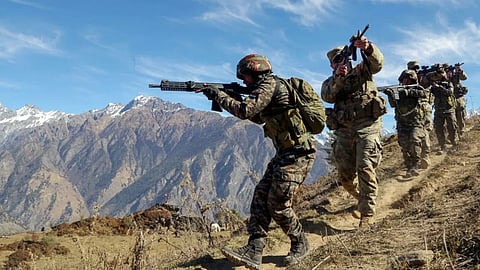
A mental toughness programme in basic military training aims to build a strong and positive mindset through physical and mental challenges. After training, the military mindset is usually defined by discipline, courage, and a sense of purpose. This training helps young people become more resilient, emotionally balanced, and better able to face difficulties in life. The main goal of conscription-style training is to shape youth in a constructive way and turn them into a productive national resource. To achieve this, it is important to take care of both physical and mental health. Military training develops mental maturity and shifts the mindset from obeying rules out of fear to practising self-discipline based on values such as duty, honour, and responsibility. By facing stressful situations, youth learn mental toughness and the ability to continue working despite difficulties, often supported by simple practices like mindfulness to control emotions. The training also teaches punctuality, accountability, teamwork, and leadership. Research shows that such training improves psychological well-being, reduces stress, and builds social support, while physically it improves strength, fitness, and heart health. It also sharpens focus, quick thinking, and decision-making under pressure.
India should consider introducing conscription or compulsory basic training at the school level and linking it with the National Education Policy (NEP) 2020. However, full universal conscription is not practical in India because of its very large population, as around 20 million young people turn 18 every year. Managing and funding such a system would be extremely difficult. Instead, a more suitable option could be to expand the National Service Scheme (NSS) by making one year of national service compulsory. Under this system, youth could choose different forms of service, such as basic military training, teaching, disaster relief work, or learning basic life-saving medical skills. This would help in developing well-rounded and skilled human resources. Another option is corporate-linked volunteerism, where employees are encouraged to complete national service. Companies could be given tax benefits or incentives for hiring people who have completed such service, and service experience could be given importance in the job market. For government jobs, special benefits could be provided to those who have volunteered for national service, such as preference in recruitment, promotion, or access to higher opportunities. Psychometric tests could also be introduced at different levels to assess personality, discipline, and leadership skills. Instead of introducing conscription only after education, service-orientated training can be included within the education system itself. Making the National Cadet Corps (NCC) compulsory in schools and colleges is one practical approach. This would help students develop discipline, teamwork, and basic military skills without the high cost of full-time military training facilities.
Mandatory service offers a well-organised way for young people to learn important life skills such as leadership, teamwork, time management, and handling difficult situations. By bringing together people from different regions, languages, cultures, and economic backgrounds, national service helps reduce social divisions and builds a strong sense of national unity and shared identity. It works as a common platform where caste and class differences matter less, encouraging mutual respect and cooperation. Such training also improves physical fitness and mental strength. It helps young people learn how to manage stress, stay healthy, and follow disciplined daily routines, such as waking up early and maintaining regular habits. Overall, mandatory service can help create a disciplined, skilled, and socially united generation. Although India has traditionally followed a voluntary system, supporters believe that introducing structured national service could prepare youth as a “second line of defence” for the country while also equipping them with essential life and work skills that are useful throughout their lives.
