
- Home
- Live Blog
- Breaking News
- Top Headlines
- Cities
- NE News
- Sentinel Media
- Sports
- Education
- Jobs
Dipak Kurmi
(The writer can be reached at dipakkurmiglpltd@gmail.com.)
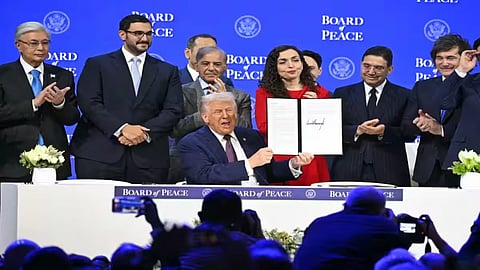
There are moments in international politics when audacity masquerades as imagination, and spectacle seeks to pass off as statesmanship. Donald Trump's latest peace proposal for Gaza, grandly termed the "Board of Peace," belongs squarely in this category. It is the kind of initiative that only Trump could conceive: a hybrid of geopolitical intervention, corporate governance, and personal authority, wrapped in the language of reconstruction and stability. On the surface, it claims to address the urgent need for post-ceasefire relief and rebuilding in a territory devastated by months of relentless war. Yet, beneath its glossy framing lies a deeply flawed design that raises troubling questions about intent, legitimacy, and precedent. The proposal is as theatrical as it is unsettling, offering a vision of peace that is transactional, exclusionary, and overwhelmingly centred on one man's power.
The mechanics of the Board of Peace reveal its true character. Membership reportedly requires a payment of one billion dollars, instantly converting participation into a privilege reserved for the wealthy and powerful. Trump would serve as chairperson with no defined end date, effectively granting him indefinite authority over the board's functioning and direction. Most strikingly, the proposal does not even explicitly mention Gaza in its charter, nor does it accord any meaningful role to the Palestinians, the very people whose lives and future are supposedly at stake. This omission is not accidental; it is structural. It reflects a worldview in which those who suffer the consequences of conflict are peripheral to decisions about their own fate. The irony is stark, particularly given the United States' unwavering support for Israel during the assault on Gaza, when hospitals, schools and civilian infrastructure were bombed with devastating consequences.
Ostensibly, the board is designed as a mechanism to stabilise and reconstruct post-war Gaza, addressing humanitarian needs and governance gaps. In practice, however, it concentrates extraordinary power in Trump's hands while opening the door to commercial ventures that blur the line between reconstruction and profiteering. The presence of Trump's family members, notably Jared Kushner with his well-documented interest in real estate opportunities in conflict zones, reinforces fears that Gaza could be transformed into a commercial project rather than rebuilt as a homeland with dignity and rights for its people. Few would deny that Gaza requires massive investment, administrative capacity and sustained international engagement. The problem lies not in the recognition of this need, but in the manner in which the solution is being imposed and who stands to benefit from it.
The board's composition adds another layer of complexity. Several key regional players, including Saudi Arabia, the United Arab Emirates, Egypt, Jordan, Türkiye and Qatar, along with Israel, have joined the initiative, giving it the appearance of a broad-based regional effort. This diversity of participants could, in theory, lend the board a measure of credibility and balance. Yet participation under a framework that centralises authority in Washington, and more specifically in Trump himself, raises concerns about the erosion of regional autonomy and multilateral norms. India, which has reportedly been invited to join, now finds itself at a delicate crossroads. As a country with long-standing ties to West Asia and a consistent record of humanitarian assistance in the region, New Delhi cannot lightly dismiss such an invitation. At the same time, the implications of participation extend far beyond Gaza.
India has historically supported the Palestinian cause, recognising Palestine in 1988 and consistently backing a two-state solution across international fora. This position is rooted not merely in ideology, but in a principled commitment to international law, self-determination and balanced diplomacy. Joining a framework that sidelines Palestinian political agency would sit uneasily with this legacy. Under the Board of Peace proposal, Palestine is not treated as an equal stakeholder but is instead offered a technocratic panel operating under the board's supervision. This arrangement reduces a national liberation struggle to an administrative problem, stripping it of political voice and legitimacy. For New Delhi, endorsing such a structure would amount to a quiet departure from its stated principles, with long-term consequences for its credibility in the Global South.
The deeper concern, however, lies in the architecture of global governance, which the board seeks to normalise. The draft charter's sweeping mandate to intervene in "areas affected or threatened by conflict" is deliberately vague, allowing for expansive interpretation. Coupled with language that disparages the United Nations, it signals an attempt to create an alternative system of conflict management that bypasses established multilateral institutions. In this model, Washington, and Trump personally, become the ultimate arbiters of peace and intervention. The power envisioned for Trump would exceed even that of the United Nations Secretary-General, effectively sidelining decades of institutional evolution designed to balance sovereignty, consensus and international law. For a country like India, which has consistently argued for multilateralism and reform rather than replacement of global institutions, this should ring loud alarm bells.
Precedents matter in international politics, and the precedent set by the Board of Peace is deeply troubling. If Gaza can be subjected to such an arrangement today, other contested regions could follow tomorrow. For India, the implications are uncomfortably close to home. The presence of Pakistan on the same board raises the spectre of future mischief. Hypothetically, a Pakistani leader could seek Trump's intervention on Kashmir, prompting the creation of a similar "board" under the same logic of external management. Such a scenario would directly challenge India's long-held position that Kashmir is a bilateral issue, not subject to third-party mediation. By participating in the Board of Peace, India risks legitimising a framework that could one day be turned against its own core interests.
The question of legitimacy extends beyond participation to the very ethos of the board. Peace processes derive their moral authority from inclusivity, consent and adherence to international norms. A structure that charges an entry fee of one billion dollars for permanent membership carries an unmistakable pay-to-play character. It privileges wealth over responsibility and influence over accountability. The prominent role of financiers and real estate interests further fuels the perception that reconstruction could become a vehicle for profit rather than a rights-based humanitarian endeavour. Gaza's suffering is immense, but suffering does not confer a licence for exploitation, however cleverly packaged as development.
None of this is to deny the urgency of addressing Gaza's devastation. The humanitarian crisis is severe, the infrastructure shattered, and governance structures fragile. The international community cannot afford paralysis or indifference. Yet urgency must not become an excuse for abandoning principles. History offers ample evidence that externally imposed solutions, especially those driven by narrow interests, rarely produce lasting peace. They may create temporary stability, but they also sow the seeds of future resentment and conflict. For India, whose foreign policy has increasingly emphasised strategic autonomy and ethical engagement, the challenge is to navigate this moment with clarity and caution.
India's decision on whether to join the Board of Peace will be closely watched, not only in West Asia but across the developing world. It will signal how New Delhi balances pragmatism with principle in an era of shifting power equations. A hasty endorsement could undermine decades of carefully cultivated diplomacy, while a measured response that insists on Palestinian agency, multilateral legitimacy and transparency would reinforce India's image as a responsible global actor. Caution, therefore, is not hesitation; it is strategic wisdom. In a world where peace is increasingly commodified and institutions are bypassed at will, the true test of leadership lies in the ability to distinguish between genuine solutions and seductive illusions.
