
- Home
- Live Blog
- Breaking News
- Top Headlines
- Cities
- NE News
- Sentinel Media
- Sports
- Education
- Jobs
Lalit Nath
(lalitnath784@gmail.com)
Renowned litterateur, historian, author, educator and Bihu culture researcher Dr Leela Gogoi, in his unique book Bihu Eti Samiksha, wrote, “The Bihu narrates the history of the past, reflects the evolution of the present and foretells the future.” His profound observation makes it clear that Bihu is not merely a festival; it is a tradition deeply intertwined with the lives of the Assamese people—an eternal heritage that has embraced the cultural elements of the past while adapting to the pace of time. It seamlessly integrates the glorious heritage of the past, the journey of the present and the hopes and aspirations of the future. Hence, Bihu is a colourful chronicle of time that keeps the culture of the community alive, eternal and dynamic. Bihu is such a culture that reflects the fundamental way of life, beliefs, practices and ethos of the Assamese community in an evolved and organised manner.
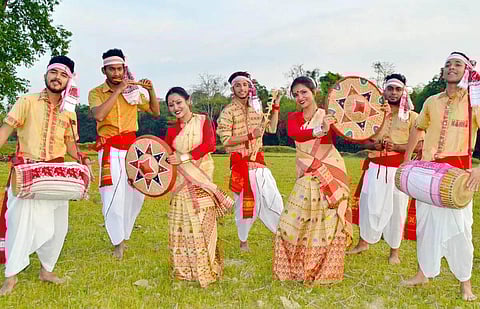
Bohag Bihu is a traditional folk festival of the Assamese people, rooted in the agrarian society. The fundamental significance of this festival is deeply intertwined with the agricultural practices of human society. Various cultural elements, rituals, songs, dances and folk customs of Assamese life have emerged from this agricultural culture, flourishing into a rich heritage. Therefore, Bohag Bihu is not merely a festival; it is a living portrait of the Assamese philosophy of life. Born in an ancient agrarian society, the Bihu festival is closely connected to the land, agriculture and livelihood. It embodies the celebration of productivity, abundance and joy.
With the passage of time, Bihu culture has evolved.
Today, Bihu is no longer confined to a rural, nature-centric celebration. The influence of urban civilization, globalisation and modernity has brought a new form to the festival. Hence, today’s Bihu is not exclusively rural or nature-centric. Bihu functions, stage performances, various competitions and digital media have given Bihu widespread publicity.
Bohag Bihu is the festival of the heart for Assamese people. In harmony with the colours and forms of nature, Bihu brings new hope to the hearts of Assam’s people. Over time, society’s structure has also changed. In the past, people sang Bihu songs by the riverbanks, under the shades of trees, near forests, and in the midst of vast fields.
“Potharor majote Aahator talote
Ami Bihu mora thai,
Bonore dewota Amak nojokaba
Okole nijanot pai.”
On the first day of Bohag, the village youths would roam around playing the dhol, pepa, and kah to ward off excess rain, drought, storms, and lightning while praying for increased crop production. On the day of Bihu, the common people would bless the king in his own house, and in return, the king would accept their service, saying, “The people are the true rulers.”
“Swargadeu olale Batchorar mukholoi
Duliyaai patile dola,
Kanot jilikile Mokore kundole
Gat gomchengor chola.”
After the arrival of the British, stage performances of Bihu began. With the rise of the anti-British national movement, national festivals also started being celebrated. The celebration of Bihu underwent changes due to scientific and economic transformations. Villages collectively organised Bihu meetings, leading society on the path of progress.
With advancements in technology, the traditional form of Bihu began to experience the influence of modernity. For the first time, the lively tunes of Bihu could be heard on the radio. The Bihu programmes broadcast by All India Radio, Guwahati, spread across Assam, resonating in every home. The melodies of Dr Bhupen Hazarika, Khagen Mahanta, Dipali Barthakur and Dipen Baruah enchanted the mountains, valleys, towns and cities of Assam.
Next came the era of gramophones. Gramophones initiated a new phase in the preservation and dissemination of music. Through records, the soulful Bihu songs of popular singers reached nearly every household in Assam. As time progressed, cassettes and tape recorders became the most popular medium for listening to Bihu songs in the 1980s and 1990s. Cassette players and recorders brought forth numerous Bihu albums, blending traditional folk music with modern tunes. Later, CDs and DVDs replaced cassettes, offering superior sound quality.
In the digital age, Bihu is not just a festival but a global cultural identity. YouTube, Spotify, JioSaavn, Facebook, Instagram Live, and other digital platforms have given Bihu and its music boundless reach. Assamese people living abroad can now sit in front of their screens and enjoy Bihu programmes from Assam, humming along to Bihu songs—a common sight today.
Even in this age of technological advancements, the core essence of Bihu remains deeply rooted in the Assamese agrarian culture and fertility beliefs. The sounds of dhol, pepa, gogona, and taal still stir the hearts of every Assamese. The fusion of traditional with modern digital music has enriched the soul of Bihu, offering a creative and contemporary experience.
E-commerce platforms have made traditional attires like gamosa and mekhela chador easily accessible, enabling Assamese expatriates to celebrate Bihu wherever they are. Digital platforms have opened new pathways for identifying Bihu among the younger generation and have brought the works of talented artists closer to the people. The Assamese Bihu dance and dhol playing have even entered the Guinness World Records.
Yet, amid these digital advantages, the heartfelt essence, social harmony and communal celebration of Bihu seem to have faded somewhat. Earlier, Bihu was a festival of strengthening bonds and sharing joy together. Nowadays, Bihu celebrations often seem restricted to media coverage, videos and reels uploaded on digital platforms, giving the impression that Bihu is celebrated more for show.
Despite this, the message of joy, harmony and unity that Bihu has carried through generations remains unchanged. The traditional sounds of dhol, pepa, gogona and taal continue to echo, evoking deep emotions in the hearts of Assamese people. The fusion of traditional and modern music has enriched the essence of Bihu, keeping it alive, vibrant, and relevant for future generations.