
- Home
- Live Blog
- Breaking News
- Top Headlines
- Cities
- NE News
- Sentinel Media
- Sports
- Education
- Jobs
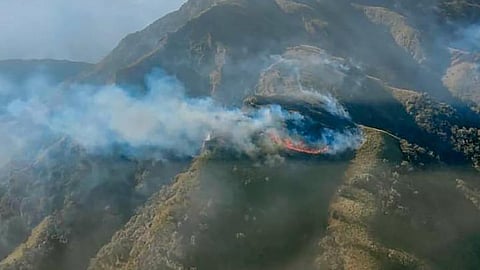
The outbreak of forest fire in Western Dzukou valley in Nagaland has set off the ecological alarm for the entire Northeast region. Recurring and rising incidents of forest fire in the region highlight both ecological fragility and gaps in the forest fire prevention alert system. Climate-induced natural causes such as rising temperatures and prolonged dry spells and anthropogenic causes such as slash-and-burn cultivation practices in hilly areas, deliberate or accidental burning, etc., increasing the vulnerability of forest fires cannot be ignored. Persistence and aggravation of such factors demand a decisive shift in forest fire prevention strategy from macro-level mitigation measures to micro-level interventions at the community and local level. It is hoped that measures initiated by the Nagaland Government, such as the deployment of a dedicated team to conduct reconnaissance and rescue operations, will contain the blaze and prevent it from spreading like the devastating fire in the Dzukou Valley in the past. The Ministry of Environment, Forest and Climate Change, through the Forest Survey of India (FSI), issues pre-fire alerts (one-week advance), large forest fire alerts and near real-time forest fire alerts to the registered subscribers and State Forest department officials to help them combat forest fires. The Ministry also provides financial assistance through the Centrally Sponsored Scheme—Forest Fire Prevention and Management to reduce forest fire frequency, improve response mechanisms, protect biodiversity and local communities, and restore affected forest areas. Information provided by the central government to the parliament highlight that financial assistance under the scheme is provided for activities such as creating and maintaining forest fire lines, engaging forest fire watchers, building water storage structures, strengthening forestinfrastructure, procuring fire-fighting equipment, conducting soil and moisture conservation inhigh-risk areas, raising awareness, and incentivizing communities for forest fire protection. The recurrence of large forest fire incidents in the region calls for a comprehensive review of implementation of such scheme to identify the critical gaps and initiate corrective measures to bridge those for increasing resilience against forest fire vulnerability. The central government prefers a rational approach that includes an audit of forest-fire prevention programmes within the scope of the Environment Audit Rules, 2025, and consequent regular audits can facilitate early detection of violations or non-compliance and help prevent fire incidences. These rules provide for engagement of Registered Environment Auditors, accredited by the Environment Audit Designated Agency, under relevant environmental laws, rules, regulations, notifications, or directions of the Government, requiring compliance verification, auditing, and additional functions as prescribed by the Central Government from time to time. The official notification, however, clarifies that the environment audit is not an alternate to the existing system of compliance and monitoring through government agencies but is only to supplement the current efforts of the government agencies, which will continue with their existing role of inspection and verification, as and when required. The objective of the National Action Plan on Forest Fire is to minimise forest fires from taking place by informing, enabling and empowering forest fringe communities and incentivising them to work in tandem with the forest departments. The plan document states that most forest fires are manmade and are linked to socio-economic and livelihood issues of the forest fringe communities, and by making these communities aware of the many tangible and intangible benefits lost to them, both individually and collectively, due to forest fires, it would be possible to greatly reduce the forest fire incidences. It is essential to undertake a survey of the forest fringe villages in the region to assess the level of awareness among the communities about their role in forest fire prevention and their lived experiences. Improving water regimes in forest areas is critical to reducing forest fire vulnerabilities. Mainstreaming traditional water governance systems prevalent among indigenous communities, which prioritise preservation of water quality and conservation of water sources like natural springs into modern forest management, can help achieve a key management intervention included in the National Action Plan – moisture retention and water conservation. This management action, under the Action Plan, aims at moisture retention for a longer time after rains and appropriate preventive measures to ensure that minor fire incidences do not escalate into major fire events, as fire hazard is greater in drier and deciduous habitats and areas with a predominance of grasses. Another forest fire management intervention included in the Action Plan is minimising accumulation of dry fuel material on the forest floor in the fire season. The utilisation of litter and other biomass on the forest floor for the benefit of the communities in the identified areas, as envisaged in the Plan, can significantly reduce the vulnerability in the fire season. Preventing forest fire through initiating intervention and management, as recommended in the National or State Action Plan must be a continuous exercise. The Northeast region needs proactive measures to prevent forest fire outbreaks, as containment and ecological loss resulting from them are irreversible and enormous.
