
- Home
- Live Blog
- Breaking News
- Top Headlines
- Cities
- NE News
- Sentinel Media
- Sports
- Education
- Jobs
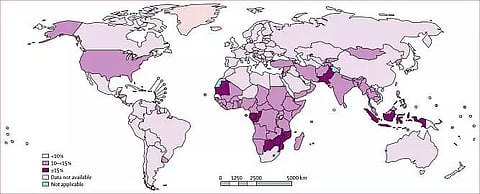
India accounting for the highest number of preterm births in 2020 is a matter of grave concern. The World Health Organisation (WHO) estimates that the country accounts for 3.02 million preterm births which is 23% of all preterm births worldwide. The WHO also found that, globally, preterm birth remains the leading cause of death in children below five years. Addressing the problem of preterm birth is not only critical to reducing child mortality but also the disease burden at all ages. The latest WHO report titled “Born too soon: Decade of Action on preterm birth” highlights that worldwide one in ten babies are preterm. India, Pakistan, Nigeria, China and Ethiopia accounted for almost half of preterm births while Bangladesh leads the chart of preterm birth rate with 16.2% followed by Malawi (14.5%) and Pakistan (14.4%). With 13% preterm birth rate, India figures at the fourth rank in the list sharing it with South Africa. Data shows that worldwide one baby dies in every 40 seconds due to preterm birth complication and hence every country addressing it is essential to achieve the Sustainable Development Goal (SDG) target of ending preventable deaths of newborns and children below 5 years of age along with other SDG goals by 2030. The report points out that millions of preterm babies survive with disabilities that follow them and their family members throughout their lives. The WHO lists four Cs- Conflict, Climate, Covid and Cost of Living Crisis as factors adding to the problem and posing “distinct but overlapping challenges”, and compounding “existing inequities, especially in places where health systems are already weak” and presenting life-or death challenges to those already facing extreme vulnerability, including small and sick newborns. Child marriage and adolescent pregnancy increase vulnerabilities of preterm deliveries. Therefore, prevention of child marriage and teenage pregnancy must remain one of focal points of policy interventions to reduce to risk of preterm deliveries. The Assam Government launching a crackdown against child marriage has succeeded in spreading awareness against the social menace but there is no room for complacency. National Family Health Survey data shows that while national average of girls marrying before attaining legal age of 18 years declined from 26.8 to 23.3 the state average in Assam increased to 31.8 from 30.8 recorded during 2015-16 which is key factor behind high infant mortality rate in the state. Prevention of child marriage cannot be a task left alone to the government alone. Non-Government Organisations, various socio-political organisations including student and youth bodies extending full cooperation by undertaking sustained awareness drive against child marriage in every nook and corner of the state is essential to turn the state government’s initiative into a wider social movement. Punitive actions against violator of the Prohibition of Child Marriage Act also helped build awareness on availability of legal provisions for protecting young girls from becoming child brides and end up delivering preterm babies at the risk of lives of the baby as well as the child or teenage mother. For interventions against child marriage through legal actions and awareness drive can to achieve the desired results, simultaneous efforts must be made to provide affordable and easily accessible quality education to every girl child. When the girl gets the opportunity to continue and complete education she is empowered to resist marriage before she becomes legally eligible to marry but when she drops out of school, it becomes difficult for her to take such a strong stand against child marriage. Continuation of education also ensures nutritional support to the girl child under flagship schemes Mid Day Meals which has been rebranded as the Pradhan Mantri Poshan Shakti Nirman. Such nutritional support is crucial to prevent preterm deliveries when the girls marry after completion of education and after becoming legally eligible to marry as she becomes aware of reproductive health and importance of adequate spacing between two deliveries. The WHO lays emphasis on reducing the burden of preterm birth so that every woman and every newborn, even if facing preterm birth, can survive and thrive, enabling countries to meet and exceed their SDG targets. Improvement of health care delivery services and increasing the number of doctors, nurse, and other healthcare personnel to ensure equitable distribution of healthcare delivery getting priorities in the roadmap of actions in the health sectors in the state and across the country. The 15th Finance Commission released Rs. 8,453 crore as health sector grant for rural and urban local bodies of 19 States including Assam strengthen health systems and plug the critical gaps in the health care system at the primary health care level. The WHO report will be useful for elected representatives and functionaries of these local bodies to understand the gravity of the problem of preterm births and play their part in addressing it at primary health care level.
