
- Home
- Live Blog
- Breaking News
- Top Headlines
- Cities
- NE News
- Sentinel Media
- Sports
- Education
- Jobs
Jayadeba Sahoo
Some festivals ornament the calendar; others illuminate the corridors of collective consciousness. Shri Krishna Janmashtami belongs magnificently to the latter category. Celebrated as the sacred commemoration of the birth of Shri Krishna, the festival is embedded within India’s civilisational memory as a radiant symbol of hope, divine intervention and moral regeneration.
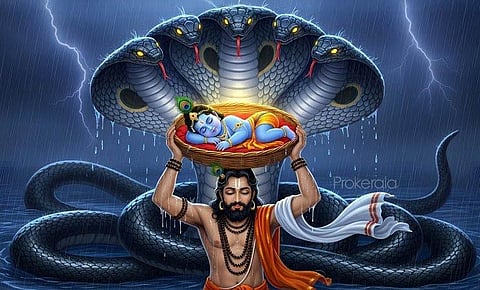
The traditional narrative situates Krishna’s birth in the oppressive atmosphere of Kansa’s tyranny. Mathura was engulfed in fear; righteousness appeared vulnerable; innocent lives were threatened, and power had become intoxicated with arrogance. It was in such a midnight of despair that Krishna was born. The symbolism is profoundly philosophical: when the darkness of human consciousness reaches its zenith, the possibility of spiritual dawn begins to germinate.
Krishna of Gita and
Krishna of Devaki
The name Lord Krishna in the Gita is another name for God Shiva and is not the same as the first child prince of the golden age born to Devaki and Vasudeva and raised by Yashoda, who was also named Prince Krishna. Millions of Hindus over the world celebrate Krishna Janamasthami, and it would be more meaningful to fully understand the roles of God Krishna of the Shrimad Gita and that of Krishna of Krishna Janamasthami.
God is not subjected to birth and rebirth
Devotees of the Gita must believe that God is not subject to birth and rebirth. God is “abhogta”, meaning that He is above the bondage of karma, nature and matter. Therefore, if God is “abhogta”, he surely has no mother or father and never takes birth from a woman. In Gita Ch-9, Vs-11, God tells Arjuna, “Fools, not knowing my supreme nature, think low of Me, the Lord of creation who has put on the human body. In other words, they perceive me, who have taken on a human form through my Yogamaya for the purpose of delivering the world, as just an ordinary mortal. “ God continues to advise in the Gita Ch10-Vs3 quote, “He who knows me in reality as without birth and without beginning, and as the supreme Lord of the universe, he, undeluded among men, is purged of all sins. “ Thus, all the Gita’s names for Krishna are divine traits of God Shiva, who alone can free mankind from Ravana’s chains.
Legend tells us that Rama invoked Shiva at Rameshwaram and Krishna offered his prayers to Him at Gopeshwar. Memorials to these events stand here even today. These legends also indicate that Shiva is worshipped as the Supreme Father of all deities. Shiva is praised as the Creator, Sustainer and Destroyer. But what does he create, sustain and destroy? If He is the sustainer, then what accounts for the scourge of poverty, hunger and sickness in this world? Does He cause the destruction and death of His creation?
The Chariot with Krishna
and Arjuna
The ordinary human person on whom Incorporeal God SHIVA descends incognito as per his promise in (Gita, Ch-4/Verse 8-9) & through whose mouth He reveals the spiritual truth about Himself, the whole Creation and the process of communion with Him (Yoga) comes to be known as Brahma or Adi Dev, Adam or Abu Tani – The First Man. By means of this spiritual wisdom, He establishes a new socio-political and socio-spiritual order called the Golden Age, or Satya Yuga – the Age of Truth/Enlightenment/Perfection. At such a juncture of ‘Dharma Glani’, i.e., moral, religious and spiritual downfall, God Shiva – the Incorporeal Supreme soul, stop to the vicious trends and creates a world of high ideals and morals and noble acts called heaven and paradise.
Prince Krishna-Shyam Sundar – The phrase “From the Ugly to the Beautiful One” refers to the transformation of Krishna from an unattractive figure to a beautiful one.
On the other hand, Prince Krishna, the son of Devaki and Vasudeva, is called Shyam Sundar. Shyam Sundar refers to the history and biography of Krishna’s 84 births in a kalpa. The understanding of the name Shyam Sundar is possibly the key to understanding the difference between Lord Krishna of the Gita and Prince Krishna, the son of Devaki. Shyam Sundar tells the entire history and geography of the world cycle. It represents the level of purity, attitude, and conduct of the world at any given time in the cycle.
In the Golden and Silver ages, Krishna is the most beautiful, has ultimate authority over the world and wears the double crown of purity and authority. There he is called “Sundar”, the beautiful (virtuous) one who enjoys perfect peace, purity and prosperity. In the dark ages of copper and iron, his birth is reflective of the stages of the ages, and in this period, he is called “Shyam” – the ugly (vicious) one. In particular, when he is Arjuna, who is the 84th birth of Krishna, he is definitely Shyam, and this is the episode of Arjuna, listening to God Krishna in the chariot, absorbing the knowledge of the Gita to transform himself from Shyam back to Sundar, the first prince of the Vaikunth called the Golden Age. The icons and murtis are the only remaining evidence of Shyam Sundar’s history. In regal and royal form and with a fair complexion, Krishna is Sundar. In dark blue form, Krishna is Shyam in reference to his copper and Iron Age births.
At this fag end of RATRI – the Dark Age/Kaliyuga – this act of the same Supreme Soul God Shiva – God Krishna of the Shrimad Gita – has been going on since 1936-37, descending into Dada Lekhraj Kripalini, a Sindhi Jeweller in Karachi, baptising him as Prajapita Brahma and imparting that spiritual wisdom to establish that Age of Perfection after the mass annihilation of this present degraded society of the Dark Age. So, let us all, irrespective of different religious faith, celebrate this ‘Krishna Janamasthami’ and empower ourselves through the process of Supreme Communion (Raja Yoga) with Him to inculcate His Supreme Commands of Universal Values to establish a “Value Based Happy Society of Culture of Peace & Non Violence” – our most cherished desire.
The true way of celebrating “Shri Krishna Janamasthami” would be to realize the significance of the present auspicious time by pledging to discard all negative traits such as anger, greed, ego and lust and by leading a life filled with love, compassion and divinity.
(BK Prof. Jayadeba Sahoo, Faculty, Brahma Kumaris, RERF & Professor (Ex-Dean & Head), Faculty of Education, Rajiv Gandhi (Central) University. He can be reached at jayadeba.sahoo @rgu.ac.in or drjayadeb12@ gmail.com.)
