
- Home
- Live Blog
- Breaking News
- Top Headlines
- Cities
- NE News
- Sentinel Media
- Sports
- Education
- Jobs
Hiranya Borah, ISS
(Former DDG, Ministry of Jal Shakti, Government of India)
We may discuss some issues that may or may not have already been discussed in some forums. Let us start with an issue that was discussed earlier.
Many people doubt the very existence of a character named ‘Jaimati’ and claim that it is an ‘imaginary character’ to explain the misgovernance of Lora Roja and political instability during 1672-1681.
However, in my opinion, Jaimati was a real character for the following reasons:
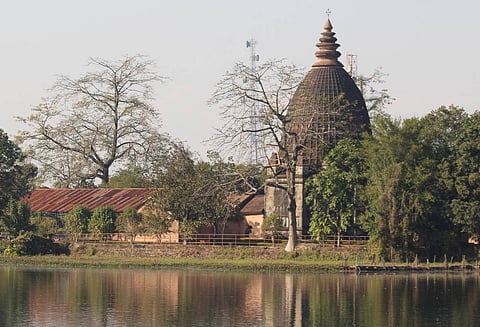
The name of the mother of Swargadeo Rudra Singha must be like ‘Jaimati’ or ‘Jaya’; otherwise, why would he have constructed ‘Jai Daul’ and dug the largest man-made water tank of the entire Northeast, ‘Jay Sagar’?
Swargadeo Rudra Singha ruled the Ahom Kingdom from 1696 to 1714, but there was no mention of a ‘Rajmao’ in his entire period of rule. Therefore, one thing is confirmed: Rudra Singha did not have a living ‘Rajmao’ during his tenure.
Again, there was no parallel in the history of the Ahoms to construct such a magnificent ‘Daul’ or such a large tank in the memory of a ‘deceased mother-queen’ in Assam. Then why was such respect shown only for Jaimati? She must have done something extraordinary for her son, which prompted one of the greatest kings of the Ahom Kingdom to construct so many things in the memory of his mother. That extraordinary thing must be her ‘supreme sacrifice,’ no matter how.
Further, if anyone visits the ‘Maidam’ of Laithepena Salal Gohain, located at Madhuri Gohain Gaon, one can easily understand that he had a lot to say in the Ahom administration during his lifetime and was holding an important post at the time of his death. It is said he was holding the post of ‘Raj Mantri.’ Once Laluksola Barphukan had concentrated all the royal power with this post to dominate the other three Dangarias of Ahom administration, viz., Burhagohain, Borgohain, and Barpatra Gohain. The size of the Maidam was larger in area than even the Maidam of Lachit Barphukan. Therefore, he might not be a mere Dangariya of the Ahom Kingdom. He was said to be a very close relative of two consecutive kings, Gadadhar Singha and Rudra Singha. There can be only one relation that suits both the father and son for faithfulness for any royalty, a father-in-law, and a maternal grandfather. So Laithepena Salal Gohain was most likely to be the father-in-law of Gadadhar Singha and grandfather of Rudra Singha. We all know that for consolidating his position, Gadadhar Singha needed a faithful person in tow. And who could have been better than his own father-in-law in the absence of his own father?
Therefore, after putting forward my arguments, I conclude four things: 1) Laithepena Salal Gohain was the father-in-law of Gadadhar Singha and was an extremely powerful person of the Ahom Kingdom at the time of his death; 2) Jaimati / Jaya was most likely the favorite daughter of Laithepena Salal Gohain and mother of Rudra Singha; 3) Jaimati must be the closest wife, even if not the only wife, of Gadadhar Singha; and 4) Jaimati had to sacrifice her life for the cause of her family and for the kingdom.
Therefore, I am more than convinced of the existence of an extraordinary lady in Assam who had sacrificed everything for her husband and for the people of the Ahom Kingdom during the last quarter of the seventeenth century.
Again, another point many have already raised: if Laithepena Salal Gohain was so powerful a Dangariya, having 24 sons in tow and eleven-plus houses of relatives through matrimonial relations, why did he not revolt against the tyrant king? One should understand the power of Laluksola Barphukan during that period of time. Earlier, he had defeated the combined force of the king, Burhagohain, Borgohain, and Barpatra Gohain near Kaliabor before taking over the newly created post (earlier this post may have been in existence) for himself, Raj Mantri, with the concentration of all royal power.
Another point I want to discuss is the age of the sons of Jaimati Kuwori. Being a professional statistician, I have to discard many popular beliefs, like Lai and Lechai were below 10 years old when their mother was tortured to death. That is demographically cannot be true, as Rudra Singha (Lai) succeeded his father in 1696 at the age of around 26 and died in 1714 at the age of 44 only. According to another popular book, Lai was 17 years old when he became the king. But historically, it is claimed, Gadadhar Singh died at the age of 68 in 1696. That means Lai, also known as Rudra Singha, was born to the couple when Gadadhar Singha was 51.
However, some history books claim Lai was born in 1665. Although this explanation is somewhat reasonable, it raises the question: why was their first son born when Gadapani was 37? These books do not explain why the father-son age difference was 37 years, given that other kings had smaller differences unless specific reasons existed.
Likewise, Jaimati (a spinster) was told about the Saraighat battle (1671) as a part of history lessons given by her grandmother in an extremely popular book, which is also unbelievable.
There may be many more such types of age contradictions in these popular books.
Considering all the age contradictions, I painfully dumped all these popular books so far as age and other chronology are concerned, for which I submit my apology for my audacity to disagree with the renowned historians and popular authors on these accounts.
Likewise, I want to say something on the character Dalimi. I personally cannot believe the very existence of the character of Dalimi, based on the arguments as follows:
As Gadadhar Singha died at the age of 68 in 1696, he might have been 51-52 when he fled to Nagaland, along with his two sons with youthful vitality (as I presume that his two sons also accompanied their father, Gadapani, to avoid amputations like their father). There may be marriages for forging allegiances between two kingdoms or leaders of two groups of people at any age, but there cannot be romance at first sight between two persons when two handsome sons are in tow and the spinster is the same age as the sons.
Further, historically, Gadapani did not stay in that Naga village for a long time; as it is claimed, Gadapani had travelled to a place that was ruled by the Mughals, where he learned about land survey and the system of payment of salary in cash to the soldiers.
Therefore, can we think somewhat differently on our icon, Jaimati Kuwori?
