
- Home
- Live Blog
- Breaking News
- Top Headlines
- Cities
- NE News
- Sentinel Media
- Sports
- Education
- Jobs
Antara Hazarika, Madhurjya Saikia
(madhurjyatu15@gmail.com)
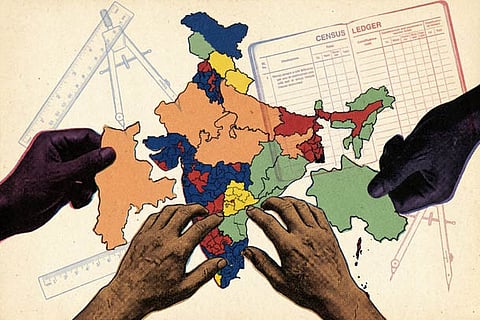
Delimitation literally means the act or process of fixing the number of seats and limits or boundaries of territorial constituencies in a country or a state having a legislative body. The job of delimitation is assigned to a high-power body. Such a body is known as a delimitation commission or a boundary commission. In India, such delimitation commissions have been constituted 4 times - in 1952 under the Delimitation Commission Act, 1952; in 1963 under the Delimitation Commission Act, 1962; in 1973 under the Delimitation Act, 1972; and in 2002 under the Delimitation Act, 2002. The Delimitation Commission in India is a high-power body whose orders have the force of law and cannot be called in question before any court. These orders come into force on a date to be specified by the President of India in this behalf. The copies of its orders are laid before the House of the People and the State Legislative Assembly concerned, but no modifications are permissible therein by them.
Delimitation is mandated by the Constitution under Articles 82 and 170 to periodically realign representation in accordance with changing demographic realities. It plays a crucial role in maintaining the horizontal balance of the federal structure by determining the number of representatives each state has in both national and state legislatures. As provided in these articles, the readjustment and division of each state into territorial constituencies-both parliamentary and assembly-are carried out by an authority and in a manner prescribed by Parliament through law. Hence, the Delimitation Commission is a statutory body constituted under a law enacted by Parliament.
Delimitation is the process of redrawing the boundaries of electoral constituencies so that each constituency has a roughly equal population, thereby upholding the democratic principle of "one person, one vote", where every vote has equal value. It is an essential feature of a participatory democracy, ensuring fairness, transparency, and accuracy in elections while strengthening political representation by organizing how people elect their representatives. Most democratic countries carry out delimitation periodically, usually after a census, to reflect population changes and prevent imbalances where some areas are over-represented and others under-represented. Proper and regular delimitation helps distribute electoral power more equally, improves administrative efficiency, and keeps the democratic system responsive to demographic shifts.
However, it also raises important concerns, especially in India, where a major debate revolves around the regional political imbalance: since seats are allocated based on population, northern states with higher population growth may gain more representation, while southern states that have successfully controlled population growth fear losing their relative political influence, creating a challenge in balancing fairness, incentives for good governance, and national unity. Since the Total Fertility Rate (TFR) in some regions of India is lower than the national average, it can affect how seats are distributed among different regions during delimitation. The main aim of delimitation is to maintain a uniform ratio between population and representation across the country using the latest census data. However, population control should also be seen as a positive achievement and rewarded politically, as even the 16th Finance Commission gives importance to states with lower TFR. Therefore, to ensure both fair representation and balanced regional participation, there should be a mathematical model to adjust seat distribution across India by considering factors like TFR, recent NSSO demographic data, migration patterns, and records such as NPR and NRC. This would help maintain the core principles of democracy while also recognizing the efforts of regions that have successfully managed population growth.
The Constitution of India requires that seats in the Lok Sabha and State Assemblies be allocated to states based on their population and that constituencies within each state should have roughly equal populations, with boundaries redrawn after every census. However, through the 42nd Constitutional Amendment, the number of seats for each state was frozen based on the 1971 census to encourage population control, a freeze later extended by the 84th Constitutional Amendment until after 2026. The 106th Constitutional Amendment introduced one-third reservation for women in the Lok Sabha and State Assemblies, to be implemented after the next census, likely delaying its effect beyond the 2029 elections. In 2026, new Bills-including the Constitution (131st Amendment) Bill and the Delimitation Bill-propose major changes such as increasing Lok Sabha seats from 550 to 850, allowing delimitation based on the 2011 census, and enabling earlier implementation of women's reservation. These Bills also give Parliament the power to decide when delimitation will occur and which census to use, instead of making it automatic after every census, raising concerns about reduced constitutional certainty and greater control by the central government. The proposed changes may significantly alter the share of seats among states, with northern states like Uttar Pradesh and Bihar gaining seats due to higher population growth, while southern states like Tamil Nadu and Kerala may lose seats despite better population control. Increasing the size of the Lok Sabha without a similar increase in the Rajya Sabha would shift the balance of power toward the Lok Sabha, affecting decisions like joint sittings and elections for the President and Vice-President. It would also allow a larger Council of Ministers under Article 75, raising concerns about governance efficiency. Additionally, a larger Lok Sabha could reduce individual MPs' opportunities to participate in debates and raise issues due to limited time and procedural constraints. While the proposed reforms aim to improve representation and efficiency, they also raise important questions about federal balance, fairness among states, and the functioning of parliamentary democracy.
