
- Home
- Live Blog
- Breaking News
- Top Headlines
- Cities
- NE News
- Sentinel Media
- Sports
- Education
- Jobs
Dr Birendra Kumar Gohain
(dr.gohain@gmail.com)
The great Tai king of Mungkhu Mungjao and a Prince of his maternal uncle's kingdom Mung Maolung, Chaolung Siukapha (as the crowning epithet Chaolung itself means great) left his country to avoid conflicts with his maternal cousin Sukhanpha, the king of the mighty Tai kingdom Mung Maolung. He knew too well that it was not easy for him to decide to pursue such an arduous journey to an unknown and mysterious landmarked by deep jungles and high hills and riverine dales. Although he knew from the 'Wiseman of the east' that the land was Kamlupu (Kamrup), which was Mung Pa Kam to the Tais, it was some hundred liis away. Being a great tiger (Siu) himself had been the crown Prince (het chi) of the great Tai Mao kingdom of Mung Maolung of his maternal uncle Pameopung, he listened to the advice of his maternal grandmother after the death of his maternal uncle that two tigers can never live in the same den. He merited his departure from the Mao lands of the Tais by going to the capital city of Mungmao in 1214-15 to bid farewell to his maternal cousin Siukhanpha, the boy King of Mung Malang. Earlier, a section of the rapacious nobles annexed the country Mungjin by killing King Chao Tailung (his eldest maternal uncle) with the knowledge of the boy king Siukhanpha, which fact saddened him the most. Under the circumstances, Chaolung Siukapha who was aghast at this dastardly act left even his own country Mungkhumungja for good, taking the oath of brotherhood and amity with Siu-Khan-Pha on the request of the maternal grandfather of the boy king Siukhanpha "till stone floats in water and crow become white."
Seven nobles, mostly governors and ministers left their country Mung Khu Mung Ja along with two scholars and Priests namely Thaomung Sengkaluk, son of Kasengdam of Mohung (Mosai) clan and Thaomung Mosam for good. They came with their families, arms and weapons, as well as the Tai brand of ornaments, kitchenware and utensils, the Tai brands of dresses and clothes and most importantly a special type of silk called Muga. In short, the material culture of Tai Mao was appropriately brought in and the games and sports also came. The leading personalities with at least 9,000 soldiers and 300 cavalrymen came with the technical know-how of the upkeep of two elephants and three hundred horses. Most importantly, they came with Tai bio-pool to Mung Pa Kam (Kamrup) which was genetically distinctive.
Coming from the city of Mungmao (present Ruili), with the people of both Mungmao and Mungkhu Mung Ja, he crossed the Tai cities Mungna and Mungti in present Yunnan. Then he crossed the river- crossing-point of the Namkiew (the Irrawaddy) at Ving mein. Here he observed the Me Dam Me Phii ritual by worshipping his Ancestors on the bank of the Irrawaddy. He conquered Mong ke, Mong Kang and Phake Chering on the way. Gradually he crossed the Doikham range. In 1226-27, he came to Mung Khamjang and set up his first kingdom.
Leaving a noble (a Bargohain) to govern the Mung Khamjang on payment of tributes, he then crossed the Doikaorong (the present Patkai) range with more nobles and families. From the low hills, he saw the fields laden with ripe rice. The day was the sixteenth of Agon,1228 (corresponding to the thirty-first January) that Siukapha saw the ripe rice lands when he exclaimed, "Mung Duun Suun Khaam"-the land of the golden harvests.
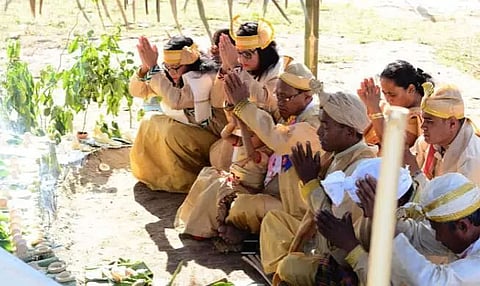
The collective ancestor worship amongst the Ahoms is called Me-Dam-Me-Phii. Literally, 'Me' means worship, 'Dam' means the dead and 'Phii' means god. That is, the dead ones are worshipped as gods by the Ahoms. This belief in the divinity of the dead is an ancient one and all the Tai groups have had the custom of worshipping their ancestors as gods in their way. The Ancestor worship in the Tai Ahom concept is related to the idea of the soul of a deceased ultimately going to heaven; after one's death, his/her soul would leave his body and go back first to dwell in the sacred dam post ( Pho' Kam) in the kitchen up to certain generations of ancestors called Na Dam (new spirits), Ghai Dam (principal spirits), Chiren Dam (ancient spirits) as well as Jakorua Dam (dam likha likhi) if there are any unmarried members or children. They have propitiated inside the principal house i.e. the kitchen. The Kha Dai Chiren Dam (the more ancient spirits) stay at the stairs conceptually earlier and outside the gate nowadays and are propitiated outside the house. Kao Chiren Dam stays in the middle space (mungklang) which is conceptualized as the jungle for final departure to heaven where their ancestors live and are also.
The practise of collective worship of the ancestors is an extremely elaborate version of a dam phii, which once was a fully-fledged state ritual commemorating the ancestors of the ruling families. This large-scale ritual has survived to our days. At the time of the Ahom kings, the Me dam Me phii celebration was attended by the kings and his senior ministers as well as a large number of followers. It took place at the great cemetery for kings and nobles at Charaideo and the preparation would last several days.
After the rule of the mighty Ahom kings was over, the celebration of the royal ceremonies of Me Dam Me Phii (ancestors' worship), Uumpha worship (worship of the gods and goddess of heaven and the jungles), Rik-khwan mung-khwan (longevity ritual for the country and the countrymen), which were compulsorily observed by the Ahom royalty came to an end. It was only at the initiative of direct descendants of the royal families dwelling in the present Sivasagar district that an annual ceremony of Ancestors' worship (Me Dam Me Phii) started in Charaideo. But in 1981 and thereafter, the ceremony started to be made purely in Tai Ahom way. Thus, the tradition of paying oblations to forty heavenly kings including Khunlung-Khunlai, who were the first Tai kings on earth has been continuing. Me dam me phii continues and that too, with the greatest enthusiasm by all Ahoms nowadays. The proper time for it is a day in the last week of January or in the first week of February or based on the astronomical calculation by the Tai Ahom priest called Mo'lung.
However, this tradition of collective ancestor worship was initiated by Chaolung Siukapha, the first Tai Ahom king of Assam. It was characterized by royal abundance in which Chaolung Siukapha and his nobles participated therein with all their companions and subjects for more than a day.
The ritual of ancestor worship (Me Dam Me Phi) was started in Assam (Mung Dun Suun Kham) by Chaolung Siukapha, the great. This important ritual was observed royally by the Tai Ahom kings several times. Chaolung Siukapha, the great Tai hero observed and held this ritual for the first time after he left his birthplace Keing-Chen-Maolung (the capital city of the (Mung Maolung) after crossing the Nam Kiu (the Irrawaddy). After he crossed the Patkai range (then called Doikaorong,) he observed it again in Namrup (then Namruk) with his prayers to his forefathers to enable and make it easy for him to conquer the new country in the Brahmaputra valley and for its good governance. Then he observed it at Lanteopha before reaching Charaideo (his Chetam-doi chelung Kham). Then he had a grand celebration of Me Dam Me Phi (Me Mung Me Ban) in the Tai lakni year Mungkao seeking blessings of his ancestors for good and effective governance of his country Mung Dun Suun Kham (present Assam) with its permanent capital at Charaideo.
About the observance of this great ritual in Namruk, one Tai chronicle mentions as follows:
"Chaolung Siukapha, while coming down from Mung mao, had crossed many mountains and hills. He crossed the Doi Kao Rong range and arrived at Namruk. There he collected and stored many things like pigs, hens, ducks etc., in one place. The king worshipped the dams of his mother, father, grandmother, grandfather, the dam of the house, the dams of the leading persons. The worship was held in a big way. The king saluted by kneeling, bowing down. After worshipping the main dam of the house, he prayed to his forefathers, "When I passed Mung-Kang ( i.e. Mogaung in Myanmar), I faced no difficulties. Therefore, there should not be any danger to me. I desire to occupy countries and I should be victorious in all cases. With this desire, I offer my prayers. O, my Chapha phet khan Kham Chao nu ru oi"(the great God and goddesses).
He also observed the worship of the ancestors and offered oblations to the great grandfathers in the sky in Charaideo. He advised his ministers and the nobles not to forsake him ever. As he was a descendant of Khunlung, the grandson of Lengdon, the Lord of Heaven, his great grandfathers were Lengdon and Thenkham, Khunlung and Khunlai of heaven. His nobles were the descendants of the gods in heaven. His prime Minister Thaomung Kotok was the descendant of the Sun god and his Deputy Premier Thaomung Kangan was the descendant of the Moon-god. His two royal priests were Mo' Sam whose name was and Mo' Sai whose name was Sengkaluk. The forefathers of these two priests were Laokhri and Pujakji respectively, who were the Gurus in heaven. Thus he along with his ministers and the nobles and his soldiers worshipped their forefathers. After his death, Chaolung Siu Ka Pha was buried in Charaideo as recorded in history and Me-Dam-Me-Phi was observed by his son Siu-Teo-Pha who became the king after him in 1268 C.E. As all the kings and queens of the Tai Ahoms got buried in this sacred place, Charaideo became the Jerusalem of the East for all the Tai-speaking people and the designs and techniques of the Moidams are drawing the attention of the scholars both national and international, as the architecture of the Moidams is unique in its way and is comparable to the Egyptian mummies. There are historical references of yearly observance 0f 'Me-Dam-Me-Phi by all the Ahom kings. Only during the reign of Jaydwaj Singha, the ritual was not observed. When Jaydwaj Singh was defeated by the Mughal army led by Mirjumla, the King said to the Prime Minister, Atan Buragohain, in deep anguish and grief, "Gohain, gods have forsaken me". Gohain then said, "Swargadeo, do not grieve. Victory and defeat are two sides of the same coin. When gods will favour us, then Swargadeo will defeat the outsiders with your might".
After the death of Jaydwaj Singha, his younger brother Swargadeo Chakradwaj Singha thought that the mighty Ahom King was defeated by the Mughals as gods were not favourable to his elder brother because he neglected their worship. This king, realizing the importance of this ritual, celebrated Me-Dam-Me-Phi at Charaideo with pomp and glory under the direct supervision of Langcheng Borgohain and with the active assistance and participation of Deodhai, Mohong and Bailing. Chakradwaj Singha won the war of Saraighat and re-established the glory of the Ahoms. The other Ahom kings also celebrated Me-Dam-Me-Phi with pomp and grandeur as an annual festival. Dihingia Raja, Pratap Singha, Gadadhar Singha and Pramattha Singha also celebrated this festival. The tradition and belief in Me-Dam-Me-Phi got resounded in the words of Chakradway Singha; "My brother Siu-Tam-la (Jaydwaj Singha) did not get the blessings of Pha-Nuru and other gods; as he did not observe the ritual of his forefathers. That is why our country got ravaged by the attack of the Mughals and our soldiers also got killed and disgraced". This festival continued to be celebrated up to the reign of the last king Chandrakanta with pomp and glory.
