
- Home
- Live Blog
- Breaking News
- Top Headlines
- Cities
- NE News
- Sentinel Media
- Sports
- Education
- Jobs
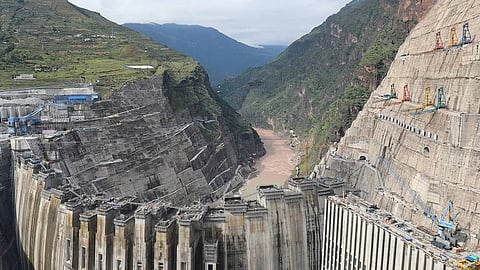
Even as the Nepal government is struggling to carry out the rescue and rehabilitation of the hundreds of people killed and massive infrastructure lost in the recent flash flood, fresh questions are being raised over the safety of the world's largest dam, China is building on the Yarlung Tsangpo, or Brahmaputra, not very far from the point where the mighty river enters India through Arunachal Pradesh. Planned to generate around 60 gigawatts (GW) of power, the upcoming dam will finally have the capacity roughly three times that of China's Three Gorges Dam, which is currently considered the world's largest dam in terms of its power-generating capacity. Though China has been extremely careful about letting the world community know the details of this dam on the Brahmaputra, the fact remains that it is located in one of the most geographically treacherous and seismically unstable regions of the world. A recent report published by the University of Melbourne, Australia, through Asialink, quoting scientists in China, has raised certain very fundamental questions. Quoting a recent paper published in the state-linked, Mandarin-language journal Sedimentary Geology and Tethyan Geology which identifies "serious geological hazards" at the site where the super-dam is being constructed, Asialink has said that the site has a "loose structure and weak cohesion" and that any major fault movement or an earthquake there or in its vicinity could easily trigger large-scale instability, threatening both the reservoir and surrounding infrastructure. Given this reality, the (Chinese) authors have recommended reinforcing the reservoir slopes, installing retaining structures, and redesigning key elements to reduce the risk of catastrophe, the report said. The Asialink report has further suggested that when scientists working under a communist regime issue such warnings, the international community must pay attention to them. It is important to note that the Yarlung Tsangpo or Brahmaputra plunges steeply through the world's deepest and longest canyon at the Great Bend just before entering India. The Great Bend itself is in the highly seismic Himalayan belt where the Indian and Eurasian tectonic plates meet and has a record of producing some of the most devastating earthquakes. The Asialink report has also pointed out that the danger is not simply that an earthquake might damage a dam. "A gigantic reservoir could itself trigger a quake by intensifying geological stresses," it said, referring to reservoir-triggered seismicity, or RTS, which has been documented in China for decades. In this connection, the report has recalled an earthquake that occurred in 2008 on the Tibetan Plateau's eastern rim, which killed nearly 90,000 people, mainly in Sichuan province. Though the exact relationship between the earthquake and the Zipingpu Dam is yet to be scientifically confirmed, the Asialink report has pointed out that certain research has pointed out that the immense weight of water stored in the Dam reservoir may have increased pressure along an underlying fault, thus causing a massive earthquake in 2008. Meanwhile, the Australian Strategic Policy Institute, in its report titled "The geopolitics of water: How the Brahmaputra River could shape India-China security competition", published in August 2024, had pointed out that the upcoming dam on the Brahmaputra in the Great Bend would create four likely strategic effects - (a) it would very likely consolidate Beijing's political control over its distant borderlands; (b) it would create the potential for massive flooding as a tool of violence; (c) it may affect human settlement and economic patterns on the Indian side of the border, downstream; and (d) it would give Beijing water and data that it could withhold from India as bargaining leverage in unrelated negotiations. In order to mitigate those challenges and risks, the Institute report has provided three policy recommendations for the Government of India and its partners in Australia and the US. First, it recommends the establishment of an open-source, publicly available data repository, based on satellite sensing, to disseminate information about the physical impacts of the Great Bend Dam. Second, it recommends that like-minded governments use international legal arguments to pressure Beijing to abide by global norms and conventions. Third, it recommends that the Quad - the informal group comprising Australia, India, Japan and the US - use its humanitarian assistance and disaster relief (HADR) guidelines to begin to share information and build capacity for dam-related contingencies. Established in 2001, the Australian Strategic Policy Institute is an independent, non-partisan think tank that produces expert and timely advice for Australian and global leaders and is partially funded by the Department of Defence. Unfortunately, the super-dam at the Great Bend of the Brahmaputra did not figure in the discussions India's NSA Ajit Doval had during his visit to Beijing last week to take part in the 25th round of Special Representatives (SR) talks with China's Foreign Minister Wang Yi.
