
- Home
- Live Blog
- Breaking News
- Top Headlines
- Cities
- NE News
- Sentinel Media
- Sports
- Education
- Jobs
Rajbir Saha
(rajbirsaha1995@gmail.com)
Ice/snow, forests, and oceans are the three major resources for the longer term of the world tourism business. Glacier tourism is predicated on the trendy glacier and glacier relics as major attractions for sightseeing, fitness, scientific research, and well-liked science and science education. It's a "return to nature," and cultivator of the temperament of the Alpine outdoors. In recent years, as major world economies and client confidence have improved, there has been steady growth in world tourism demand. Within the future, cryospheric tourism is anticipated to develop rapidly. At present, glacier tourism has become a crucial tourism project in mountainous countries. Climate change can have prices and advantages for ice mass-covered areas.
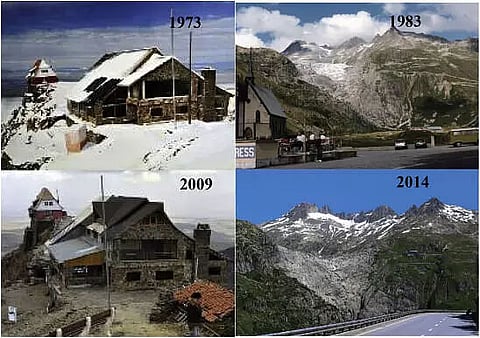
However, fast warming will have a doubtless impact on natural and social systems IPCC, 2014. Owing to its distinctive and spectacular landscapes, sights and sensitive environmental conditions and environmental implications, some mountain glaciers are selected as world heritage sites and world region reserves, to be protected and exploited. Thanks to the intense sensitivity of mountain glaciers to climate modification, as region temperatures have up slightly, glaciers soften and shrink, and a few glacier landscapes even face extinction. Since 1950, most of the world's mountain glaciers are decaying and receding because of world warming, and, considering imbalances in the current climate, conditions can cause glaciers to shrink even within the absence of future temperature rise (IPCC, 2013). The UN Environment Programme, United Nations World Business Organization (UNWTO), and World Meteorological Organization have paid special attention to the integrated impact of world temperature change on tourism. Some studies have additionally confirmed that global climate change has had a big impact on mountain tourism. Warming indirectly affects the sweetness and quality of glacier landscapes and affects the property development of mountain glacier tourism. In the past, studies have centred on the results of climate change on mountain natural environments (alpine meadows, forests, forest lines, biodiversity, associate degreed environment), and infrequently on the impacts of temperature change on ice mass business and adaptation studies. Therefore, measures and techniques in response to climate warming are imperative to the glacier tourism sector. This study includes an analysis and assessment of climate change impacts on glacier tourism and relevant adaptation. At constant times, this study discusses the potential climate change risks of two glacier destinations in China.
Finally, we tend to recommend a large adaptation strategy for the property development of glacier tourism. Temperature change represents one of the foremost important challenges to humanity within the twenty-first century and is anticipated to possess major consequences for climate-sensitive businesses extremely passionate about glaciers. Generally, the influence of regional climate on glacier tourism is influenced by meteorological and weather conditions. Most of the environmental conditions are focused on the daily or multi-day scale, whereas environmental conditions are centred on a multi-annual or decadal scale. In general, meteorological conditions (such as fog, serious rain, robust sunlight, and wind winds, etc.) in the main affect the visibility, accessibility, and knowledge of glacier tourism, moving entry and activity safety by influencing glacial runoff and earth stability. Weather conditions mainly affect the fast melting of glaciers, so the standard or attractiveness of the glacial landscape has been damaged; a number of the glacier landscape can disappear, moving correlation dependence inside snow, glacier and culture. At constant times, temperature change has also contributed to soil changes within the glacier regions, similarly to ice/snow/rock and frozen lake expansion, therefore, increasing the problem of tourists coming into and experiencing glaciers (ice surface, ice caves, icicles, etc.). A number of the potential risks of glacial disasters will represent a precise threat to the security of tourists. As per the results of the global Tourism Organization (UNWTO), in 2016, the quantity of outward-bound tourists worldwide exceeded 1.235 billion, a rise of five hundred million over the previous 10 years. As the main business attraction, glaciers occupy a crucial position within the world tourism system, having shown nice economic advantages for several mountainous countries, even in the Polar Regions. However, the fast retreat of glaciers following climate warming has or is close to limiting the property development of tourism in mountainous countries.
Within the twenty-first century, the temperature change is doubtless the toughest challenge for glacier tourism. Glacial resources are the foremost important for tourism, therefore, additionally the livelihoods of native populations in mountainous countries or regions. These areas are experiencing the severe challenge of shrinking glaciers. Beneath current climate conditions, glacial melting and its integrated impact on future property is unavoidable and is that the primary thought in coming up with glacier business. Business stakeholders shouldn't solely bear in mind the opportunities and issues of glacier tourism, but also the risks related to temperature change within the future. The fast ablation of the glacial landscapes could be a direct result of global climate change, creating management of world temperature rises imperative. All countries around the world ought to actively support and implement world environmental and energy policies, encouraging the utilization of cleaner energy and new technologies, notably following the urban centre protocol, the Bali Road Map, the national capital Summit on Climate Change, and also the Paris Agreement. Energy conservation and emission reduction quotas should be enforced as shortly as possible. Of course, native adaptation will hardly solve the property development problems with ice mass tourism, and measures should embrace adaptation of business structure, energy structure optimization, low-carbon merchandise development, and promotion of "green" consumption.